
Ardabil Rugs: A Journey Through History, Craftsmanship and Design
In northwestern Iran, where mountain landscapes meet broad grasslands and long-established rural communities, carpet weaving has developed as part of everyday life.
Introduction: Understanding the Character of Ardabil Rugs
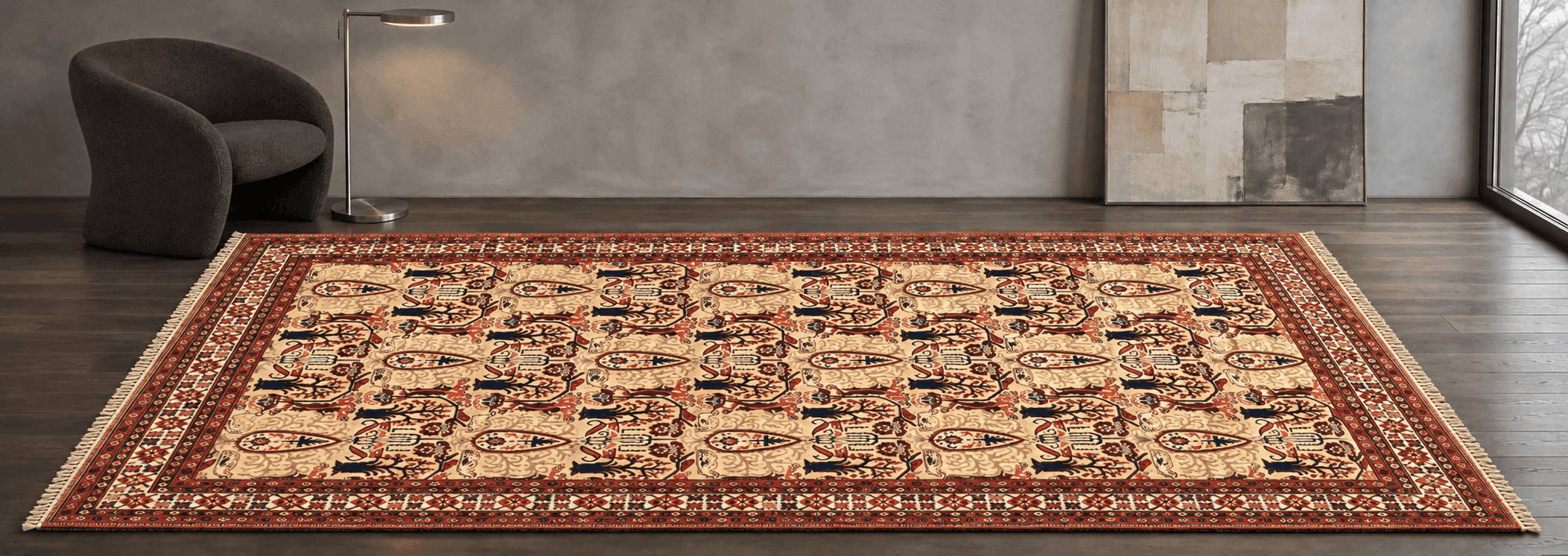
In northwestern Iran, where mountain landscapes meet broad grasslands and long-established rural communities, carpet weaving has developed as part of everyday life. The province of Ardabil is one of the regions where this tradition can still be understood through the relationship between people, materials and place.
Ardabil rugs belong to the wider weaving culture of Iranian Azerbaijan and the neighbouring Caucasus. Their character is not defined by one single design or construction method. Instead, it comes from several related traditions: workshop-made city carpets, village rugs with geometric compositions, and the more flexible, often flat-woven textiles associated with nomadic communities.
For anyone exploring Persian handmade rugs, Ardabil offers an especially interesting subject. Its weaving heritage includes repeating floral designs, bold geometric patterns, richly coloured wool, and a variety of structures developed for different purposes and ways of life.
The name Ardabil is also familiar to many carpet enthusiasts because of one extraordinary Safavid masterpiece: the celebrated Ardabil Carpet, dated 1539–1540 and now divided between two major museum collections. Its history is closely connected with the region, although the precise place where it was woven remains a matter of scholarly discussion.
To understand Ardabil rugs properly, it is useful to look beyond the famous museum piece and explore the wider weaving traditions of the province.
1. Ardabil: Geography, Climate and the Foundations of Weaving
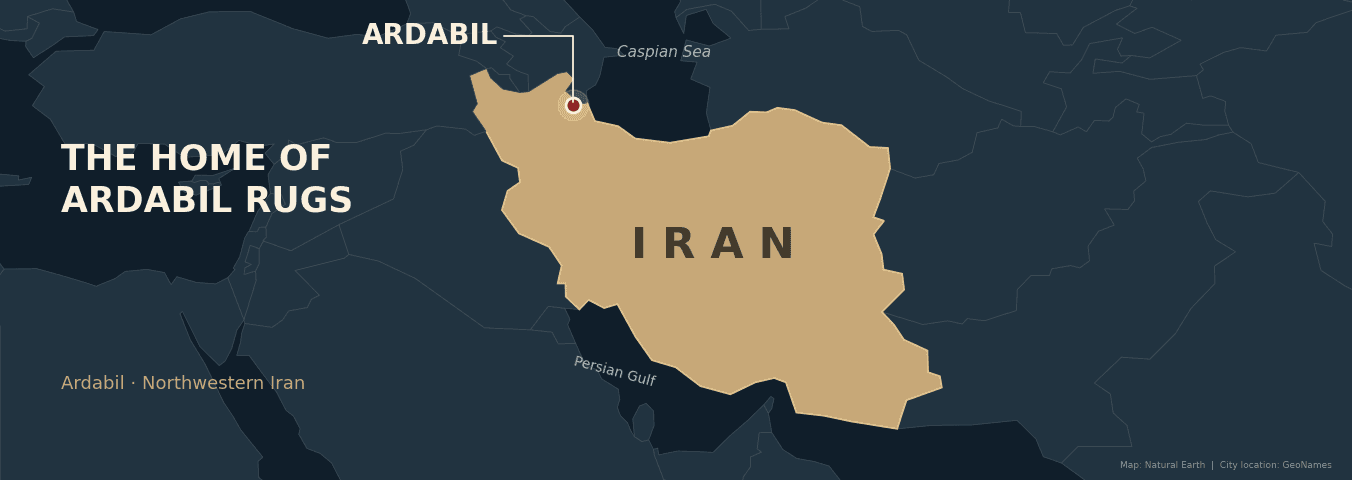
Ardabil Province lies in northwestern Iran, close to the Republic of Azerbaijan and the Caspian region. Its landscape includes the highlands around Mount Sabalan, agricultural valleys, grasslands and areas traditionally used for livestock grazing.
These geographical conditions have influenced the region's textile culture for generations.
Sheep husbandry has long been important in the local economy. Wool therefore became one of the principal materials available to village and nomadic households. Depending on the community and the type of textile being produced, weavers also used cotton yarn and other materials obtained through regional trade.
The importance of geography can be seen in several aspects of Ardabil weaving:
- Wool production: Sheep farming provided an accessible source of wool for pile rugs and flat-woven textiles.
- Seasonal work: In agricultural villages, weaving could become particularly important during periods when farming activities were less intensive.
- Mobility: Nomadic and semi-nomadic communities needed textiles and equipment suited to seasonal movement.
- Regional exchange: Ardabil's position within the wider Azerbaijan region encouraged the circulation of designs, materials and weaving knowledge.
It is important, however, not to assume that every rug made in the province shares the same materials or construction. Urban, rural and tribal production developed according to different practical needs and artistic traditions.
2. Three Main Weaving Traditions in Ardabil
A useful way to understand Ardabil's textile heritage is to distinguish between three broad production environments: urban workshops, rural households and nomadic communities.
These are not rigid categories. Techniques and designs have moved between them over time, and individual pieces may combine characteristics from more than one tradition.
Urban Weaving: Workshop Production in Ardabil
Urban production, particularly in the city of Ardabil, is associated with more organised workshop practices and the use of established designs.
Unlike purely spontaneous or memory-based compositions, many workshop carpets are made from prepared patterns. Repeating motifs and balanced layouts are especially important. The Herati or Mahi design is among the patterns associated with this tradition.
A typical urban Ardabil carpet may feature:
- A carefully planned, repeating floral pattern
- A Herati or fish motif, sometimes arranged across the entire field
- A central medallion or corner-and-medallion composition
- Cotton foundations in many examples
- A relatively regular pile and knot structure
Vertical looms are commonly associated with this type of production. Some carpets are woven using a two-weft construction, while other examples may have different structural arrangements.
In more recent production, techniques such as Souf weaving and silk highlights in the foundation or pile have also appeared. These developments show how regional weaving traditions have adapted to changing tastes and market requirements.
Rural Weaving: Carpets Made Within Village Life
In the villages surrounding Ardabil, carpet weaving has traditionally been closely connected with household life and the agricultural calendar.
The quieter months, particularly from autumn into winter, could provide more time for spinning, preparing looms and weaving. Women and girls have played a particularly important role in maintaining this domestic craft tradition.
Rural Ardabil carpets are often recognised by their more geometric visual language. Their designs may include:
- Repeated diamond-shaped medallions
- Two- or three-medallion arrangements along the field
- Angular floral elements
- Eight-pointed flowers and star-like motifs
- Framed compositions with strong borders
Some older village examples have a more open or less densely packed construction than finely woven workshop carpets. However, density alone should never be treated as a measure of quality. The intended use, materials, knotting, structure and overall condition all matter.
Over time, commercial demand has encouraged some village production to adopt more regular patterns and denser structures. As a result, the distinction between urban and rural production is not always clear in contemporary carpets.
Nomadic Weaving: The Shahsavan Tradition
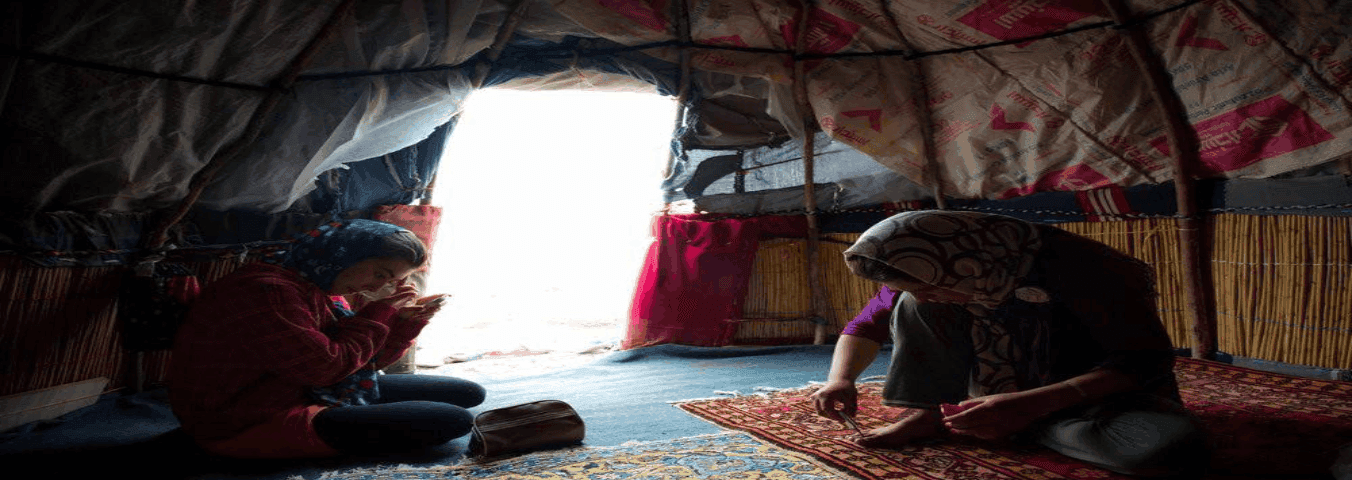
The Shahsavan communities are an important part of the cultural landscape of the Ardabil and Mughan region.
Their traditional way of life, historically connected with seasonal movement and livestock keeping, encouraged the production of textiles that were practical, portable and suited to everyday use.
Their weaving heritage includes several different forms:
- Pile rugs
- Kilims
- Jajims
- Flat-woven and supplementary-weft textiles
- Verneh, a particularly distinctive textile associated with the Mughan region
Nomadic textiles often have a more direct visual relationship with the weaver's surroundings and daily experience. Geometric shapes, stylised animals, plants and repeated symbolic-looking forms may appear in their compositions.
Many traditional examples use wool for their structural and decorative elements. Portable horizontal looms are associated with nomadic weaving, although equipment and techniques vary between communities and textile types.
The most important point is that Shahsavan weaving should not be reduced to a single carpet style. It is a broader textile tradition that includes both knotted and flat-woven forms.
3. Verneh of Mughan: A Distinctive Flat-Woven Tradition
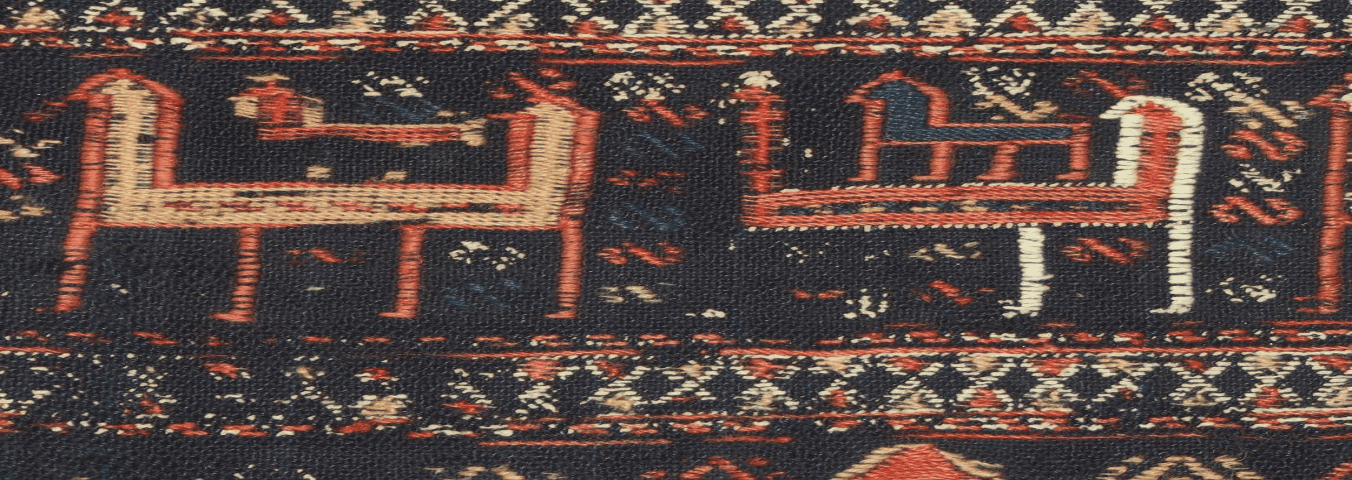
Among the most recognisable textiles associated with the wider Ardabil region is Verneh, particularly linked with the Mughan plain and Shahsavan weaving culture.
Verneh is not simply another name for a pile carpet. It belongs to the family of flat-woven textiles and is traditionally associated with supplementary-weft or sumak-style techniques.
In these textiles, the decorative yarns create patterns across the surface without producing the cut pile found in a conventional hand-knotted rug.
This gives Verneh a distinctive appearance:
- A flat or relatively low-profile surface
- Strong geometric compositions
- Repeated motifs and stylised forms
- A close relationship with wool and traditional household production
- Practical uses in nomadic and domestic settings
Verneh designs may include geometric interpretations of animals, plants and other forms. Their visual language is often more abstract than a realistic drawing: a bird, animal or flower may be reduced to a sequence of lines, angles and repeated shapes.
For European buyers familiar mainly with pile carpets, Verneh offers an opportunity to discover another side of Persian textile heritage. It is best appreciated as a distinct weaving tradition in its own right, rather than judged by the standards used for hand-knotted carpets.
4. The Historic Ardabil Carpet: A Safavid Masterpiece
No discussion of Ardabil and Persian carpet history would be complete without the celebrated Ardabil Carpet.
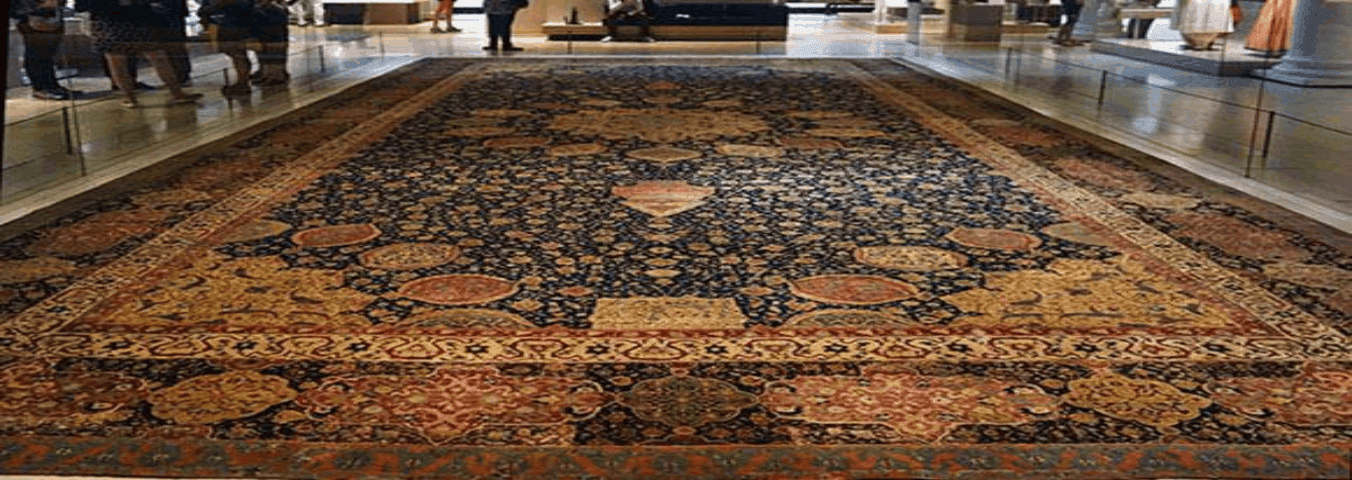
Dated to 946 AH, corresponding to 1539–1540 CE, this remarkable Safavid-period carpet is one of the most important surviving examples of classical Persian carpet design.
The famous carpet is now represented by two related pieces:
- The larger and more complete example is held by the Victoria and Albert Museum in London.
- Its companion is held by the Los Angeles County Museum of Art (LACMA).
The pair is traditionally associated with the shrine complex of Shaykh Safi al-Din Ardabili, the spiritual ancestor of the Safavid dynasty. They are believed to have been commissioned for the shrine during the reign of Shah Tahmasp.
The inscription and the name of Maqsud Kashani
One of the most important features of the Ardabil Carpet is its inscription.
It includes a poetic couplet attributed to the fourteenth-century Persian poet Hafez, followed by the name of Maqsud Kashani and the date of completion.
The inscription identifies Maqsud as a servant of the shrine or court. His precise role is not fully established, but museum scholarship generally considers him to have been an official responsible for the production or supervision of the project, rather than necessarily the person who physically tied the knots.
The date, 1539–1540, makes the carpet an exceptionally important reference point for the study of Safavid textile art.
Design and construction
The carpet is famous for its large central medallion, radiating pendants, hanging-lamp motifs and intricate floral arabesques.
Its deep blue field provides a dramatic background for the carefully arranged decorative elements. The overall composition demonstrates the sophisticated relationship between carpet design, manuscript illumination and other forms of Safavid decorative art.
The principal materials are:
- Foundation: Silk warp and weft
- Pile: Wool
- Technique: Hand-knotted pile
- Date: 1539–1540 CE
The exceptionally high knot density allowed the weavers to achieve a remarkable level of detail.
Was the Ardabil Carpet woven in Ardabil?
This is a question worth treating carefully.
The carpet's name and historical association connect it with Ardabil and the shrine of Shaykh Safi al-Din. However, the precise workshop or city of manufacture is not conclusively established.
The scholarly literature has discussed several possible locations, including Tabriz and other important Safavid weaving centres. The name Maqsud Kashani should also not automatically be taken as proof that the carpet was woven in Kashan.
For this reason, it is more accurate to describe the Ardabil Carpet as a masterpiece associated with the shrine at Ardabil, rather than state with certainty that it was physically woven in the city.
This distinction does not diminish its importance. On the contrary, it helps us understand the sophisticated network of artistic patronage and specialised production that existed in Safavid Iran.
5. Patterns and Motifs: The Visual Language of Ardabil Rugs
Ardabil rugs bring together several design traditions from Iranian Azerbaijan and the neighbouring Caucasus.
Some patterns are highly organised and repetitive, while others are more geometric or closer to the visual language of village and tribal weaving.
The main design families include the following.
Herati or Mahi: The Fish Pattern
The Herati pattern, often called Mahi in Persian, is one of the best-known designs associated with Ardabil workshop carpets.
It is built around a repeating arrangement of floral elements, leaves and curved forms. The pattern is commonly interpreted as a stylised fish motif, although its decorative structure is more complex than a literal representation of fish.
Depending on the composition, the design may cover the entire field or appear within a more formal medallion arrangement.
For interiors, Herati carpets can offer a particularly balanced appearance: detailed enough to reward close inspection, yet repetitive enough to create a harmonious overall effect.
Geometric Medallions
Village carpets from the Ardabil region may feature repeated diamond-shaped medallions, sometimes arranged in pairs or groups of three.
These compositions often use strong outlines and contrasting colours. Their visual character is direct and structured, with a rhythm created by the repetition of shapes along the length of the carpet.
Quba and Caucasian Influences
The wider Azerbaijan and Caucasus region has a long history of interaction in textile design.
Patterns associated with Quba, Qarabagh and other Caucasian weaving areas can be found within the broader design vocabulary of the region.
These may include geometric medallions, angular floral forms and bold border arrangements.
However, a resemblance to a Caucasian pattern does not by itself establish the exact origin of a carpet. Design traditions travelled across communities and commercial networks, and similar motifs can appear in carpets from different places.
Lachak and Toranj: Corner and Medallion Designs
The Lachak-Toranj composition is one of the best-known layouts in Persian carpet design.
A central medallion, or Toranj, is balanced by quarter-medallions in the corners, known as Lachak. In Ardabil-associated workshop carpets, these designs may be combined with flowing floral scrolls and repeating decorative elements.
Other Local and Decorative Motifs
Other motifs reported in Ardabil carpets include:
- Eight-pointed flowers and star forms
- Stylised ram's-head motifs
- Single-flower designs
- Scissor-like decorative forms
- Framed borders and panel-like arrangements
- Designs described as Zir-e Khaki
Some local design traditions are also associated with individual designers and workshops. The name Vossough, and later the Vossoughi name, appears in accounts of modern Ardabil carpet design. Their work should be understood within the development of workshop production and commercial design, rather than as a complete explanation of the region's much older and more varied weaving heritage.
6. Wool, Foundations and Knotting Techniques
A handmade rug is more than the pattern visible on its surface. Its structure determines how it feels, how it behaves underfoot and how it may age.
Ardabil carpets can vary considerably in their construction, but several characteristics are frequently mentioned in descriptions of the region.
Wool and pile
Wool is one of the most important materials in Ardabil's weaving tradition.
The wool used in regional carpets is often described as relatively substantial, resilient and capable of producing a full pile. Some examples have a medium-to-long pile, giving them a solid, tactile appearance.
The feel of wool depends on several factors, including the breed of sheep, climate, grazing conditions, shearing, washing, spinning and finishing.
It would therefore be misleading to assume that every Ardabil rug has identical wool characteristics.
Cotton and silk foundations
Many workshop carpets use cotton for the warp and weft, while wool is commonly used for the pile.
Some more decorative examples incorporate silk, either in the foundation or as highlights within the design. Carpets described as Kaf-e Abrisham may include silk in parts of their construction, although the precise meaning and structure should be checked for each individual piece.
The famous Safavid Ardabil Carpet is a different and exceptional case: it has a silk foundation and wool pile.
Symmetrical knots
The symmetrical knot, commonly called the Turkish or Ghiordes knot, is an important feature of much weaving in Iranian Azerbaijan.
It is also widely used in neighbouring Caucasian weaving traditions.
However, knot type should be established by examining the back of the actual carpet. Regional labels alone are not enough to identify the construction of an individual piece, and variations can occur within a broad geographical area.
Two-weft and other constructions
Two-weft construction is reported in many traditional Ardabil carpets. In this method, two weft shoots are inserted between rows of knots, often with different thicknesses and functions.
Other carpets may use a different weft arrangement.
A one-weft structure should not automatically be considered inferior, nor should two-weft construction alone be treated as proof of quality. The overall strength and suitability of a rug depend on the relationship between its foundation, knotting, materials, tension, finishing and condition.
Knot density
Some published descriptions of Ardabil workshop carpets give a figure of approximately 1,500 knots per square decimetre. Lower knot counts are also reported for certain tribal or village textiles.
These figures should be treated as indicative descriptions, not as a universal technical standard for every Ardabil rug.
A higher knot count can allow more intricate detail, but it does not automatically make a carpet more durable or more desirable. Wool quality, structural integrity, design, workmanship and intended use are equally important.
7. Colours and Dyeing Traditions
The colours of Ardabil rugs are often associated with the wider palette of Iranian Azerbaijan: reds, dark blues, creams, browns and lighter accent colours.
Older village and tribal textiles sometimes made use of naturally coloured wool, including white, cream, brown and black. This allowed weavers to create contrast without dyeing every yarn.
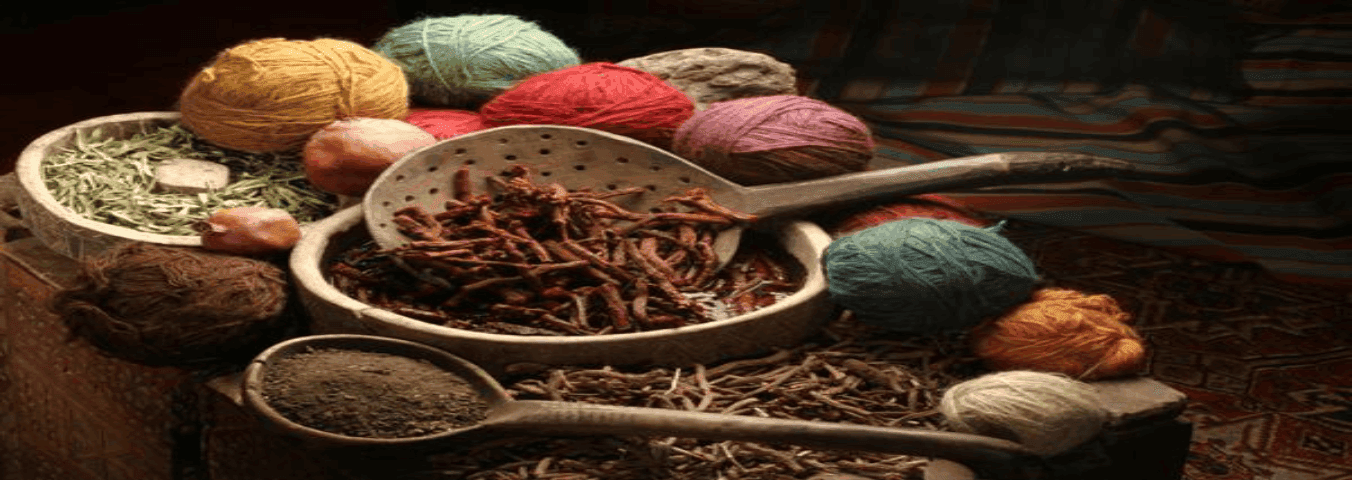
Traditional natural dyeing in the wider region has included materials such as:
- Madder: Used to create red and reddish tones
- Walnut husks: Associated with brown and earthy shades
- Pomegranate rind: Used in some traditional dye recipes, often with different results depending on the mordant and process
- Indigo: A traditional source of blue
The final colour of a dyed yarn depends on more than the plant or dye material itself. Water quality, mordants, temperature, preparation and the original wool all influence the result.
Today, many workshop carpets use synthetic dyes, while natural dyeing continues in some traditional communities and specialist production.
For buyers, the important point is not to assume that an old-looking colour is necessarily natural, or that a synthetic dye automatically indicates poor quality. Dye quality, colour consistency and fastness should be assessed in the context of the individual rug.
8. Sizes and Practical Uses
Ardabil carpets and rugs have traditionally been woven in a variety of sizes, from smaller room pieces to long runners and larger carpets.
Common regional size categories include:
Traditional term
General description
Rug / Qaliچه
Small and medium room rugs
Zar-o-Nim
A traditional size category, with dimensions varying by local practice
Kallegi
A wider, elongated format
Miane
A medium-sized carpet category
Kenareh
A long, narrow runner for corridors and passageways
Exact dimensions are not fixed across all workshops or periods. Traditional terms can vary by region and producer.
For contemporary interiors, smaller Ardabil rugs can work well in reading corners, bedrooms and compact living spaces. Larger examples may suit a central seating area, while runners are particularly useful in hallways and entrance spaces.
The right size is always a matter of proportion: a rug should relate naturally to the furniture and architecture around it.
9. How to Evaluate an Ardabil Rug
A regional name can help us understand a carpet's cultural background, but it cannot replace a careful examination of the actual piece.
When assessing an Ardabil rug, consider several elements together.
1. Examine the back
The reverse side reveals important details about the knotting, foundation and weft structure.
Look for consistency in the rows of knots and the way the wefts pass through the foundation. The back can also help distinguish a hand-knotted pile rug from a flat-woven textile.
2. Look at the wool
Good wool should be assessed through its resilience, texture, handle and overall condition.
A substantial pile can feel reassuring, but softness or thickness alone does not prove quality. The fibre should be considered alongside the construction and intended use.
3. Assess the colours
Look for colour consistency and signs of fading, staining or uneven dyeing.
Natural dyes can produce beautiful variation, but colour variation alone does not prove that a rug was dyed naturally. If colour fastness is a concern, it should be tested by a qualified professional rather than through an uncontrolled home test.
4. Study the design and workmanship
Check the balance of the composition, the clarity of the motifs and the quality of the borders.
Small irregularities are not necessarily defects in a handmade rug. In some pieces, they are part of the character of hand production. What matters is whether the overall workmanship is sound and appropriate to the type of carpet.
5. Check the condition
Inspect the pile, edges, fringes and foundation. Look for repairs, worn areas, moth damage, colour changes and previous restoration.
A well-preserved older carpet can be more desirable than a newer example with significant structural problems, but age alone does not determine value.
6. Understand what you are buying
A hand-knotted Ardabil carpet, a Shahsavan flatweave and a Verneh textile are different types of objects.
They should be assessed according to their own techniques, materials, purposes and cultural backgrounds—not by applying the same technical expectations to all of them.
10. Ardabil Rugs in Contemporary Interiors
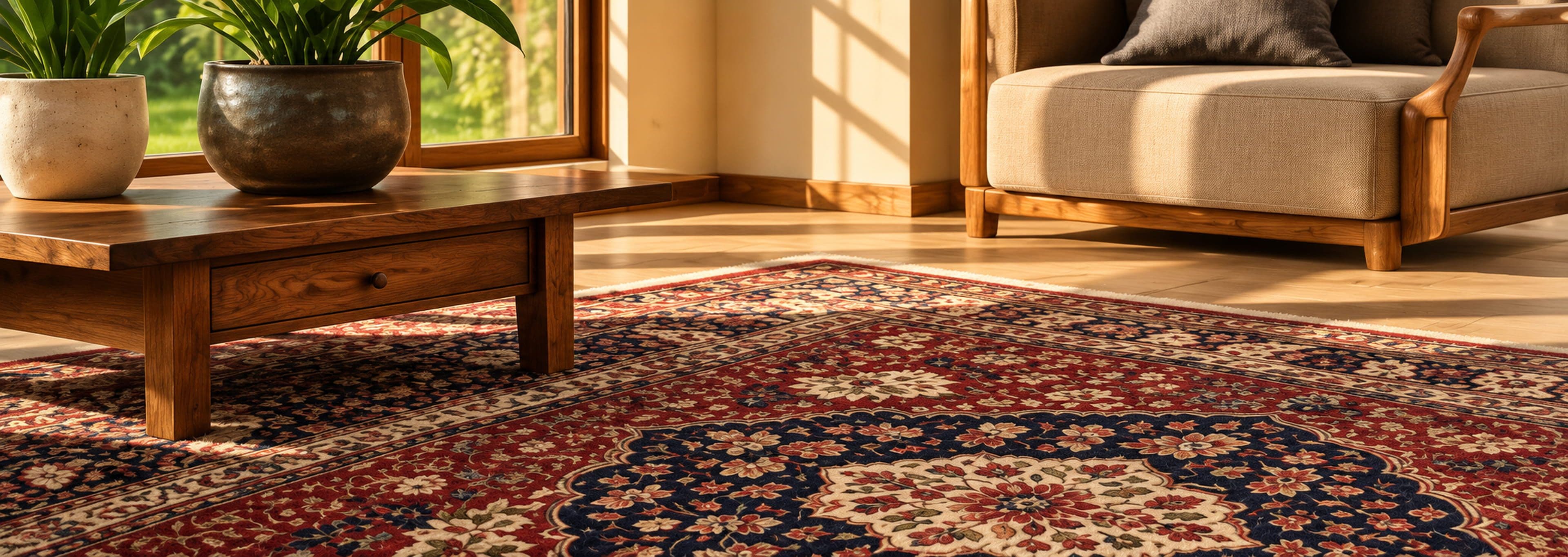
Ardabil rugs can work beautifully in European homes because their design vocabulary offers a balance between traditional detail and strong geometric structure.
A Herati-patterned rug in deep blue, red and cream can bring rhythm and visual depth to a classic interior. A more geometric village carpet may create a striking contrast in a minimalist room.
A Shahsavan flatweave or Verneh can introduce texture and a more informal, expressive character.
When choosing a rug, consider:
- The relationship between the rug's colours and the room's existing palette
- Whether the design is formal, geometric or more spontaneous
- The scale of the pattern in relation to the room
- The rug's pile height and suitability for the intended area
- The practical requirements of everyday use
A handmade rug does not need to match every colour in a room. Often, it works best when it introduces a distinctive element that connects the different parts of the interior.
Conclusion: More Than a Carpet
Ardabil's weaving heritage cannot be reduced to one pattern, one knot type or one famous historical carpet.
It is a broader tradition shaped by mountain landscapes, sheep farming, village households, nomadic movement and the exchange of artistic ideas across Iranian Azerbaijan and the Caucasus.
The region's workshop carpets, geometric village rugs, Shahsavan textiles and Mughan Verneh each express a different relationship between craft and daily life.
The celebrated Safavid Ardabil Carpet adds another dimension to this story. Its exceptional design, inscription and technical achievement remind us of the sophistication of Persian carpet-making in the sixteenth century, while the uncertainty surrounding its exact place of manufacture encourages a more careful understanding of historical attribution.
For us, the appeal of an Ardabil rug lies not simply in its appearance. It lies in the knowledge that every piece belongs to a living history of materials, skills and human creativity.
More than a rug, it is a piece of cultural heritage—woven one knot at a time.
Frequently Asked Questions About Ardabil Rugs
What are Ardabil rugs known for?
Ardabil rugs are known for their connection with the weaving traditions of Iranian Azerbaijan, including Herati or Mahi patterns, geometric village designs, wool pile carpets and the wider Shahsavan textile heritage.
Where is Ardabil located?
Ardabil is a province in northwestern Iran, near the Republic of Azerbaijan and the Caspian region. Mount Sabalan is one of the most important geographical landmarks in the area.
What is the difference between an Ardabil rug and a Shahsavan textile?
Ardabil rugs can refer broadly to carpets produced in the province. Shahsavan textiles are associated with the weaving traditions of particular nomadic communities and include pile rugs, kilims, jajims and Verneh. They are not all made using the same technique.
What is Verneh?
Verneh is a traditional flat-woven textile associated particularly with the Mughan region and Shahsavan weaving culture. It is commonly linked with supplementary-weft or sumak-style techniques and should not be confused with a conventional hand-knotted pile carpet.
What is the famous Ardabil Carpet?
The famous Ardabil Carpet is a Safavid-period masterpiece dated 1539–1540 CE. The larger, more complete example is held by the Victoria and Albert Museum in London, while its companion is in the Los Angeles County Museum of Art.
Was the historic Ardabil Carpet made in Ardabil?
Its historical association is with the shrine of Shaykh Safi al-Din in Ardabil. However, the exact place of manufacture is not conclusively established. Tabriz and other Safavid centres have been discussed in scholarly literature.
What materials are used in Ardabil carpets?
Many regional carpets use wool pile and cotton foundations. Some examples incorporate silk. Traditional tribal textiles may use wool for the foundation and decorative elements, depending on the technique and intended use.
Are Ardabil rugs suitable for modern interiors?
Yes. Their geometric designs, repeating floral patterns and rich but balanced colours can work in both traditional and contemporary European interiors. The most suitable choice depends on the size, colour palette and function of the room.
References and Further Reading
- Victoria and Albert Museum.The Ardabil Carpet. Museum history, inscription, date and historical context.
https://www.vam.ac.uk/articles/the-ardabil-carpet - Los Angeles County Museum of Art (LACMA).Maqsud Kashani, Ardabil Carpet, dated 1539–40 (A.H. 946). Collection record, materials, dimensions and curatorial notes.
https://collections.lacma.org/object/15378 - Encyclopaedia Iranica. May H. Beattie, Ardabil Carpet. Historical discussion of the two carpets, provenance and questions of attribution.
https://www.iranicaonline.org/articles/ardabil-carpet-persian-carpet-acquired-by-the-victoria-and-albert-museum-in-1893/ - Encyclopaedia Iranica. Daniel Walker, Carpets ix. Safavid Period. Historical background to Persian carpet production under the Safavids.
https://www.iranicaonline.org/articles/carpets-ix/ - Smarthistory. Elizabeth Macaulay, The Ardabil Carpet. Accessible discussion of the carpet's design, inscription and historical context.
https://smarthistory.org/the-ardabil-carpet/ - Khan Academy.The Ardabil Carpet. Educational overview of the carpet, Safavid context and technical characteristics.
https://www.khanacademy.org/humanities/ap-art-history/west-and-central-asia/a/the-ardabil-carpet - Persian-language regional study. Ardabil Carpet, supplied research document, pp. 1–9. Used for regional weaving categories, designs, materials, dimensions and local terminology.
- Persian-language technical notes. Comprehensive Encyclopaedia and Technical Analysis of Ardabil Handwoven Carpets, supplied research material. Used as a working regional framework; technical details requiring independent confirmation have been qualified in this article