
The Boteh Motif in Persian Carpets: Ancient Roots, Qajar Textiles and the Global Story of Paisley
It is one of the most recognisable designs in the history of Persian textiles. You can find it in carpets, handwoven shawls, luxury fabrics and decorative objects. It has also travelled far beyond Iran, becoming a familiar pattern in European fashion, interior design and textile production.
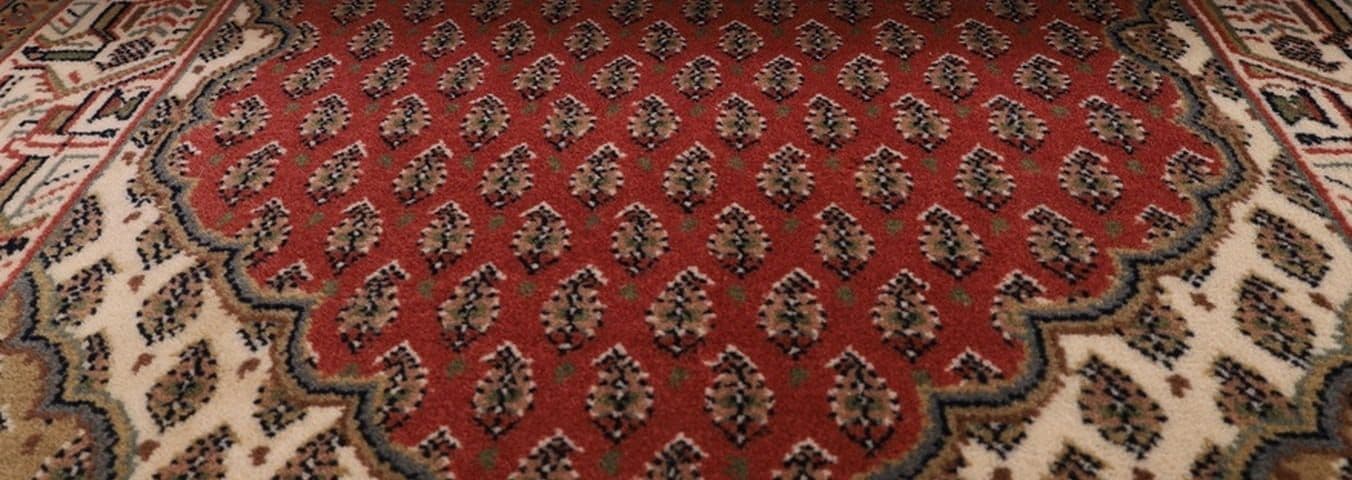
Look closely at a traditional Persian carpet and you may notice a distinctive shape repeated across its surface: a curved, teardrop-like form, sometimes filled with flowers and delicate details, sometimes simple and almost abstract.
In Iran, this motif is known as boteh. In much of Europe and the English-speaking world, it is more familiar as paisley.
It is one of the most recognisable designs in the history of Persian textiles. You can find it in carpets, handwoven shawls, luxury fabrics and decorative objects. It has also travelled far beyond Iran, becoming a familiar pattern in European fashion, interior design and textile production.
But where did the boteh actually come from? Is it a stylised leaf, a flower bud or a representation of the Persian cypress tree? Did it exist before the arrival of Islam in Iran? And how did a traditional Iranian design become a global textile icon?
The answers are more interesting than a single origin story. The history of boteh is a story of artistic development, cultural exchange, skilled craftsmanship and changing tastes across centuries.
1. What Exactly Is the Boteh Motif?
The boteh is a decorative motif with a curved, usually teardrop-shaped outline. Its upper end often bends to one side, creating the characteristic hooked form that many people recognise as paisley.
Inside the outline, the design may contain flowers, leaves, smaller botanical patterns or intricate ornamental details. Some examples are highly elaborate, while others are reduced to a simple curved shape.
The Persian word boteh is associated with a plant, a small bush, a sprig or a flower bud. This botanical character is reflected in many traditional interpretations of the motif.
However, boteh is not one fixed design. Over time, artists and weavers have developed many variations, adapting the shape to different materials, weaving techniques and artistic traditions.
In carpet design, it is useful to distinguish between three things:
- Motif: one individual decorative element, such as a single boteh.
- Pattern: the way individual motifs are repeated or arranged.
- Composition: the overall organisation of the design across the carpet or textile.
This distinction helps explain why two carpets can both feature boteh motifs but look entirely different.
2. Ancient Roots: Was Boteh Known Before Islam?
One of the most fascinating questions about boteh concerns its possible pre-Islamic history.
Iran has a long tradition of botanical and geometric ornament. Flowers, leaves, branches and stylised plants appear in the decorative arts of ancient Iranian cultures, including the Achaemenid, Parthian and Sasanian periods.
Some of these forms resemble later versions of boteh. Yet resemblance alone does not prove that they are the same motif or that one developed directly from another.
Early Iranian forms
The Textile Research Centre in Leiden, the Netherlands, presents an important interpretation of the motif's early development.
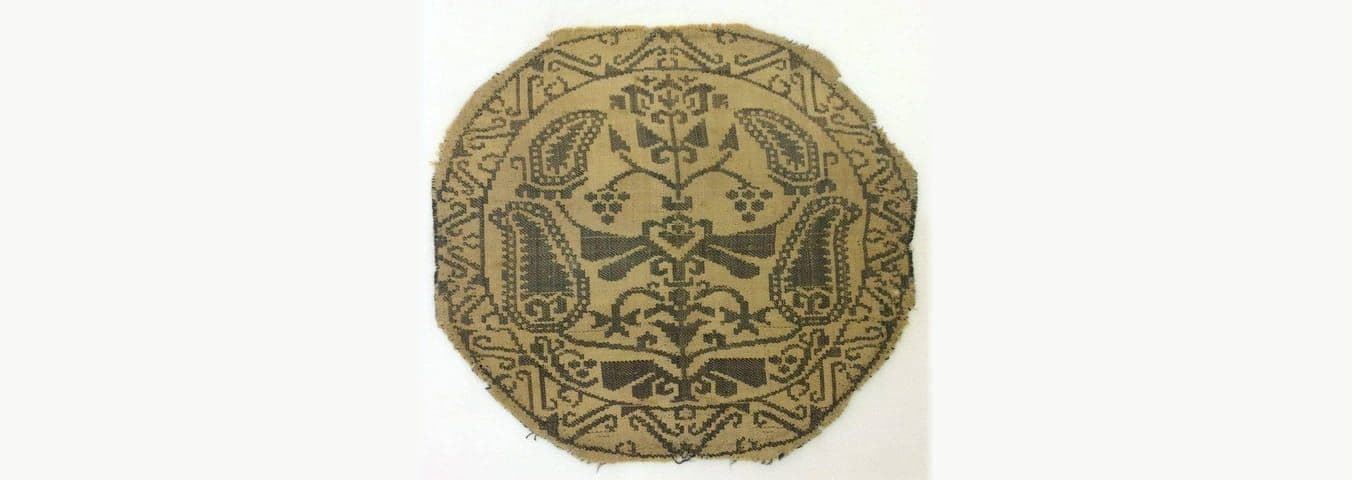
According to its research exhibition, related forms may have appeared in Iran during the early first millennium AD. These early designs were often bulbous, almond-shaped or floral, and did not necessarily have the pronounced curved tip associated with modern paisley.
The research also discusses the use of related forms during the Sasanian period (224–651 AD), including decorative architecture, tiles and silk textiles.
This is an important proposed history of the motif, but it should be understood as a scholarly interpretation rather than proof of one uninterrupted design lineage.
The Sasanian period
The Sasanian Empire was one of the most influential periods in the history of Iranian art. Its decorative traditions included elaborate textiles, metalwork, architectural ornament and repeated botanical designs.
The survival of ancient textiles is particularly challenging: organic materials deteriorate over time, and the number of securely documented examples is limited. For this reason, researchers must distinguish between surviving objects, archaeological evidence and later interpretations of related designs.
A particularly interesting example discussed by the Textile Research Centre is the decoration of the Noh-Gumbad Mosque, also known as Masjid-i Haji Piyada, in Balkh, in present-day Afghanistan. Its relief decoration includes forms that the research associates with the broader history of boteh-like ornament.
The important point is not that every ancient leaf-shaped design was already the modern paisley motif. Rather, these examples suggest that the visual vocabulary from which later forms developed has a long history in the Iranian cultural sphere.
What can we say with confidence?
There is evidence for early Iranian botanical and almond-shaped decorative forms, and specialist research connects some of them with the Sasanian period.
However, the precise date at which the familiar hooked boteh emerged remains a separate historical question. The available evidence does not justify assigning the modern form with certainty to every earlier Iranian dynasty.
For a careful history, it is better to speak of early forms related to boteh rather than claim that the fully developed modern motif has been conclusively identified in every ancient period.
3. Where Did the Boteh Come From? Four Interpretations
There is no single explanation accepted by all researchers. Several interpretations have been proposed, and they do not necessarily exclude one another.
1. A leaf, sprig or flower bud
The botanical interpretation is perhaps the most intuitive. The shape resembles a leaf, a young shoot or a small flowering branch.
The Persian word boteh itself is associated with botanical forms, making this interpretation particularly relevant to the motif's name.
2. The cypress tree
One of the best-known interpretations connects boteh with the Persian cypress.
The cypress has an important place in Iranian visual culture and poetry. Its tall, upright form has often been associated with grace, dignity and freedom.
Some writers interpret the curved boteh as a stylised or bent cypress. This is an attractive cultural interpretation, but it should not be treated as a proven historical origin.
A study by Mozhgan Kheirollahi Aznavle and Esmael Bani Ardalan specifically examines different scholarly explanations of boteh and challenges the assumption that the cypress must be its single origin.
Their discussion is particularly useful because it raises the possibility that different forms grouped under the name boteh may have developed from different sources.
3. A flower or abstract botanical form
Some versions of boteh look more like a bud or flower than a tree. In traditional design, artists often transform natural forms rather than reproduce them literally.
A leaf can become more symmetrical, a flower can be simplified, and a branch can be reduced to a flowing outline. Over generations, these changes may produce a decorative motif that no longer represents one specific plant.
4. More than one origin
A further possibility is that the boteh family includes motifs with different historical origins that gradually came to resemble one another.
This interpretation is especially important when comparing examples from different regions and periods.
A rounded floral design on an ancient textile and a sharply hooked paisley on a later shawl may share visual characteristics without necessarily having a direct historical connection.
Our view: The most responsible approach is to recognise the different interpretations while avoiding a single definitive origin story that the evidence cannot fully establish.
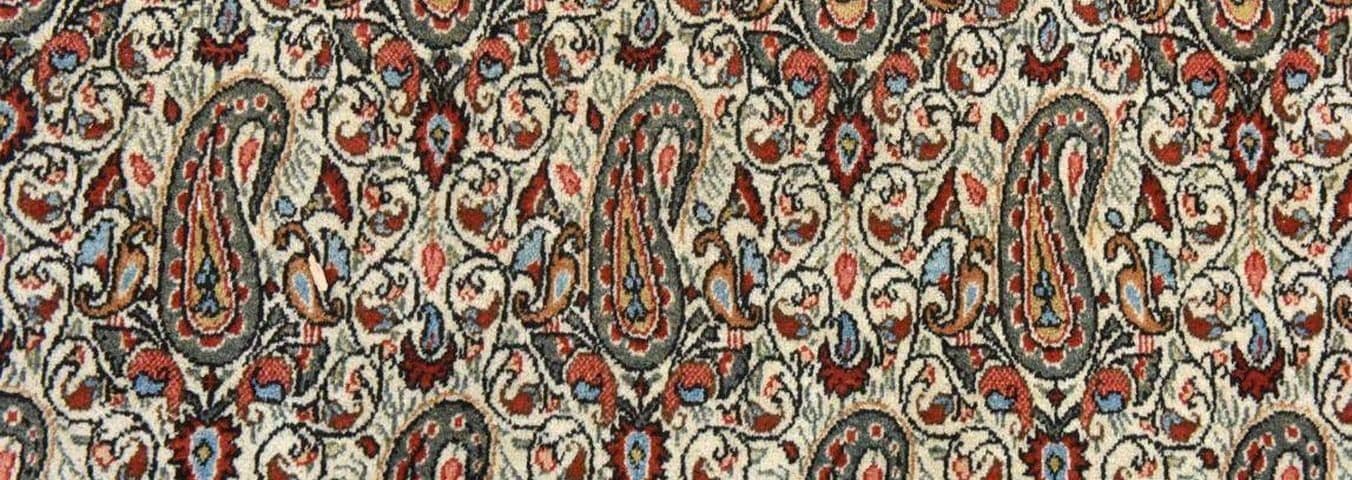
4. From Early Forms to the Recognisable Hooked Boteh
The boteh did not necessarily appear in its familiar modern form all at once.
The Textile Research Centre's historical account suggests that the motif evolved over time from earlier floral and almond-shaped forms into the more recognisable hooked design.
According to this interpretation, the familiar hooked variation had developed in Iran by the late Safavid period (1501–1736).
The hooked form is sometimes referred to in technical terminology as kalga or kalga boteh, although modern usage often applies the general name boteh to both earlier and later forms.
This development is important because it reminds us that the history of a decorative motif is rarely a simple sequence of identical shapes. Artists adapt designs to new materials, tastes and cultural settings.
A motif that begins as a floral ornament may eventually become an independent decorative symbol.
5. Boteh in Persian Carpets
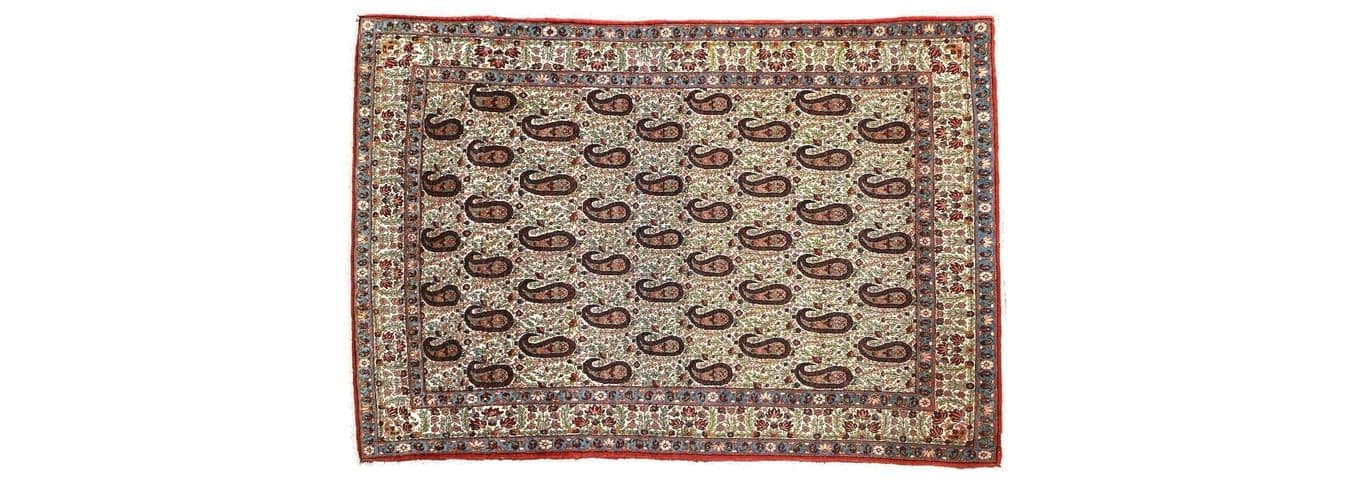
In Persian carpet design, boteh can appear in many different arrangements.
Depending on the weaving tradition and the overall composition, it may be used as:
- A repeated all-over pattern.
- A series of individual motifs arranged in rows.
- A decorative element within a larger field.
- A detail combined with flowers, branches or other traditional ornaments.
The motif's flowing outline makes it particularly adaptable. It can be repeated in a regular rhythm or arranged more freely, creating a sense of movement across the carpet.
A note on carpet history
The history of boteh in textiles should not be confused with its history in knotted-pile carpets.
Annette Ittig's specialist entry in Encyclopaedia Iranica discusses the introduction of the bota into the repertoire of Persian carpet designs during the later eighteenth century.
This does not mean that similar botanical forms were absent from earlier Iranian art. It means that the appearance and adoption of a particular motif in carpets must be studied separately from its wider history in architecture and textiles.
Does boteh identify a carpet's region?
Not by itself.
Boteh appears in different artistic and weaving traditions. Its presence alone cannot establish where a carpet was made, how old it is or whether it is authentic.
A proper assessment requires a wider examination of the carpet, including its structure, materials, colours, knotting technique, design details, dimensions and documented history.
For buyers, this is an important distinction: a familiar motif can tell you something about a carpet's visual language, but it cannot replace expert evaluation.
6. Qajar Termeh: When Boteh Became a Symbol of Luxury
One of the most revealing chapters in the history of boteh is found not in carpets, but in Persian luxury textiles.
During the Qajar period (1779–1925), finely woven termeh fabrics held an important place in Iranian courtly and elite culture.
Termeh is a traditional handwoven textile, often made from wool and silk. Its intricate designs and demanding production techniques made fine examples highly prized.
The boteh was among the most characteristic designs used in termeh.
A textile fit for the royal court
A particularly valuable source for understanding Qajar termeh is the collection of the Smithsonian's National Museum of Asian Art.
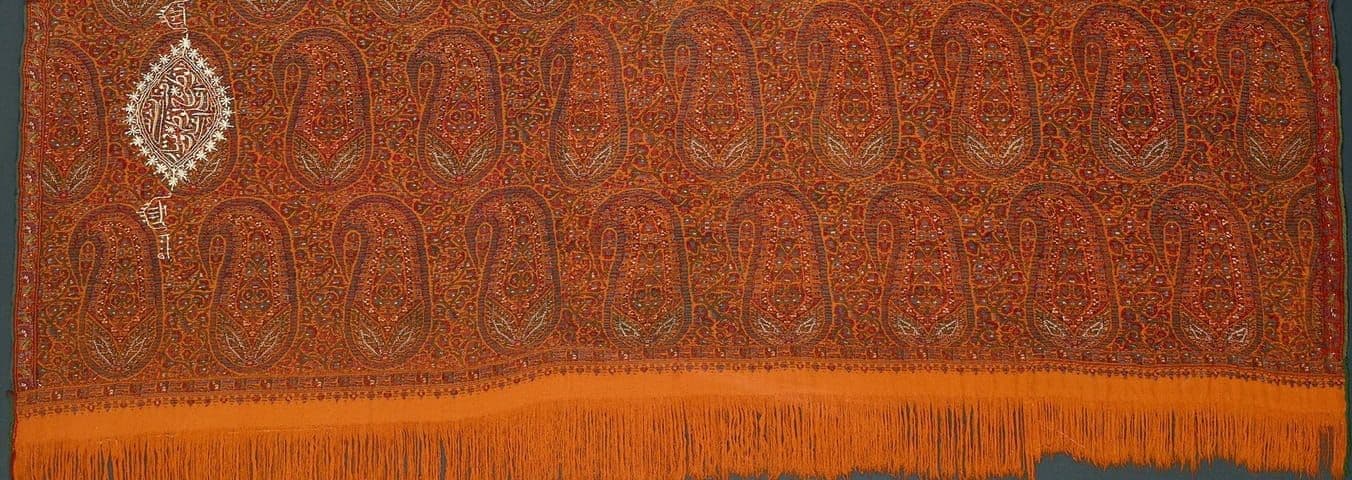
The museum holds a large Iranian termeh dated to approximately 1875–1900. The textile is made of silk and wool and is believed to have been produced in Yazd, a city known for its textile tradition.
The museum describes paisley, known in Persian as boteh, as the most common design for termeh.
It also explains that these finely designed fabrics were favoured for making khil'at — robes of honour bestowed by rulers on members of the nobility and high-ranking officials.
Such garments appear in numerous Qajar royal portraits.
This provides a valuable connection between the motif, luxury textile production and social status in nineteenth-century Iran.
More than decoration
In this context, boteh was not simply a decorative detail. It was part of a prestigious textile tradition associated with craftsmanship, courtly dress and the visual language of status.
The use of fine materials and intricate weaving techniques made high-quality termeh a significant expression of the skill of Iranian textile artisans.
It is worth remembering that not every Qajar garment was made from termeh, and the fabric was not exclusive to one social group. Its use varied according to occasion, status and individual circumstances.
Yazd, Kerman and the wider textile tradition
Yazd was an important centre of textile production, as the Smithsonian's documented example demonstrates.
Kerman also had a significant textile history. During the eighteenth and nineteenth centuries, the region became well known for its fine woollen shawls, which were traded beyond Iran and found markets in Europe, particularly Britain.
The Encyclopaedia Iranica account of Kerman's carpet industry describes the importance of the region's shawl trade and its place in the development of the local textile economy.
It is important, however, not to confuse all historical shawls with termeh or to attribute every surviving Iranian textile to Kerman. Different regions had their own production traditions, materials and techniques.
Why Qajar termeh matters today
Authentic Qajar textiles are now valued by museums, collectors and specialists in historical textiles.
Their importance depends on several factors:
- Documented origin and authenticity.
- Age and historical context.
- Quality of fibres and materials.
- Complexity and precision of weaving.
- Design and colour.
- Condition and completeness.
- Rarity and collection history.
A textile should not be considered valuable simply because it carries a boteh design or is described as Qajar. Its individual history and technical qualities matter.
7. The Cypress in Persian Poetry: Cultural Meaning, Not Proof of Origin
The cypress has long been a familiar image in Persian literature.
Persian poets have used the tree to evoke beauty, dignity, grace and freedom. These literary associations help explain why some people connect boteh with the cypress.
Saadi, one of the most influential Persian poets, writes:
“If you can give, be generous like the palm;
If you cannot, be free like the cypress.”
The verse comes from Saadi's Gulistan and uses the cypress as an image of freedom.
Hafez also uses the cypress in his poetry:
“Last night, the nightingale upon the cypress branch
Sang in the Pahlavi tongue the lessons of spiritual states.”
These literary references show the cultural significance of the cypress in Persian imagination.
However, poetry cannot by itself establish the historical origin of a textile motif. It provides cultural context, not archaeological proof.
The distinction matters: a design may later acquire symbolic associations that were not necessarily part of its original meaning.
8. From Boteh to Paisley: A Motif Travels the World
The story of boteh does not end in Iran.
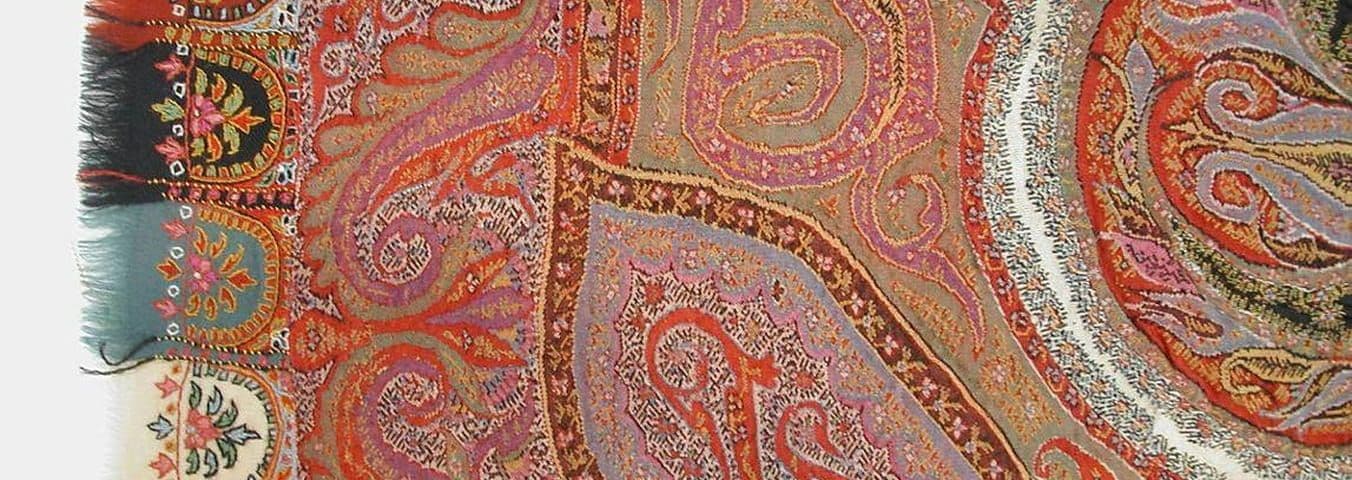
The motif became closely associated with the fine woollen shawls woven in Kashmir, in the northern Indian subcontinent. These shawls were admired for their softness, complex patterns and skilled craftsmanship.
Through trade and cultural exchange, Kashmir shawls became highly fashionable in Europe.
European manufacturers began producing their own versions, particularly in the nineteenth century. One of the most important centres of this production was Paisley, a town in Scotland near Glasgow.
The town became so closely associated with the design that its name eventually became the familiar English word for the motif.
This is why the same decorative form is known by different names in different places:
- Iran: Boteh.
- Afghanistan: Bota.
- Europe and North America: Paisley.
- Parts of South Asia: Names often associated with the mango or its seed.
- Japan: It may be described using terms associated with a pinecone or other familiar shapes.
The different names reflect the ways cultures interpret the same or related visual forms.
The global journey of paisley is a good example of how textile designs travel. They move with merchants, artisans, luxury goods, fashion trends and changing consumer tastes.
9. What Does Boteh Symbolise?
There is no single meaning that can be confidently applied to every boteh motif across all periods and regions.
Depending on its context, the shape has been interpreted as a leaf, a flower bud, a seed, a cypress or an abstract botanical form.
These interpretations have encouraged associations with:
- Growth and renewal.
- Nature and plant life.
- Continuity and endurance.
- Beauty and elegance.
- Freedom and dignity, particularly through the cultural association with the cypress.
Some modern explanations also connect boteh with protection, fertility or good fortune. Such interpretations may be meaningful in particular cultural contexts, but they should not automatically be presented as the original meaning of every historical example.
For a European reader, perhaps the most useful way to understand boteh is to see it as a design that has remained open to interpretation.
Its form is simple enough to be recognised, yet flexible enough to be reimagined by generations of artists and craftspeople.
10. How to Recognise Boteh in a Persian Carpet
When looking at a Persian carpet, you can often recognise boteh by its distinctive curved outline.
Here are a few features worth noticing:
The outer shape: Look for a teardrop or almond-like form, often with a curved or hooked tip.
The internal decoration: Some boteh motifs contain small flowers, leaves or ornamental details.
The arrangement: Motifs may appear in rows, repeated across the field or incorporated into a larger composition.
The weaving: Look closely at how the design has been translated into knots. The precision of the outline, colour changes and small details can reveal the weaver's skill.
Remember that the motif is only one part of a carpet's identity. Materials, structure, dyes, craftsmanship and provenance are equally important when assessing a handmade rug.
11. Why the Boteh Motif Still Matters
Today, paisley remains familiar in fashion, scarves, upholstery, decorative fabrics and interior design.
Its appeal lies partly in its versatility. It can look traditional or contemporary, delicate or bold, highly ornamental or surprisingly minimal.
For Persian carpets, boteh offers another way to appreciate the relationship between design and craftsmanship.
A handmade carpet is not simply a floor covering. Its patterns carry traces of regional traditions, artistic choices and the skills of the people who made it.
When you recognise a boteh motif in a Persian rug, you are looking at a design with a complex history — one that connects Iranian artistic traditions with a much wider world of textiles and decorative art.
At Rugeast, we believe that understanding the story behind a handmade rug makes choosing one more meaningful. A pattern is not only something to look at; it can also be a way into the history and culture of the people who created it.
Discover the beauty of Persian handmade carpets and explore the designs that make each piece unique.
Frequently Asked Questions
Is the boteh motif the same as paisley?
They are closely related terms. Boteh is the Persian name for the motif, while paisley is the name widely used in English and many European languages. The English name comes from the Scottish town of Paisley, which became an important centre of nineteenth-century production of paisley-patterned textiles.
Is boteh originally Persian?
The motif is generally associated with Iranian artistic traditions, and specialist research discusses early related forms in Iran. However, its precise origins and development remain subjects of scholarly discussion.
Did boteh exist before Islam?
Research by the Textile Research Centre in Leiden connects early forms related to boteh with pre-Islamic Iranian art, including the Sasanian period. It is important to distinguish these earlier forms from the fully developed hooked motif familiar today.
Does boteh represent the cypress tree?
This is one interpretation, supported by the cultural importance of the cypress in Persian art and literature. However, researchers have questioned whether the cypress can be considered the single origin of the motif.
Why was boteh so common in Qajar termeh?
Boteh was one of the characteristic designs of Persian termeh. Fine termeh fabrics were used for luxury garments and robes of honour in Qajar court culture. The Smithsonian's National Museum of Asian Art documents a late nineteenth-century Iranian example with a boteh design.
Were all Qajar termeh textiles made in Kerman?
No. Yazd was also an important textile-producing centre, and the Smithsonian's documented Qajar termeh is believed to have been made there. Kerman was particularly known for its woollen shawl industry.
Does a boteh pattern prove that a carpet is Persian?
No. Similar motifs appear in several textile traditions. A carpet's origin must be assessed through its structure, materials, weaving technique, design, colours and provenance — not by one motif alone.
Is paisley still used today?
Yes. Paisley remains popular in fashion, accessories, upholstery and interior decoration. Its long history and adaptable form have helped it remain relevant across different cultures and design styles.
References and Further Reading
The following sources were consulted for the historical and technical information in this article. They are included so readers can explore the subject further and verify the historical context.
English-language academic and museum sources
- Ittig, Annette. “Carpets iv. Knotted-pile carpets: Designs, motifs, and patterns.” Encyclopaedia Iranica.
https://www.iranicaonline.org/articles/carpets-iv/ - Textile Research Centre, Leiden. “3. History of the Paisley Motif.” From Buteh to Paisley: The History of a Global Icon.
https://trc-leiden.nl/trc-digital-exhibition/index.php/from-buteh-to-paisley/item/265-3-history-of-the-paisley-motif - Textile Research Centre, Leiden. “2. But What Is Paisley?” From Buteh to Paisley: The History of a Global Icon.
https://trc-leiden.nl/trc-digital-exhibition/index.php/from-buteh-to-paisley/item/264-2-but-what-is-paisley - Smithsonian National Museum of Asian Art. “Termeh cloth.” Iran, probably Yazd, ca. 1875–1900. Wool and silk. Accession number S2017.14.
https://asia.si.edu/explore-art-culture/collections/search/edanmdm%3Afsg_S2017.14/ - Smithsonian Collections Search Center. “Termeh cloth.” Collection record, accession S2017.14.
https://collections.si.edu/search/detail/edanmdm%3Afsg_S2017.14 - Gustafson, James M. “Kerman xv. Carpet Industry.” Encyclopaedia Iranica.
https://www.iranicaonline.org/articles/kerman-15-carpet-industry/ - Gustafson, James M. “Kerman ix. History in the Qajar Period.” Encyclopaedia Iranica.
https://www.iranicaonline.org/articles/kerman-09-qajar-period/
Persian-language academic source
- Kheirollahi Aznavle, Mozhgan, and Esmael Bani Ardalan. “Explaining the Botteh Motif's Characteristics Considering the Views and Opinions of the Scholars about Its Origin in Islamic Art and a Critique of the Cypress Tree View as the Origin of This Motif.” Negareh, vol. 13, no. 47, 2018, pp. 62–81.
DOI: 10.22070/negareh.2018.2822.1767
https://doaj.org/article/2131de5e807e47e88005899b9e7cd0aa
Notes on historical interpretation
The early history of boteh is not fully settled. This article distinguishes between ancient botanical forms that resemble the motif and the later hooked design commonly recognised as paisley. The cypress interpretation is presented as one cultural and scholarly explanation, not as an established fact.
Direct quotations from Persian poetry should be checked against the specific edition used before publication. The English renderings in this article are translations for general readers rather than claims of a definitive literary translation.
About the Author
Mohammad Hossein Bidabadi holds an M.A. in Handmade Carpet Management and Marketing from the University of Kashan. A university lecturer and carpet specialist with a family background in the handmade carpet trade spanning three generations, he writes about Persian carpets, traditional textiles, craftsmanship and the cultural history of oriental rugs.