
Kashan Rugs: History, Design and Craftsmanship of Persian Carpets
Among the many traditions of Persian carpet weaving, Kashan holds a particularly distinguished position. Known for its refined floral designs, the city has been one of Iran's most important centres of textile and carpet production for centuries.
Introduction: The Timeless Beauty of Kashan Carpets
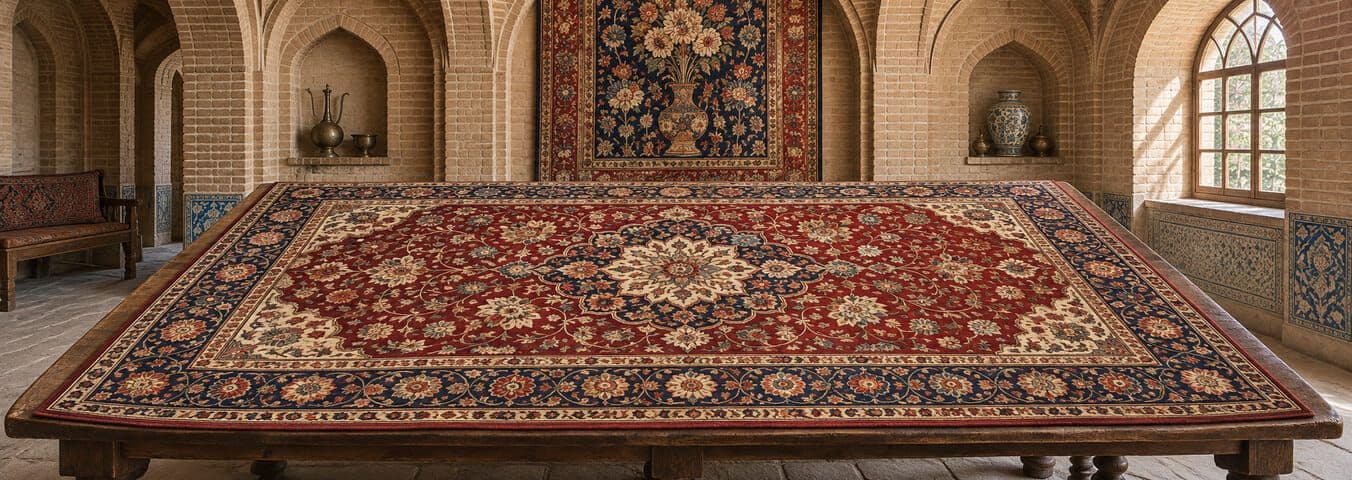
Among the many traditions of Persian carpet weaving, Kashan holds a particularly distinguished position. Known for its refined floral designs, balanced compositions, rich colours and exceptional weaving skills, the city has been one of Iran's most important centres of textile and carpet production for centuries.
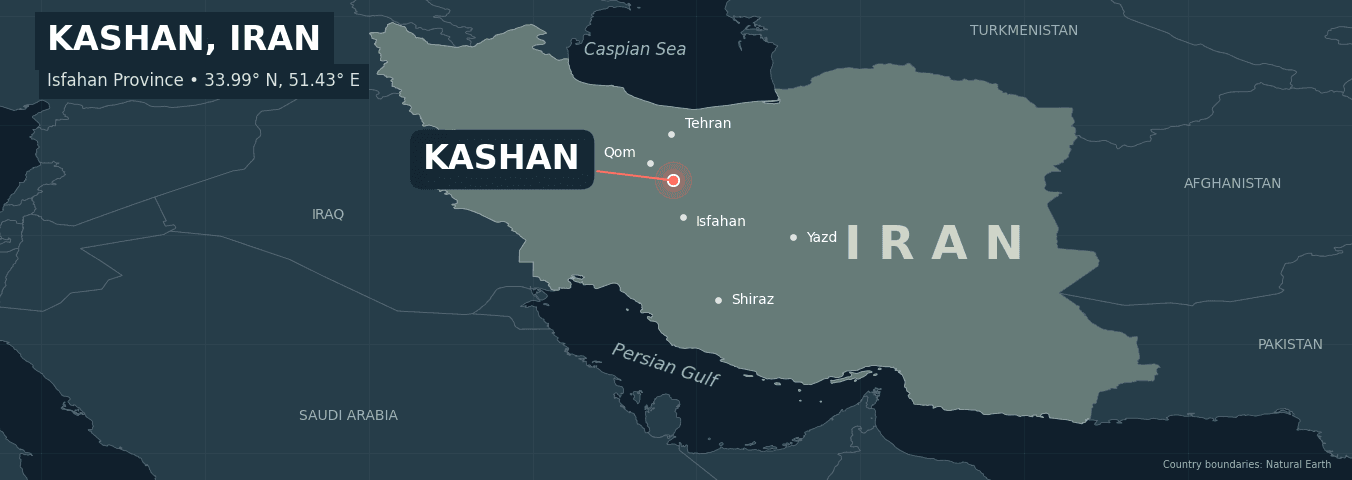
Located in central Iran, between Tehran and Isfahan, Kashan has a long artistic history. Its reputation extends beyond carpets to silk textiles, velvet, ceramics, glazed tiles and other traditional crafts. This broader artistic environment helped shape the distinctive character of Kashan rugs.
The history of Kashan carpets is especially interesting because it reflects several important periods in Persian art. During the Safavid era, the city became associated with luxurious silk carpets, some incorporating gold and silver threads. In the nineteenth century, the famous Mohtasham group of Kashan carpets emerged, becoming particularly admired for its fine weaving, sophisticated floral patterns and rich colours.
Today, Kashan rugs remain among the best-known examples of traditional Persian city carpets. Their designs range from elaborate medallion compositions and flowing floral patterns to more contemporary interpretations using lighter colours and softer decorative elements.
But what exactly makes a Kashan rug different from other Persian carpets? How is it woven? Which materials are used, and what do its traditional patterns represent?
This guide explores the history, geography, materials, weaving techniques, colours, designs and cultural heritage of Kashan carpets, helping readers understand not only their appearance but also the craftsmanship behind them.
1. Where Is Kashan? Geography and Cultural Background
Kashan is a historic city in Isfahan Province, in central Iran. It lies on the western edge of the Dasht-e Kavir, one of Iran's major desert regions, along an important historical route connecting Tehran with Isfahan.
The city's geographical position contributed to its development as a centre of trade and craftsmanship. Although the surrounding landscape is relatively dry, Kashan became an important centre for textile production, commercial activity and traditional industries.
One of the most remarkable archaeological sites in the region is Sialk (Tepe Sialk), located near modern Kashan. Archaeological discoveries there demonstrate that the area has been inhabited for thousands of years and was home to early communities with developed craft and manufacturing traditions.
Kashan's historical identity was shaped by several important industries, including:
- Silk weaving and textile production
- Velvet and fine fabric manufacturing
- Pottery and ceramic production
- Traditional tile-making
- Carpet weaving and other handmade textiles
These crafts developed within a shared artistic environment. Knowledge of colour, pattern design, textile structures and decorative techniques was exchanged between different workshops and generations of artisans.
This background helps explain why Kashan became such an important centre of refined carpet production.
1.1. What Does the Name Kashan Mean?
The precise origin of the name Kashan remains uncertain, and several explanations have been proposed.
One popular local story connects the name with the Persian word kah (straw). According to this account, straw was scattered around the settlement to mark or define its boundaries, leading to the expression Kah-Neshan, which eventually developed into Kashan.
Another interpretation divides the name into two elements, suggesting that Ka referred to a fortress or tower and Shan to a territory or region.
Some writers have also proposed a connection with the ancient Kassite or Kassi peoples, while other interpretations link the name to legendary royal traditions.
These explanations should be treated as historical or local hypotheses rather than established linguistic facts.
For the history of Kashan's carpet industry, the more important point is that the city developed a distinctive cultural and commercial identity, which eventually became closely associated with some of the finest handmade textiles and carpets in Iran.
2. The History of Kashan Carpets: From the Safavid Era to the Mohtasham Tradition
The history of Kashan carpets is closely connected with the wider development of Persian art and textile production.
Although the region has a much older tradition of craftsmanship, the Safavid and Qajar periods are particularly important for understanding the development of the carpets now associated with Kashan.
2.1. The Safavid Period: The Golden Age of Persian Carpet Art
The Safavid dynasty ruled Iran from 1501 to 1736. This period is widely regarded as one of the greatest eras in the history of Persian decorative arts.
Royal patronage, specialised workshops, international trade and the development of sophisticated artistic techniques contributed to the production of some of the most celebrated Persian carpets.
Kashan was an important centre of silk production during this period. Its textile workshops were known for fine fabrics, velvet and luxurious silk products. The city's expertise in silk and other textile materials also supported the development of exceptionally fine carpets.
Safavid Kashan carpets were sometimes produced using silk for the foundation and pile, while certain luxury examples incorporated gold and silver threads.
Their designs often featured:
- Elaborate central medallions
- Floral compositions and scrolling vines
- Palmettes and stylised leaves
- Hunting scenes and animal figures
- Complex borders and decorative details
These carpets were not simply practical floor coverings. Many were luxury objects made for palaces, wealthy patrons, religious institutions and international trade.
Their craftsmanship reflected the high artistic standards of the Safavid period.
2.2. The Polonaise Carpets: Persian Masterpieces with a European Name
One of the most fascinating groups of historical Persian carpets is known internationally as the Polonaise carpets.
Despite the name, these carpets were not woven in Poland. They are associated with Safavid Iran and are particularly notable for their silk foundations, luxurious decoration and the use of metallic gold and silver threads.
The name became popular after some examples were associated with Polish aristocratic heraldic symbols. A carpet exhibited in Paris in 1878 helped reinforce the Polish attribution, although the group was subsequently recognised as Persian.
Many examples are traditionally associated with Kashan, reflecting the city's importance as a centre of silk production. However, scholars do not attribute every Polonaise carpet to Kashan; other Iranian production centres may also have been involved.
Their characteristic features include:
- Silk pile and, in some examples, silk foundations
- Gold and silver metallic decoration
- Elaborate floral and medallion compositions
- Rich ornamental borders
- Luxurious materials and highly sophisticated craftsmanship
Today, examples of these carpets are preserved in major museums and private collections.
They demonstrate the international reach of Persian textile craftsmanship during the Safavid era.
2.3. The Ardabil Carpet and Maqsud Kashani
The famous Ardabil Carpet is one of the most important surviving examples of Safavid carpet weaving.
Dated 1539–1540, it is particularly significant because its inscription includes the name Maqsud Kashani.
The carpet is now associated with the Ardabil shrine tradition, and one of its surviving examples is preserved at the Victoria and Albert Museum in London.
An important historical distinction should be made here: the name Kashani in the inscription identifies Maqsud's geographical or personal association, but it does not independently prove that the carpet was manufactured in the city of Kashan.
Nevertheless, the inscription is an important reminder of the role played by individuals associated with Kashan in the artistic world of Safavid Iran.
2.4. The Qajar Period: The Revival of Kashan Carpet Weaving
Following the Safavid era, political instability and economic changes affected several traditional industries in Iran.
During the nineteenth century, however, carpet production experienced a revival in Kashan.
This revival coincided with growing international demand for Persian carpets and the development of organised weaving workshops.
Among the most important names associated with this period is Mohtasham, whose name became closely connected with some of the finest historical Kashan carpets.
2.5. Mohtasham Kashan Rugs: A Distinguished Nineteenth-Century Tradition
Mohtasham carpets occupy a special place in the history of Kashan weaving.
They are admired for their refined construction, elaborate floral patterns, rich colours and high-quality materials.
According to a traditional account preserved in Kashan's carpet history, Haji Mollah Hassan Mohtashami established a carpet workshop in the city approximately 120 years before the time described in that account.
His wife reportedly came from Anjedan, near Arak, and was familiar with local carpet-weaving techniques. The workshop initially developed around silk weaving, making use of the materials and textile expertise available in Kashan.
According to the same account, one of the early silk rugs was presented to Naser al-Din Shah Qajar. The workshop subsequently expanded, with the participation of Mohammad Taghi Poshtibaf.
These historical narratives are important parts of the local tradition. However, the precise identity and role of the original Mohtasham master remain subjects of scholarly discussion. At least two signed carpets bearing the name Haji Mollah Mohammad Hassan Mohtasham are known, while many other carpets attributed to this group are unsigned.
The term Mohtasham is therefore best understood as the name of a distinguished historical workshop tradition and group of carpets, rather than an automatic guarantee that every example was made by one individual.
What makes Mohtasham carpets special?
Their main characteristics include:
- Exceptionally fine and regular weaving
- Rich floral designs and elaborate medallions
- High-quality wool, sometimes combined with silk
- Silk foundations in certain examples
- Deep red, burgundy, navy, ivory and warm brown tones
- Carefully finished edges, including distinctive reddish-purple silk selvedges in some examples
The quality and artistic sophistication of these carpets made them highly desirable among collectors and connoisseurs.
3. The Kashan Carpet-Weaving Region
The term Kashan carpet does not necessarily refer only to carpets woven within the city itself.
Carpet weaving has historically extended across the surrounding towns and villages, forming a broader regional weaving tradition.
Important centres and areas associated with Kashan carpet production include:
- Kashan
- Aran and Bidgol
- Qamsar
- Natanz
- Ravand
- Nushabad
- Khaveh
- Mashhad Ardehal
- Niasar
- Barzok
- Fin
- Armaq and surrounding villages
Although these areas share certain design traditions, their carpets are not necessarily identical in quality, structure or artistic characteristics.
Some workshops follow the more refined urban Kashan tradition, while others produce carpets with regional variations.
For international buyers, this distinction is important. The name Kashan may refer to a carpet's actual place of manufacture or to a broader design and commercial category.
A reliable description should therefore identify the actual weaving location whenever that information is available.
4. How Are Kashan Carpets Made?
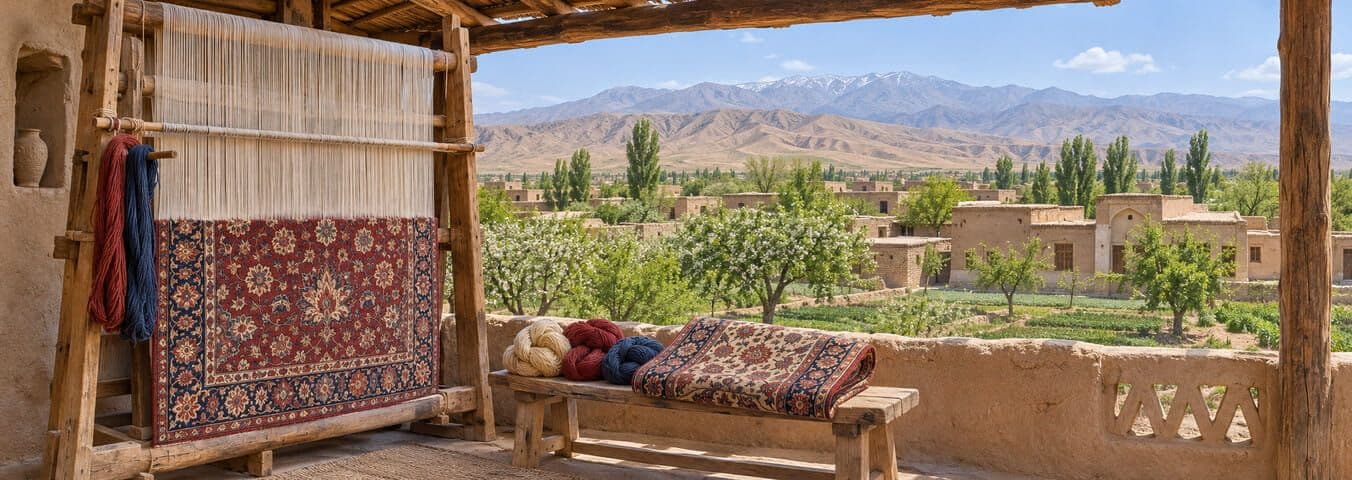
A handmade Kashan carpet is the result of a sequence of carefully coordinated processes.
Unlike machine-made rugs, in which the pattern is produced mechanically, a hand-knotted carpet is created through thousands of individual knots tied by skilled weavers.
Each knot contributes to the structure and design of the finished carpet.
Understanding the basic construction helps explain why traditional Kashan rugs are valued for their craftsmanship.
4.1. The Loom and Warp Preparation
The traditional Persian carpet loom is known as a dar.
It can be made of wood or metal and provides the framework on which the carpet is woven.
The first step is preparing the warp threads, known in Persian as tar.
These are the vertical threads running along the length of the carpet. They form the foundation to which the pile knots are attached.
Cotton is widely used for the warp in traditional Kashan carpets, although silk foundations can also be found in finer and historical examples.
Proper warp preparation is essential. The threads must be evenly spaced and maintained under suitable tension to prevent distortion during weaving.
4.2. The Persian Knot: The Asymmetrical Knotting Technique
One of the most characteristic technical features of Kashan carpets is the use of the Persian knot, also known as the asymmetrical knot.
In this technique, a short length of pile yarn is wrapped around two adjacent warp threads, but the knot is formed asymmetrically rather than symmetrically around both warps.
The two ends of the yarn are then cut to form the carpet pile.
Thousands of these individual knots create the surface of the rug.
Two major knotting techniques are commonly discussed in Persian carpet studies:
Persian or asymmetrical knot
The pile yarn is wrapped asymmetrically around the warp threads. This technique is widely used in Persian city carpets, including Kashan rugs.
Turkish or symmetrical knot
The pile yarn is wrapped symmetrically around two adjacent warp threads.
Both techniques are found across different carpet-producing regions, and neither should be considered exclusive to one country or ethnic tradition.
The traditional Kashan weaving technique is specifically associated with the Persian or asymmetrical knot.
4.3. The Two-Weft Structure: An Important Feature of Kashan Weaving
One of the most important structural characteristics of traditional Kashan carpets is the use of two wefts after each row of knots.
To understand this technique, it is useful to distinguish between warp and weft.
The warp threads run vertically along the carpet. The wefts, known in Persian as pud, pass horizontally through the warps and help secure the rows of knots.
In the traditional Kashan two-weft system, two cotton wefts of different thicknesses are inserted after each row of knots.
The thick weft (under-weft)
This is the thicker thread, approximately comparable in thickness to the warp threads.
The thin weft (upper-weft)
This is a much finer thread inserted after the thicker weft.
The wefts are then beaten into place using a special comb-like tool known as a daftin.
This process compresses the woven rows and helps create a firm and stable carpet structure.
UNESCO's technical nomination file describes this traditional Kashan technique and records a history of approximately four centuries for this form of Persian weaving.
The two-weft structure is therefore an important part of Kashan's traditional technical identity.
4.4. What Does Lool-Baft Mean?
In Iranian carpet terminology, Lool-baft is a traditional trade expression used to describe a particular type of carpet construction.
It is not a universally standardised international technical classification, so it should be used with care when describing a carpet to an international audience.
In practical carpet assessment, the important factors are the relationship between the warp and weft threads, the degree of compression, the knot structure and the overall firmness of the foundation.
For buyers, examining the reverse side of the carpet can reveal useful information about its construction.
4.5. Materials Used in Kashan Carpets
The quality of a handmade carpet depends heavily on its raw materials.
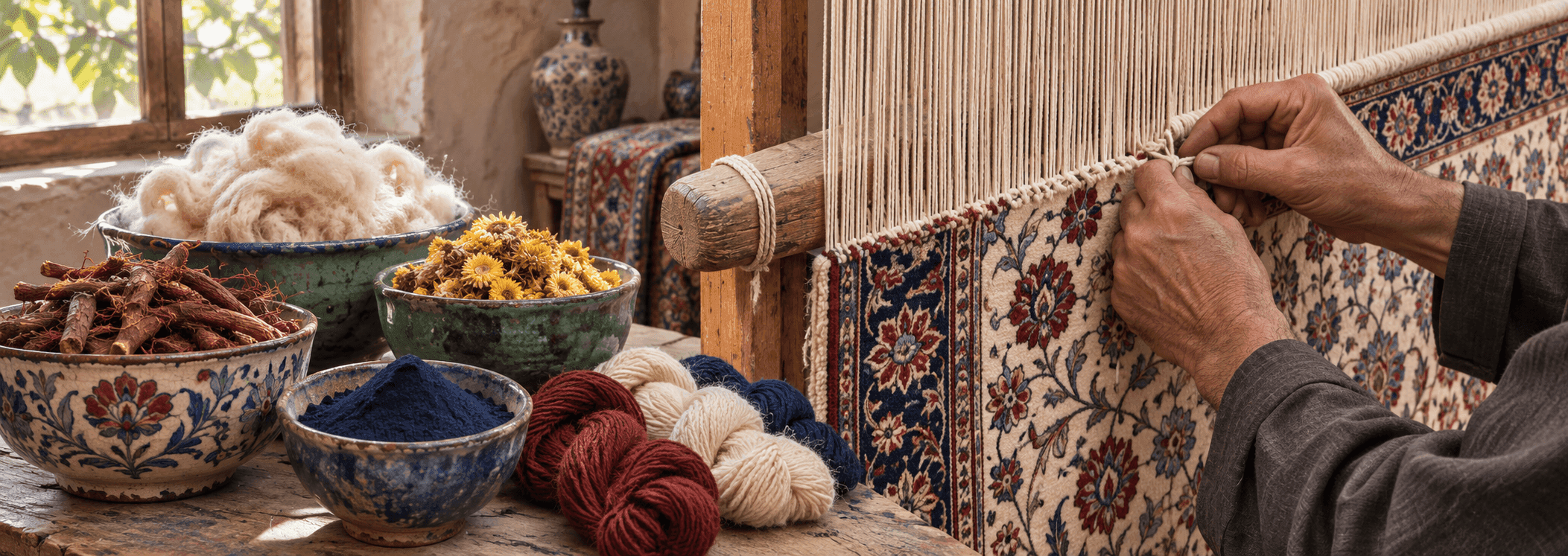
Traditional Kashan carpets are generally made using three main fibres: cotton, wool and silk.
Cotton
Cotton is commonly used for the warp and weft. It provides a stable foundation and supports the overall structure of the carpet.
Wool
Wool is the principal pile material in many Kashan carpets.
Its quality affects softness, durability, texture and the way colours appear on the surface.
Fine wool is particularly important in carpets intended for detailed designs and long-term use.
Silk
Silk is valued for its natural lustre, strength and fineness.
It can be used for the pile, foundation or decorative details, depending on the carpet's design and quality.
In some Kashan rugs, silk is used throughout the pile. In others, it is introduced selectively to highlight flowers, leaves, outlines and other decorative elements.
Certain fine examples also incorporate kurk, a particularly soft and fine type of wool.
The combination of these materials varies according to the workshop, period and intended quality of the carpet.
5. Understanding Kashan Carpet Density and Knot Count
One of the most common questions among international carpet buyers concerns the density of handmade rugs.
A higher knot count generally allows more detailed designs, but it does not automatically mean that a carpet is better.
In Iranian carpet terminology, several traditional systems are used to describe weaving fineness.
5.1. What Is Raj-Shomar?
Raj-shomar is a traditional Iranian term used to describe carpet fineness.
It refers to the number of knots measured across a defined section of the carpet.
For international readers, the term knots per square metre (KPSM) is often more familiar.
KPSM expresses the number of knots within one square metre of carpet.
These two measurements should not be treated as identical, because they use different measurement conventions.
5.2. The Local Kashan Measurement: Rag
In Kashan's traditional design and weaving terminology, the word Rag is also used.
According to Mohammad Hossein Bidabadi's technical description, one Rag represents the number of knots counted across a width of 26 centimetres.
This measurement is particularly useful when discussing traditional Kashan design papers and local workshop terminology.
It provides an additional way of describing the relationship between the drawn pattern and the actual woven carpet.
5.3. The Number of Design Squares
Another traditional commercial method used in Kashan is to describe the number of design squares across half the carpet.
For example, certain commercial six-square-metre carpets with approximately 28–30 Raj may be described as having 40 squares across half their width.
Similarly, some nine-square-metre carpets with approximately 30 Raj may be described as having 60 squares.
The greater the number of squares in the corresponding measurement system, the finer the design grid.
These traditional terms are useful when communicating with Kashan carpet manufacturers and traders, although international buyers should request clear technical specifications rather than relying on a local expression alone.
5.4. Does a Higher Knot Count Always Mean Better Quality?
No.
Knot density is only one aspect of carpet quality.
A good Kashan carpet should also be evaluated according to:
- Quality of wool and silk
- Consistency of the knots
- Evenness of the weaving
- Strength of the foundation
- Colour quality and stability
- Design execution
- Finishing and edge construction
- Overall condition
A carpet with moderate knot density but excellent materials and craftsmanship can be more valuable than a highly dense carpet made with inferior materials.
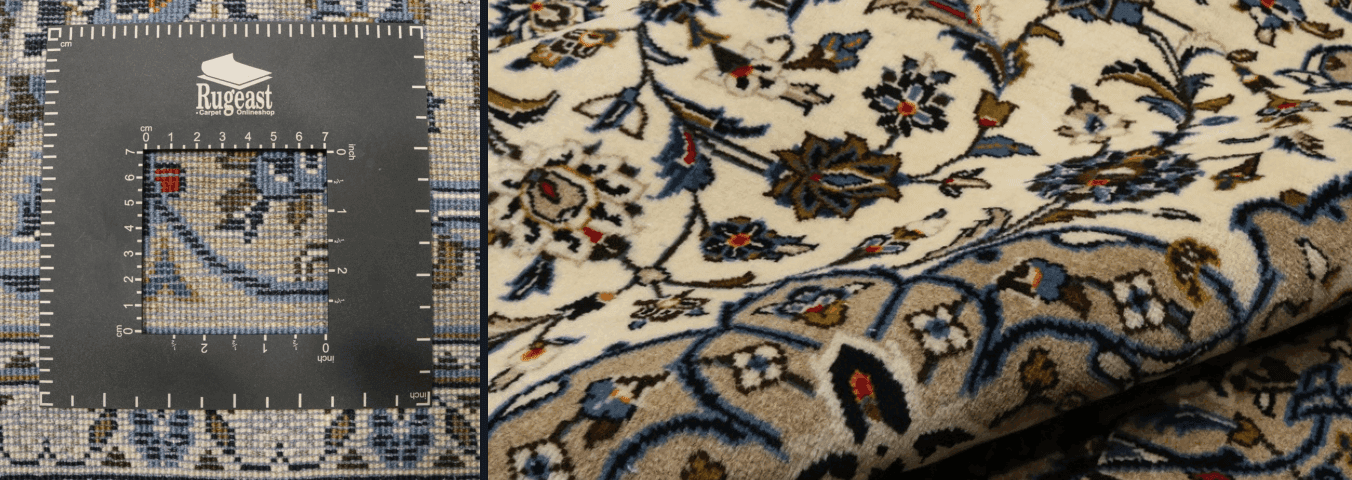
6. Colours and Natural Dyeing in Kashan Carpets
Colour is one of the defining visual characteristics of traditional Kashan rugs.
Historical examples are particularly admired for their rich red, navy blue, ivory, cream and warm brown tones.
In many classical Kashan carpets, a deep red field is combined with dark blue borders and delicate floral details.
However, the colour palette has changed considerably over time.
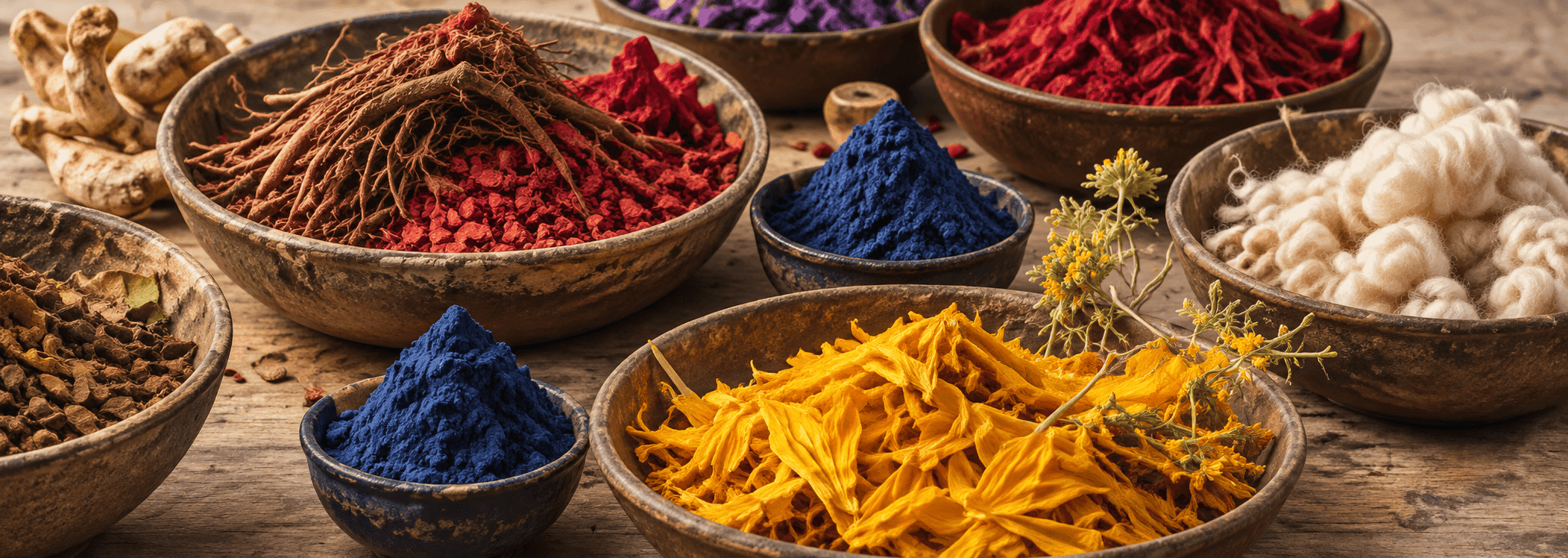
6.1. Traditional Natural Dyes
Traditional Kashan carpet dyeing used a variety of natural materials.
Among the most important are:
- Madder root, used for red and related shades
- Walnut husks and skins, used for brown tones
- Pomegranate skins, used for warm yellow and related shades
- Vine leaves, used in traditional plant-based dyeing
The final colour depends not only on the plant material but also on the dyeing process, water quality, temperature, mordants and the type of fibre being dyed.
Natural dyeing is therefore a specialised craft requiring considerable practical knowledge.
6.2. Lac Red: A Classic Kashan Colour
One of the most recognisable colours in traditional Kashan carpets is Lac red.
This deep, warm red has been widely used in classical Persian carpet design.
Combined with navy blue, ivory and golden shades, it creates a strong but balanced visual composition.
Many historical Mohtasham carpets are particularly admired for their rich and sophisticated colour combinations.
6.3. The Modern Shift Towards Lighter Colours
In more recent decades, Kashan carpet production has increasingly responded to changing interior design preferences.
Cream, beige, ivory, light brown and softer neutral shades have become more common.
These colours are especially attractive to buyers who prefer contemporary European interiors, where natural wood, light walls and understated furniture are frequently used.
The shift from traditional red and navy combinations towards lighter palettes reflects changes in market demand rather than the disappearance of the older artistic tradition.
7. Kashan Carpet Designs and Motifs
The design tradition of Kashan carpets is one of the most important elements of their identity.
Historically, Kashan rugs have featured a wide range of patterns, from elaborate medallion compositions to hunting scenes, floral arrangements, prayer designs and decorative motifs.
Although modern production is more concentrated around a smaller number of popular designs, the historical repertoire remains extensive.
7.1. The Lattice and Medallion Design (Lachak-o-Toranj)
The Lachak-o-Toranj design is one of the most recognised patterns in Kashan carpets.
It consists of three principal elements:
Toranj – The Central Medallion
The Toranj is the main decorative element, usually placed in the centre of the carpet.
It may be circular, oval, diamond-shaped or star-like.
Lachak – The Corner Elements
The Lachak motifs are decorative quarter-medallions positioned in the four corners of the field.
They are often designed to complement the central medallion.
The Field
The remaining background is filled with floral motifs, leaves, branches and other ornamental elements.
This design creates a strong sense of symmetry and balance.
It is particularly suitable for formal living rooms and traditional interiors, where the central medallion can act as a visual focal point.
7.2. Afshan Design: A Continuous Floral Composition
The Afshan pattern is another important design in Kashan carpet production.
Unlike the medallion design, Afshan usually does not have a dominant central medallion.
Instead, flowers, leaves and curved branches spread throughout the carpet's field.
The motifs are connected through flowing stems, creating a continuous and harmonious composition.
Shah Abbasi flowers and Khatai motifs are frequently used in these designs.
Afshan carpets are particularly attractive to buyers who prefer a more evenly distributed decorative pattern rather than a strong central focal point.
7.3. The Prayer-Niche Design (Mihrabi)
The Mihrabi design takes inspiration from the architectural form of the prayer niche found in mosques.
Its main feature is an arch-shaped composition, usually positioned at one end of the carpet.
The interior of the niche may contain flowers, vases, trees, hanging lamps or other decorative elements.
Some Kashan prayer rugs are relatively simple, while others contain elaborate floral arrangements and detailed borders.
The design reflects the long relationship between Persian carpet art and Islamic architectural decoration.
7.4. Vase and Haj Khanomi Designs
Vase designs are among the traditional decorative forms found in Kashan carpets.
A central vase may be placed at the lower part of the field, with flowering branches extending upwards and across the composition.
These designs can be relatively simple or highly detailed.
One particularly interesting design name in Kashan's weaving tradition is Haj Khanomi.
According to the specialist source provided by Mohammad Hossein Bidabadi, this design is associated with the work of Mohammad Dabir al-Sanae.
The same source also identifies Mina Khanomi and Zill al-Sultan as designs associated with his work.
These names are part of the specialised vocabulary of Kashan carpet design and deserve further documentation through surviving examples and workshop records.
7.5. Gol-Farang: European Floral Influence in Persian Carpet Design
Gol-Farang, literally referring to foreign or European-style flowers, is an interesting example of artistic exchange between Iran and Europe.
In these designs, more naturalistic flowers are incorporated into traditional Persian compositions.
Roses, irises, daffodils and other floral forms appear alongside Persian scrolls, leaves and decorative branches.
Sometimes these flowers are placed within a classical medallion design. In other examples, they form part of a continuous floral field.
The Gol-Farang tradition demonstrates that Persian carpet design has never been completely isolated from international artistic influences.
Instead, it has repeatedly adapted and incorporated new visual ideas while maintaining its own decorative language.
7.6. Hunting Scenes and Animal Motifs
Some historical Kashan carpets feature hunting scenes, horsemen, birds and animals.
These designs are particularly associated with the sophisticated artistic environment of the Safavid period.
Hunting imagery was widely used in Persian court art and could represent power, prestige, nature and royal culture.
In these carpets, animals are often placed among flowering plants and decorative trees.
Such examples demonstrate that Kashan's carpet tradition is much broader than the familiar floral medallion designs.
7.7. Shah Abbasi, Khatai and Eslimi Motifs
Several decorative motifs are central to the visual language of Kashan carpets.
Shah Abbasi Flowers
These stylised flowers are among the best-known motifs in Persian decorative art. They are commonly used in floral medallions and repeating compositions.
Khatai Motifs
Khatai refers to a family of floral elements, leaves and stems arranged in flowing decorative patterns.
Eslimi or Arabesque Motifs
Eslimi designs consist of curved, interconnected branches and scrolling lines.
They help connect flowers and other decorative elements into a continuous composition.
The combination of these motifs gives many Kashan carpets their distinctive floral richness and balanced appearance.
8. Four Major Artistic Phases in Kashan Carpet Design
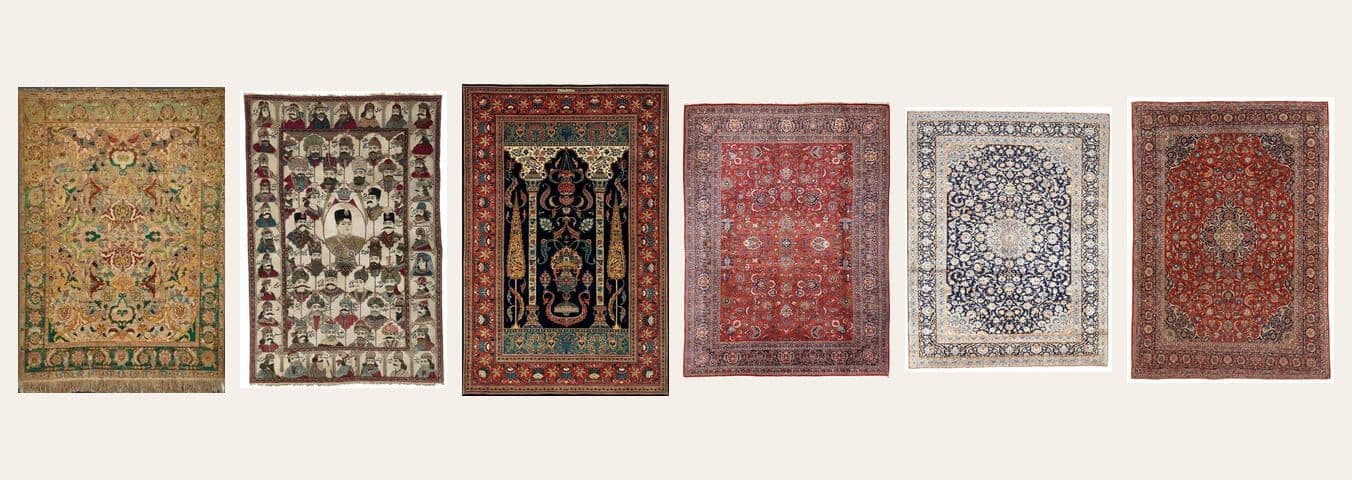
The design history of Kashan carpets can be understood through four broad artistic phases.
These categories are a useful framework for understanding stylistic development, although their dates overlap and should not be treated as rigid historical boundaries.
Phase One: The Classical Safavid Style
The Safavid period established an important foundation for the artistic identity of Kashan carpets.
Characteristics included:
- Elaborate Eslimi and Khatai designs
- Complex floral compositions
- Central medallions
- Silk and metallic threads in luxury examples
- Large-format carpets
- Highly detailed borders
The Ardabil Carpet and the historical silk carpet groups associated with Kashan are important references for understanding this artistic environment.
Phase Two: The Angular and Broken-Branch Style of the Qajar Period
During the Qajar era, certain Kashan designs developed more angular and geometric characteristics.
Features of some examples included:
- Diamond-shaped medallions
- Thick decorative branches
- Larger floral motifs
- More angular compositions
- The integration of traditional Persian and European floral elements
- Rich colours such as burgundy, copper, cream and dark blue
The Mohtasham workshop tradition, together with other important Kashan producers, contributed to the development of this period.
Phase Three: The Integration of Classical Persian and Gol-Farang Designs
In this phase, traditional Persian patterns increasingly incorporated naturalistic European-style flowers.
The designs became more elaborate, with:
- Flowing stems and branches
- Roses, irises and daffodils
- Fruit-bearing branches
- Birds and animals
- Vase and tree compositions
- Decorative inscriptions and detailed borders
- More complex floral arrangements
Some carpets also incorporated architectural and pictorial elements inspired by historical buildings and monuments.
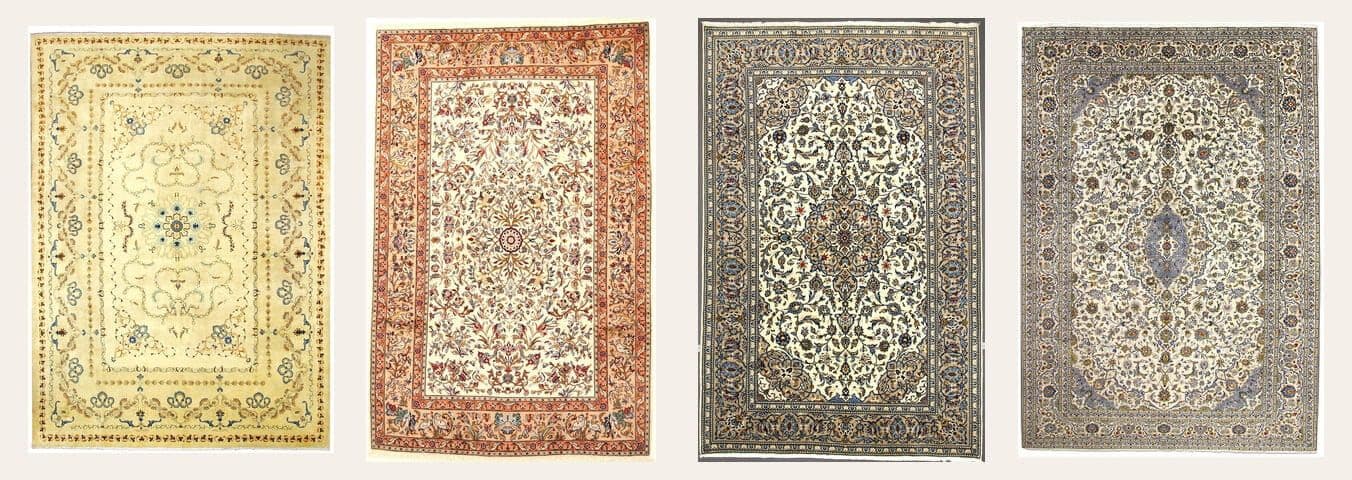
Phase Four: The Classical Revival in Modern Production
During the later Pahlavi period and subsequent decades, classical Kashan designs continued to develop.
Designers maintained the traditional medallion and Afshan compositions while introducing finer branches, more delicate flowers and lighter colour combinations.
The influence of Isfahan's design tradition also became visible in some examples.
Rounder medallions, star-shaped central elements and lighter cream backgrounds became increasingly popular.
Modern production continues to combine traditional compositions with changing market preferences.
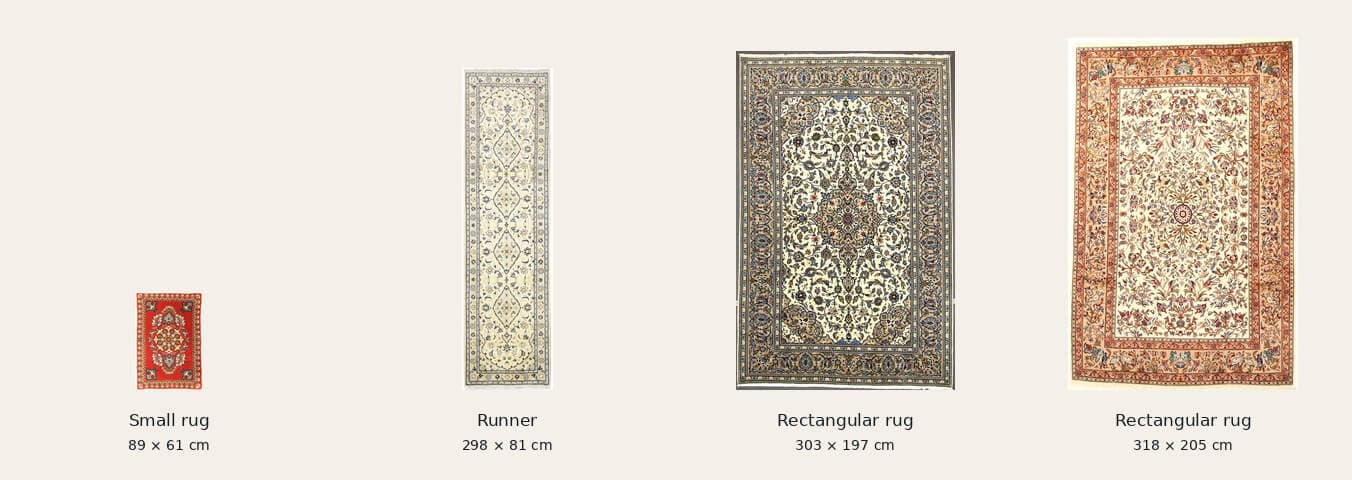
9. Carpet Sizes and Formats in Kashan
Kashan carpets are traditionally produced in a variety of rectangular sizes.
Unlike some other weaving traditions, round, oval and polygonal carpets are not typical formats in the Kashan tradition. Square carpets are also relatively uncommon.
Common formats include:
- Small rugs and accent carpets
- Zaro-Nim and other traditional Persian sizes
- Approximately 6-square-metre carpets
- Approximately 9-square-metre carpets
- Approximately 12-square-metre carpets
- Long runners
- Cushion covers and small decorative pieces
- Large-format carpets, sometimes reaching approximately 40 square metres
For international buyers, dimensions should always be provided in centimetres or metres.
The traditional Iranian size names are useful for understanding local trade terminology, but they should not replace exact measurements when purchasing a rug.
10. Designers, Master Weavers and Important Names in Kashan
The history of Kashan carpets is not simply the history of workshops and weaving techniques.
It is also the story of designers, painters, master weavers and families whose skills shaped the region's artistic identity.
Several important names appear in the specialist history of Kashan carpet production.
Among the producers and workshop figures mentioned in the source material are:
- Haji Mollah Hassan Mohtasham
- Mohammad Taghi Poshtibaf
- Mir Alavi
- Mohammad Ali Farshchi
- Mohammad Toqloki
- Mohammad Hassan Samsar
- Arbab Hassan Tafazzoli
- The Ataei family
- The Esfahanians
Among the designers and painters are:
- Seyyed Reza Sanei
- Mirza Nasrollah Naqqashzadeh
- Mohammad Afsari
- Nezam Afsari
- Abbas Sanei
- Hossein Sabet
- Frouzan
- Ismail Khan Tehrani
- The Kahkeshani brothers
- Abed
- Eshqi Golbaz
These names represent different generations and areas of expertise, and their contributions should be understood within the broader development of Kashan's weaving workshops.
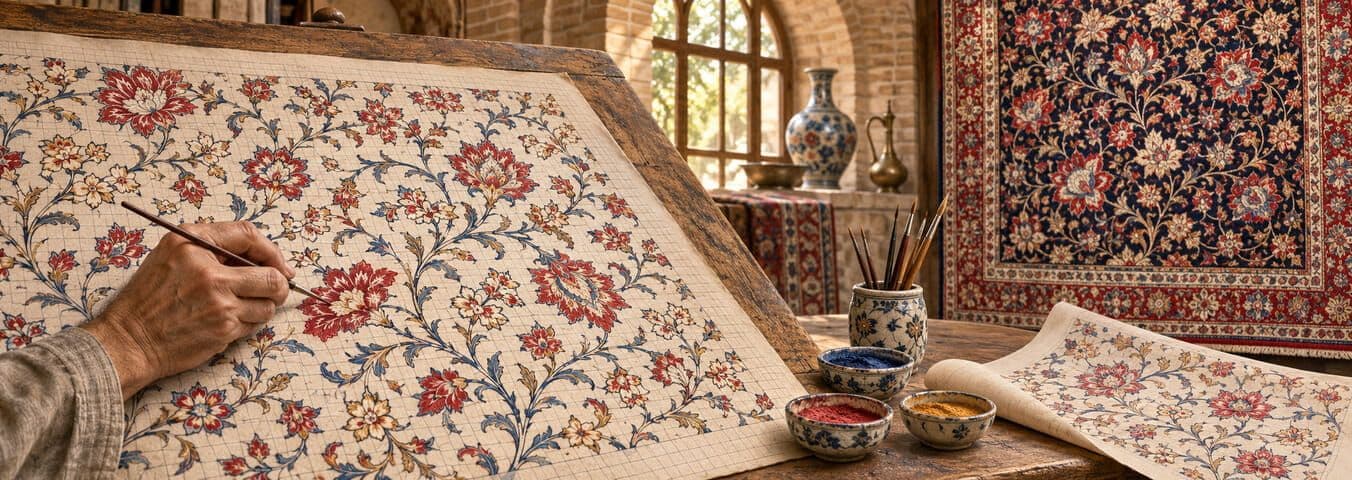
10.1. Mohammad Dabir al-Sanae
Mohammad Dabir al-Sanae was an important carpet designer and painter associated with Kashan.
According to the specialist account provided by Mohammad Hossein Bidabadi, his original name was Agha Mohammad, also known as Farshchi.
He became particularly associated with the promotion of continuous floral and Afshan designs.
His work is also linked in the source material to the Haj Khanomi, Mina Khanomi and Zill al-Sultan patterns.
The title Dabir al-Sanae was reportedly awarded in recognition of his contribution to the production of fine carpets for Saadabad Palace.
10.2. Seyyed Amir Hossein Afsari
Seyyed Amir Hossein Afsari was born in Kashan in 1935 into a family with a strong artistic background.
He developed his skills in carpet drawing, painting and weaving from an early age, influenced by his mother Farrokh-Lagha and other members of the Afsari family.
He became known for his technical knowledge and artistic abilities.
According to the biographical material supplied by Mohammad Hossein Bidabadi, Afsari received national recognition for his carpet-weaving expertise during the 1960s.
He was also involved in a state-supported project to reproduce the Pazyryk carpet, with reproductions subsequently presented as gifts to international dignitaries.
His artistic work included pictorial carpets inspired by figures such as Avicenna and Ferdowsi, as well as experimental compositions combining ancient Iranian visual elements with traditional Kashan design.
The Afsari family became particularly well known for fine commissioned carpets and pictorial weaving.
11. Kashan Carpet Weaving and UNESCO Intangible Cultural Heritage
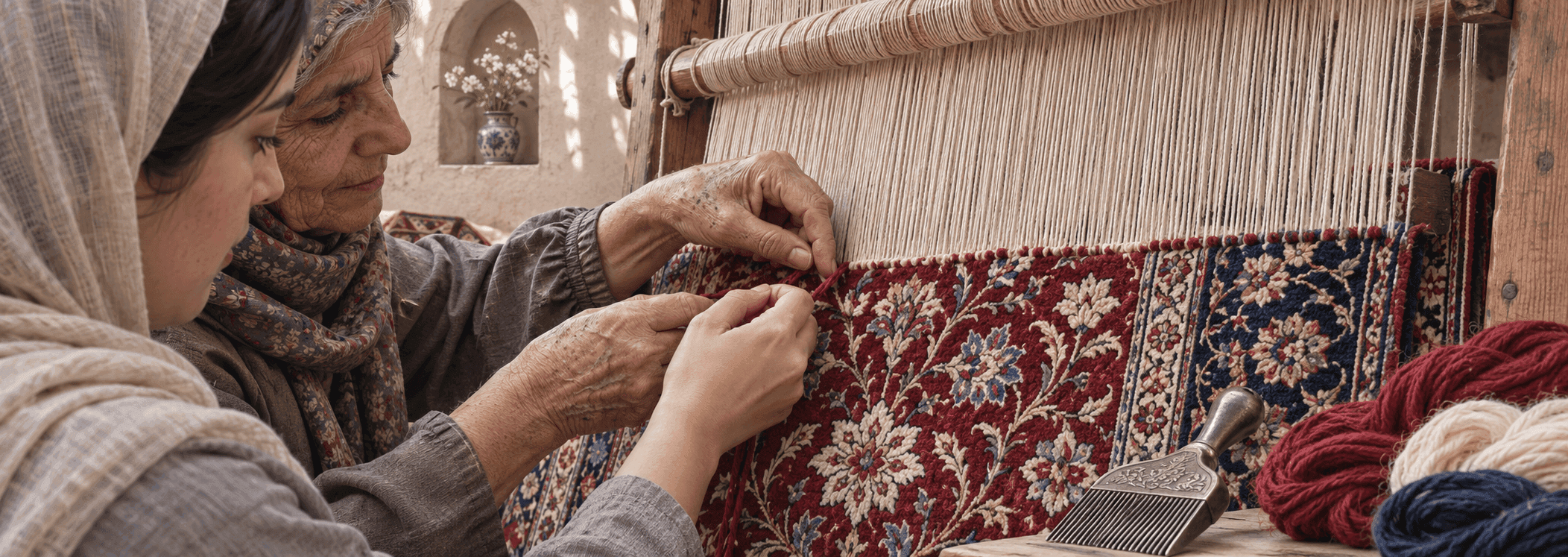
In 2010, the traditional skills of carpet weaving in Kashan were inscribed on UNESCO's Representative List of the Intangible Cultural Heritage of Humanity.
This recognition is important because it focuses not simply on the carpets themselves but on the knowledge and skills involved in producing them.
UNESCO highlights several aspects of the Kashan tradition:
- The use of the Persian asymmetrical knot
- Traditional loom construction
- Cotton and silk foundations
- Wool and silk pile materials
- Traditional natural dyeing
- The use of a comb to compress the woven rows
- The transmission of skills between generations
One particularly important aspect is the role of women in preserving the weaving tradition.
Many women learned carpet weaving from their mothers and grandmothers, passing their knowledge to younger generations through practical training.
Men have also traditionally contributed to related activities such as design, dyeing, wool preparation, loom construction and tool-making.
The UNESCO recognition therefore celebrates a living cultural tradition rather than simply a historical product.
12. Kashan vs Isfahan vs Nain: What Are the Differences?
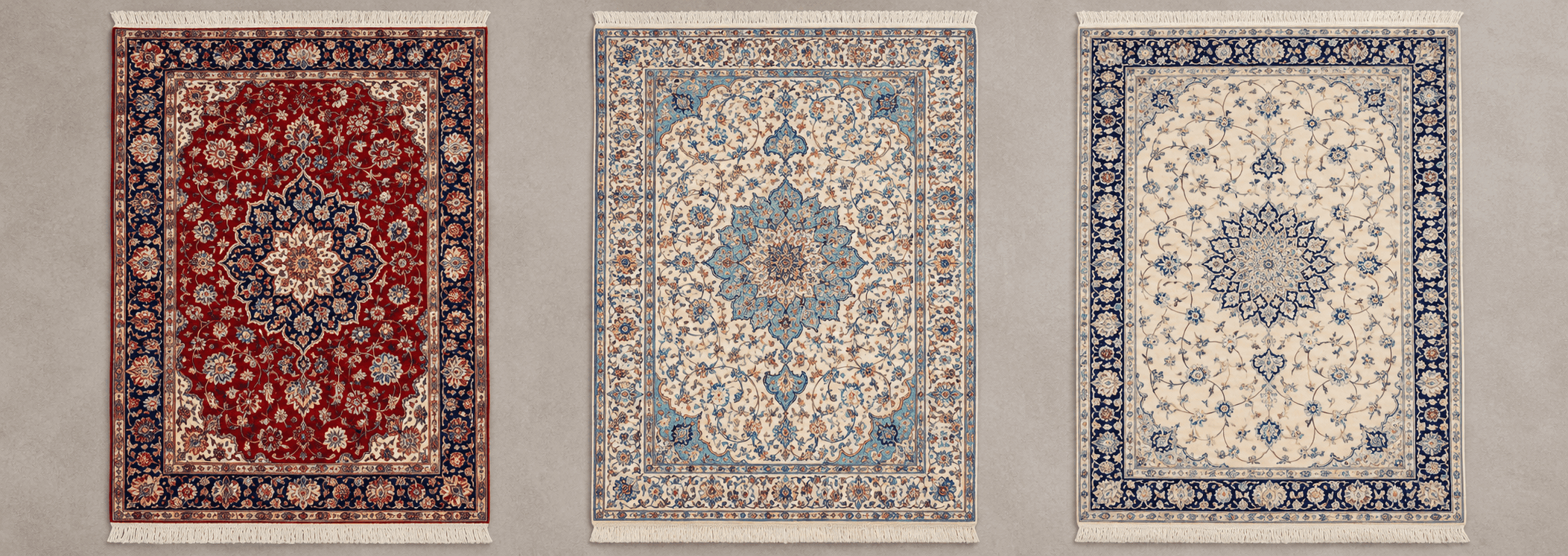
For many international buyers, Persian carpets from Kashan, Isfahan and Nain may appear similar at first glance.
All three regions are known for refined urban carpet weaving, floral designs and sophisticated compositions.
There are many exceptions, particularly among antique and individually commissioned carpets.
How can you recognise the differences?
Kashan carpets often feature rich floral compositions, strong medallions and warmer colour combinations.
Isfahan carpets are frequently admired for their highly refined drawing, intricate Eslimi patterns and precise symmetry.
Nain carpets are often recognised by their lighter backgrounds, delicate floral details and restrained blue and ivory palettes.
A reliable identification should also consider the back of the carpet, knot structure, foundation materials, weaving density, finishing and documented origin.
13. How to Choose a Good Kashan Rug
Buying a handmade Kashan rug should involve more than choosing a beautiful colour or pattern.
The buyer should consider the carpet's materials, construction, design, condition and suitability for the intended space.
Here are some important points to consider:
1. Examine the reverse side
The back of a handmade carpet reveals important information about the knotting, regularity and weaving structure.
2. Check the materials
Ask whether the pile is wool, silk or a combination of both. The warp and weft materials should also be clearly identified.
3. Assess the colours
Look for harmonious colours and good dye quality. Natural dyes may be present in older or traditionally produced carpets, but this should not be assumed without evidence.
4. Consider the design
Choose a medallion, Afshan or floral design according to the style and proportions of your room.
5. Check the condition
Examine the pile, edges, fringes and foundation for damage, repairs, moth activity or signs of moisture.
6. Ask about the place of manufacture
A carpet with a Kashan-style design is not necessarily woven in Kashan. Ask the seller to clarify its actual origin.
A knowledgeable seller should be able to explain the carpet's construction and provide honest information about its age, materials and condition.
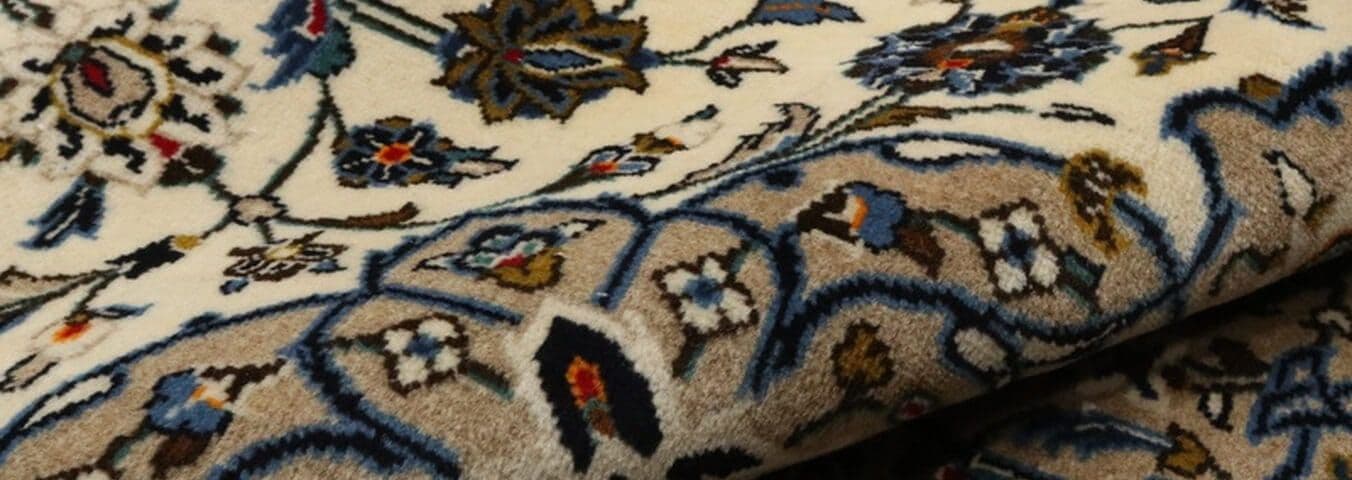
14. Why Kashan Rugs Work So Well in European Interiors
One of the great advantages of Kashan carpets is their ability to complement different interior styles.
Their range of colours, sizes and patterns makes them suitable for both traditional and contemporary homes.
Classic interiors
A deep red Kashan rug with a navy border can add warmth and character to a room with traditional furniture and wooden details.
Neoclassical interiors
A cream or beige medallion carpet can create an elegant connection between classical architecture and modern furnishings.
Contemporary interiors
Lighter Kashan rugs with delicate floral details can introduce texture and craftsmanship without overwhelming a minimalist space.
Eclectic interiors
A historical Persian carpet can create an interesting contrast with modern furniture, simple lighting and contemporary artwork.
A handmade rug also brings something that many mass-produced decorative products cannot offer: individual character.
Small variations in colour, texture and weaving are part of the nature of handmade production.
A well-made Kashan carpet can remain an important part of a home for generations.
Conclusion: Kashan Rugs – A Living Tradition of Persian Art
Kashan carpets represent one of the most distinguished traditions of urban carpet weaving in Iran.
Their history connects the luxury silk textiles of the Safavid period with the refined Mohtasham carpets of the Qajar era and the classical designs that continue to be produced today.
Their distinctive characteristics include Persian asymmetrical knotting, traditional two-weft construction, carefully selected wool and silk, rich colours and sophisticated floral compositions.
Designs such as Lachak-o-Toranj, Afshan, Mihrabi, Gol-Farang and Vase patterns reveal the artistic diversity of this tradition.
But the true value of a Kashan carpet goes beyond its technical features or decorative appearance.
Each handmade carpet represents a combination of knowledge, experience and craftsmanship passed from one generation to another.
For European collectors and homeowners, choosing a Kashan rug means bringing a piece of Persian artistic heritage into everyday life.
It is not simply a decorative object. It is a handmade work of art with a history, a cultural identity and a character of its own.
Frequently Asked Questions About Kashan Rugs
1. What is a Kashan rug?
A Kashan rug is a traditional Persian handmade carpet associated with the city of Kashan in central Iran. It is known for floral designs, medallion compositions, fine weaving and rich colours.
2. What is special about Kashan carpets?
Kashan carpets are particularly recognised for their Persian asymmetrical knots, traditional two-weft construction, refined floral patterns and the use of high-quality wool, cotton and silk.
3. What is a Mohtasham Kashan carpet?
Mohtasham refers to a distinguished group of historical Kashan carpets, particularly associated with the late nineteenth and early twentieth centuries. They are admired for their fine weaving, elaborate patterns and luxurious materials.
4. Are Kashan rugs made of wool or silk?
Most traditional Kashan rugs use wool for the pile and cotton for the foundation. Silk is also used in finer carpets, decorative details and some historical examples.
5. What knot is used in Kashan carpets?
The traditional Kashan technique uses the Persian or asymmetrical knot, also known as the Farsi knot.
6. What does two-weft mean in a Kashan rug?
It means that two horizontal weft threads of different thicknesses are inserted after each row of knots. This traditional construction helps secure the knots and create a firm carpet structure.
7. What colours are typical of Kashan rugs?
Traditional Kashan rugs often feature lac red, navy blue, ivory, cream and warm brown. Contemporary examples also use beige and other lighter neutral shades.
8. How can I distinguish a Kashan rug from an Isfahan or Nain rug?
Kashan rugs are often recognised by their warm colours and classical floral designs. Isfahan rugs are frequently more intricate in their drawing, while Nain carpets are often characterised by lighter backgrounds and delicate blue and ivory patterns. Technical inspection is necessary for reliable identification.
9. Are Kashan rugs suitable for modern homes?
Yes. Their variety of colours and patterns makes them suitable for classic, neoclassical, contemporary and eclectic interiors.
10. Are Kashan carpets recognised by UNESCO?
Yes. The traditional skills of carpet weaving in Kashan were inscribed on UNESCO's Representative List of the Intangible Cultural Heritage of Humanity in 2010.
References and Further Reading
The following sources provide historical, technical and museum-based information relevant to Kashan carpets.
Primary Specialist Source
Bidabadi, Mohammad Hossein.Kashan Carpet (قالی کاشان). Specialist Persian-language research and educational article supplied by the author.
This source provides detailed information on the geography of the Kashan weaving region, local carpet terminology, weaving techniques, design classifications, historical workshops, designers and master weavers.
Academic and Institutional References
- UNESCO. Traditional Skills of Carpet Weaving in Kashan. Inscribed in 2010 on the Representative List of the Intangible Cultural Heritage of Humanity.
https://ich.unesco.org/en/RL/traditional-skills-of-carpet-weaving-in-kashan-00383 - UNESCO. Nomination File No. 00383: Traditional Skills of Carpet Weaving in Kashan. Technical documentation describing the two-weft construction, Persian knotting and traditional tools.
https://ich.unesco.org/doc/src/07476-EN.pdf - Encyclopaedia Iranica. Carpets: Safavid Period. Historical study of Persian carpets during the Safavid dynasty.
https://www.iranicaonline.org/articles/carpets-ix/ - Encyclopaedia Iranica. Carpets: Techniques and Structures. Academic reference on knotting methods, warp, weft and carpet construction.
https://www.iranicaonline.org/articles/carpets-iii/ - Encyclopaedia Iranica. Knotted-Pile Carpets: Designs, Motifs, and Patterns. Reference on Persian carpet design terminology and decorative compositions.
https://www.iranicaonline.org/articles/carpets-iv/ - Fondazione Cerruti. Kashan Carpet. Museum documentation discussing nineteenth-century Kashan carpets and the Mohtasham group.
https://fondazionecerruti.org/en/artworks/tappeto-kashan-2 - Victoria and Albert Museum. The Ardabil Carpet. Museum reference for the celebrated Safavid carpet dated 1539–1540.
- Christie's. A Mohtasham Kashan Carpet, Central Persia, Late 19th Century. Historical and technical discussion of the Mohtasham tradition.
About the Specialist Source
The Persian specialist article Kashan Carpet was written by Mohammad Hossein Bidabadi, an Iranian handmade carpet specialist, university lecturer and holder of an M.A. in Handmade Carpet Management and Marketing from the University of Kashan.
His research and professional experience in Persian carpet history, regional weaving traditions, design and marketing contribute to the specialist foundation of this article.