
Goat Hair in Iranian Nomadic Rugs: The Traditional Wisdom Behind a Remarkable Natural Fibre
When people think of traditional Persian rugs, sheep’s wool and silk usually come to mind. Yet the history of Iranian weaving includes another, less familiar natural material: goat hair.
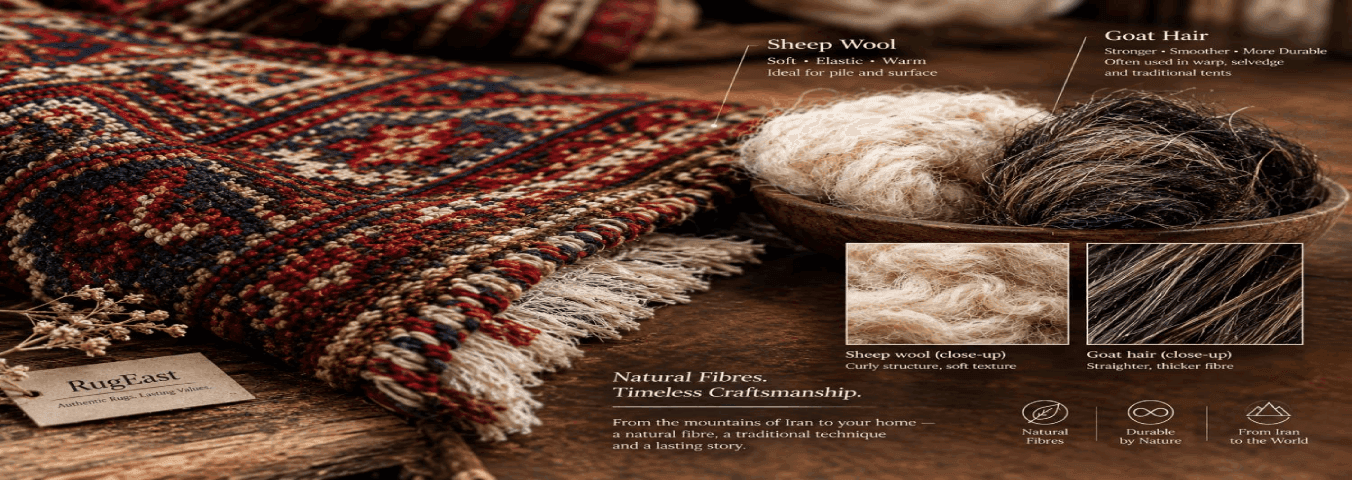
Why did Iranian nomads use goat hair in rugs, woven textiles and traditional black tents?
When people think of traditional Persian rugs, sheep’s wool and silk usually come to mind. Yet the history of Iranian weaving includes another, less familiar natural material: goat hair.
For centuries, some Iranian nomadic communities used goat hair in practical textiles, including parts of handmade rugs, flatwoven fabrics and the distinctive black tents that served as their homes during seasonal migrations.
At first, this may seem surprising. Why would weavers choose a relatively coarse fibre when soft sheep’s wool was available? And what made goat hair suitable for both the structure of certain rugs and the construction of traditional tent coverings?
The answer lies in the relationship between materials, craftsmanship and everyday life. Nomadic weavers did not select fibres only for their appearance or softness. They also considered how a material would perform in a particular part of a textile.
Today, historical sources and modern textile research offer an opportunity to explore this traditional knowledge more closely.
In this article, we look at the characteristics of goat hair, its documented uses in Iranian weaving, its role in traditional black tents and what modern research can—and cannot—tell us about this remarkable natural fibre.
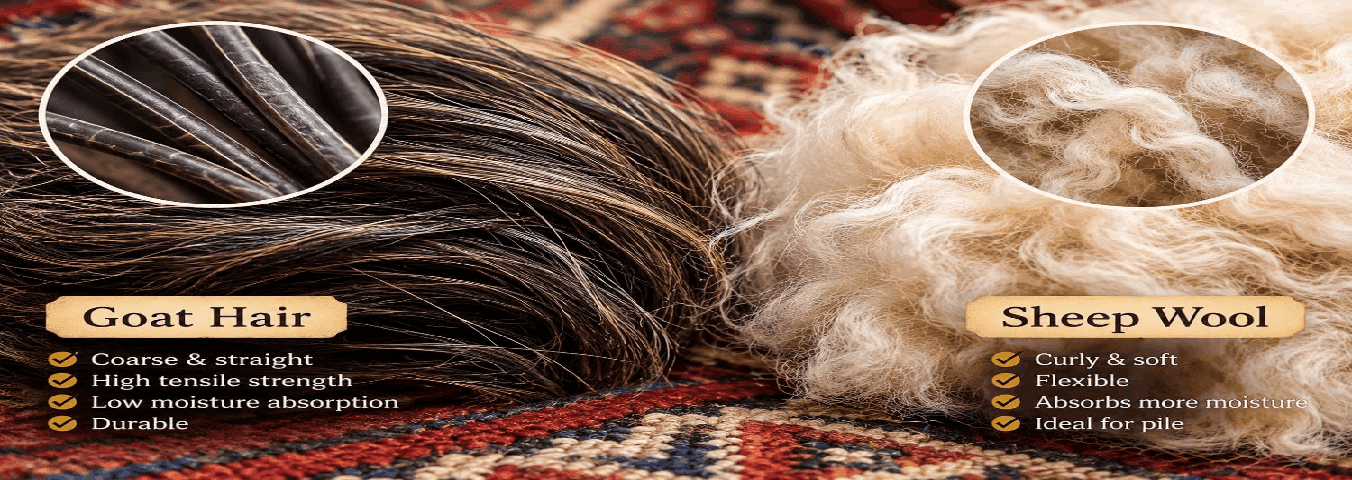
1. Goat Hair and Sheep’s Wool: What Is the Difference?
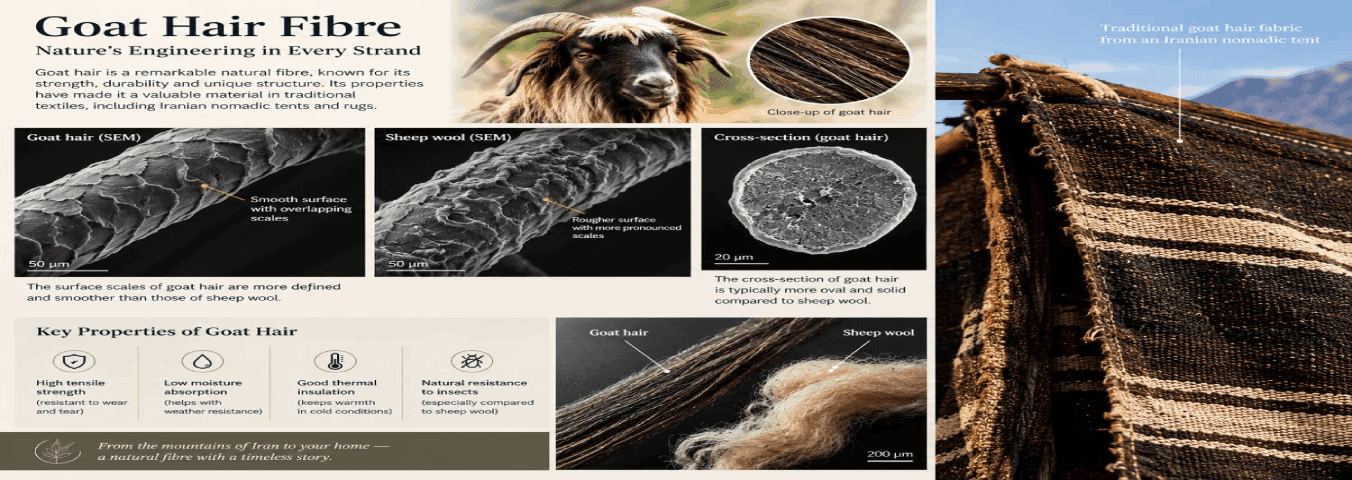
Goat hair and sheep’s wool are both animal-derived natural fibres, but they are not identical. Their characteristics vary according to the animal breed, the part of the fleece from which the fibre comes, and the way it has been processed.
Many goats produce two distinct types of hair:
- The fine undercoat: A soft layer beneath the outer coat. In certain goat breeds, it produces valuable fibres such as cashmere.
- The outer guard hair: Generally coarser, longer and straighter than the undercoat. This is the type more relevant to many traditional applications of goat hair.
It is important not to confuse ordinary coarse goat hair with cashmere or mohair. Cashmere comes from the fine undercoat of particular goats, while mohair is produced by Angora goats. These are specialised textile fibres with different qualities and uses.
Sheep’s wool also varies considerably. Depending on the breed, it can range from fine and soft to relatively coarse and strong.
For traditional weavers, the choice was therefore not simply between two materials. It was about selecting the appropriate fibre for the intended purpose.
Goat hair and sheep’s wool at a glance
Neither fibre is universally stronger or better than the other. Their performance depends on the specific material and how it is used.
2. Why Did Nomadic Weavers Use Goat Hair?
To understand the use of goat hair, it helps to consider the practical demands of nomadic life.
For communities that moved seasonally, textiles were not simply decorative objects. They were part of a wider system of everyday equipment: floor coverings, storage bags, transport textiles, tent fabrics and household furnishings.
Materials had to be selected with practical needs in mind. Some parts of a textile required softness, while others needed to withstand tension, handling or repeated use.
Goat hair offered another option within the range of fibres available to local communities.
Its use was not universal, and it should not be assumed that all Iranian nomadic rugs contain goat hair. Instead, historical evidence points to particular applications in certain weaving traditions.
The important lesson is that traditional weavers understood that different parts of a textile could benefit from different materials.
This practical approach is one of the most interesting aspects of traditional Iranian weaving.
3. Goat Hair in the Structure of Iranian Nomadic Rugs
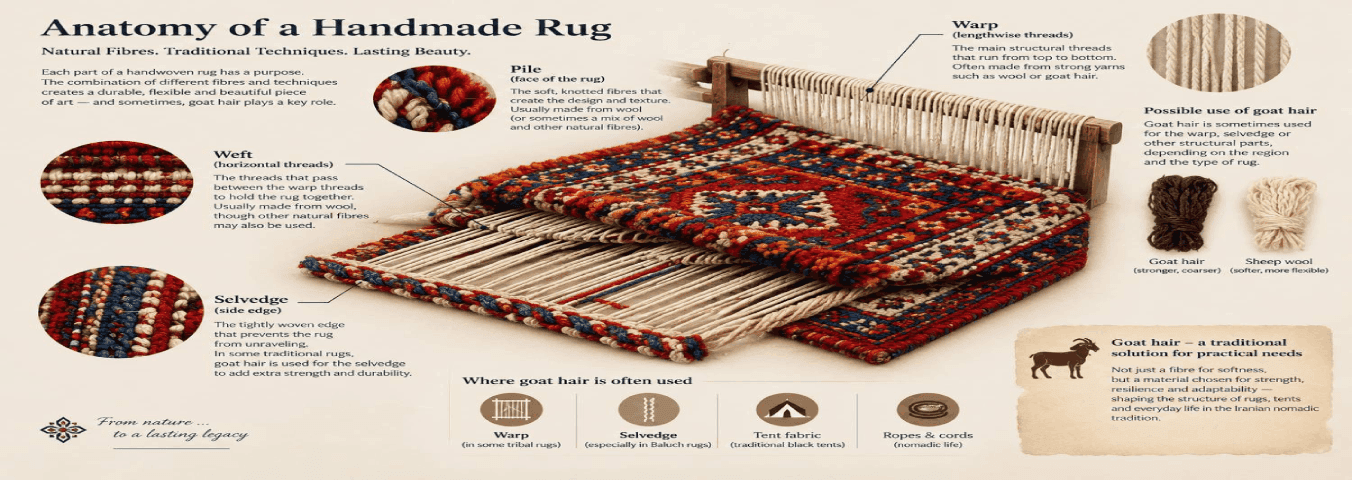
A handmade rug is more than its visible surface. Beneath the pattern lies a structure made from several interconnected elements.
The main components include:
- Warp: The lengthwise foundation threads running through the rug.
- Weft: The crosswise threads passed through the warp.
- Pile: The visible surface formed by knots in pile rugs.
- Selvedge: The finished side edges that help protect the rug’s structure.
Historical descriptions of Iranian carpets record the use of goat hair in some of these structural applications.
Goat hair in rug warps
The warp forms the foundation of a woven or knotted rug. In some Iranian tribal weaving traditions, goat hair was used for warp threads, sometimes mixed with coarse sheep’s wool.
The choice of material for the warp is different from the choice of material for the pile. The warp is part of the rug’s underlying construction, so softness and visual appearance are not necessarily its primary requirements.
The use of goat hair in this part of certain rugs illustrates how traditional weavers selected materials according to function.
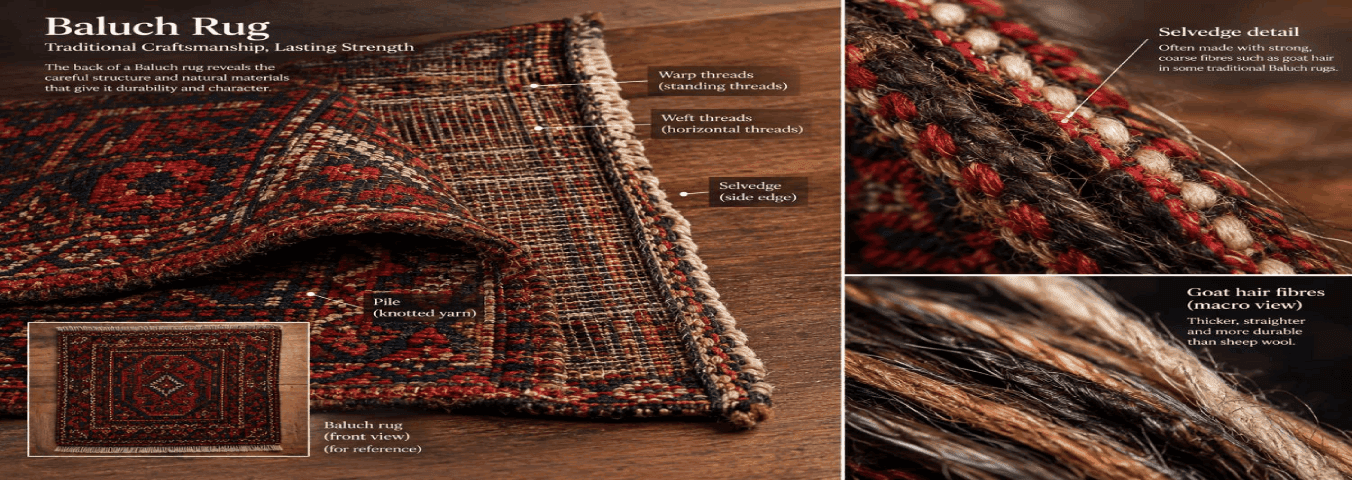
Goat hair in Baluch rug selvedges
Another documented application is the use of goat hair in the selvedges of some coarser Baluch rugs.
The selvedge is the finished edge running along the sides of a rug. It helps secure the construction and protects the side of the textile from wear and unravelling.
The Encyclopaedia Iranica entry on carpet raw materials and dyes specifically mentions goat hair in connection with the warps of some tribal carpets and the selvedges of certain coarser Baluch rugs.
This is an important historical detail, but it needs to be understood precisely: not every Baluch rug has goat-hair selvedges, and not every tribal rug contains goat hair.
The materials used in a rug depend on its region, weaving tradition, intended purpose and the resources available to its makers.
4. Iranian Black Tents: Another Remarkable Use of Goat Hair
Perhaps the best-known traditional application of goat hair in some Iranian nomadic communities is the construction of the black tent.
Known in different regions by local names, these tents were an important form of mobile architecture. They provided shelter while allowing families to move with their livestock and belongings as the seasons changed.
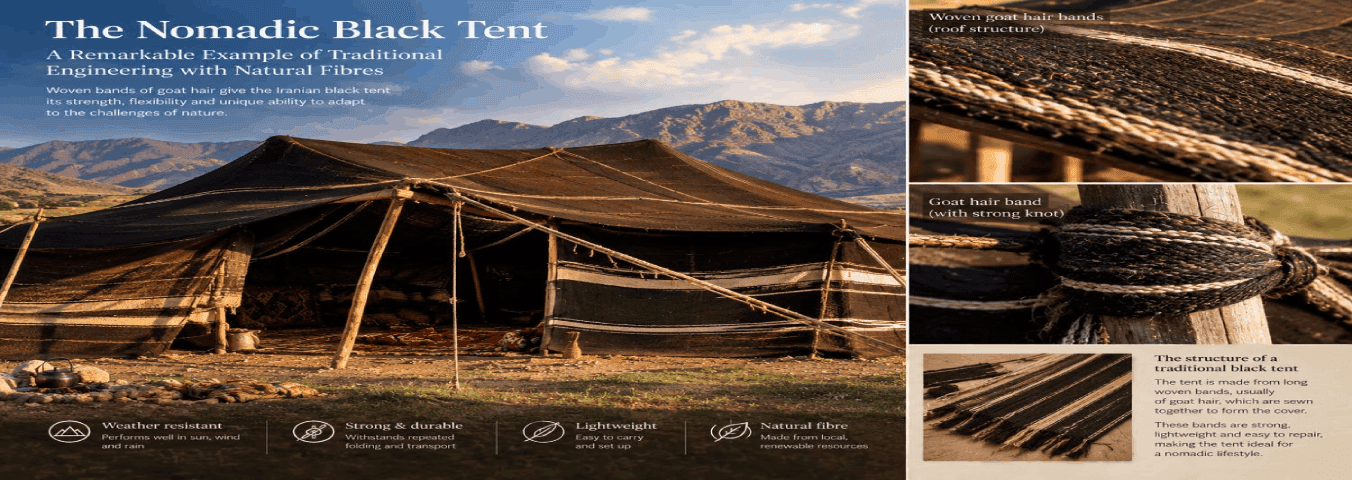
Historical and ethnographic sources describe black tents in Iran and neighbouring regions as being made from long woven strips of goat hair, which were sewn together to create a larger covering.
This construction method is particularly interesting because it turns a relatively simple natural fibre into a large, functional architectural textile.
The tent covering was not a single piece of fabric. It was assembled from woven bands, and its overall performance depended on the material, the weaving structure, the stitching and the way the tent was erected.
Why was goat hair suitable for tent fabrics?
Several factors help explain its traditional use:
- Goat hair could be spun and woven into strips suitable for tent construction.
- Coarser fibres were appropriate for certain practical textile applications.
- Woven strips could be joined to create a larger covering.
- The material was available within the livestock-based economy of many nomadic communities.
The effectiveness of a traditional tent, however, cannot be explained by fibre alone. Yarn construction, weave density, seams, roof shape, slope and local weather conditions all played a role.
5. Were Goat-Hair Black Tents Waterproof?
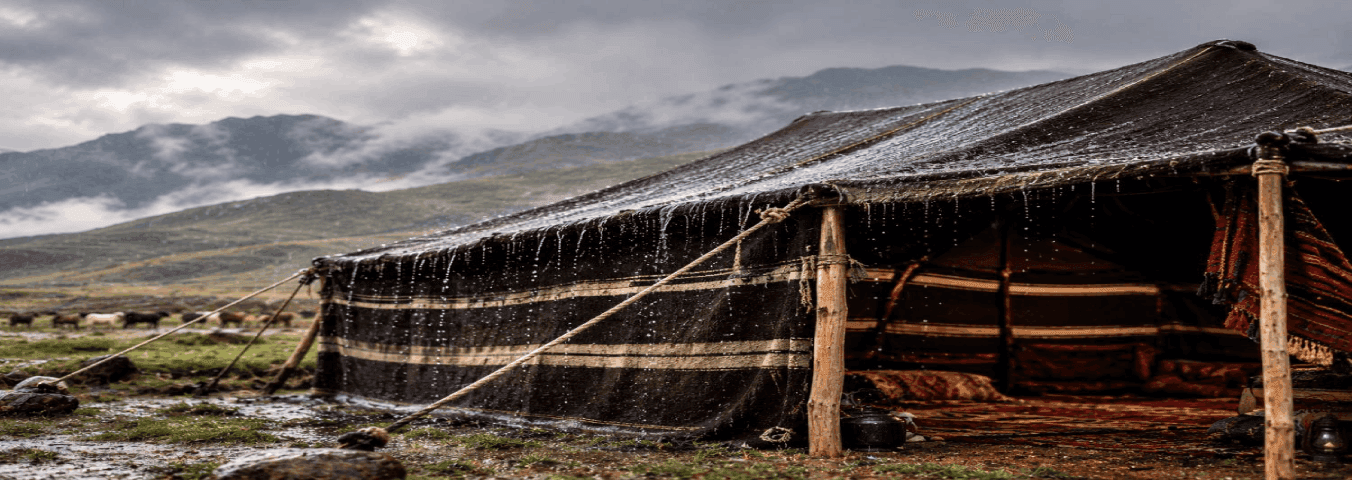
One of the most interesting questions about traditional goat-hair tents concerns their behaviour in wet weather.
A popular explanation claims that goat hair absorbs moisture, swells and closes the gaps between the fibres, making the tent completely waterproof.
This explanation is too simple and should not be presented as an established scientific fact.
The resistance of a woven textile to rain depends on several interacting factors:
- The type and condition of the fibres.
- The twist and construction of the yarn.
- The density and structure of the weave.
- The way individual fabric strips are joined.
- The slope and shape of the roof.
- The intensity and duration of rainfall.
A woven covering may offer useful protection from rain under certain conditions without being completely waterproof.
For this reason, it is more accurate to describe traditional black tents as coverings designed to perform in outdoor conditions, with their resistance to rain depending on their construction and the environment.
This distinction matters. Traditional textiles can be remarkably functional without needing to be described in exaggerated terms.
6. What Does Modern Science Tell Us About Goat Hair?
Traditional knowledge is often based on generations of observation and practical experience. Modern textile science offers additional ways to examine the materials behind that knowledge.
In 2025, a research paper titled Unveiling the Secrets of Goat Hair: Structural and Qualitative Insights for Iranian Nomadic Black Tent was published in the Journal of Natural Fibers.
The study examines structural and qualitative characteristics of goat hair used in Iranian nomadic black-tent textiles. It considers aspects of the material’s physical and mechanical behaviour, as well as its thermal properties.
The published abstract reports a surface weight of approximately 1,588 grams per square metre for the fabric sample examined. It also discusses the mechanical and thermal characteristics of the studied material.
These findings are valuable because they bring measurable material properties into a subject that has often been discussed mainly through historical descriptions and traditional knowledge.
However, one important qualification is necessary: the results relate to the samples examined in that particular study. They should not be treated as universal measurements for every goat-hair fabric or every Iranian black tent.
The study does not automatically prove every traditional claim about goat hair. Instead, it provides a scientific starting point for understanding the material and its use in a specific textile tradition.
For readers interested in natural fibres, traditional architecture and textile engineering, this is a fascinating example of how historical materials can be investigated using modern research methods.
7. Is Goat Hair Naturally Resistant to Moths?
Another claim sometimes associated with goat hair is that it naturally repels moths because it contains sulphur.
There is a chemical fact behind this explanation: both goat hair and sheep’s wool are made primarily of keratin, a protein containing sulphur-bearing amino acids.
But the presence of sulphur in keratin does not, by itself, demonstrate that goat hair repels textile moths.
To establish such a property, controlled comparative tests would be needed. These would have to examine how different fibres respond to moth activity under comparable conditions.
Without sufficient evidence, it would be misleading to describe goat hair as naturally moth-proof.
Owners of handmade rugs should therefore follow appropriate textile-care practices regardless of whether a rug contains sheep’s wool, goat hair or a combination of fibres.
Regular inspection, suitable storage, cleanliness and the control of excessive humidity are more reliable elements of long-term textile preservation than assumptions about a fibre’s natural insect resistance.
8. Does Goat Hair Repel Snakes?
Some local stories associate goat hair with keeping snakes away from nomadic living areas.
Such stories may be interesting from an ethnographic perspective. They show how communities developed explanations and beliefs around the materials they used and the environments in which they lived.
However, the scientific sources reviewed for this article do not provide sufficient evidence that goat hair has a snake-repellent property.
It is therefore important to distinguish between a local belief and a scientifically demonstrated effect.
A traditional practice may have cultural value without every explanation attached to it being scientifically confirmed.
For a reliable account of Iranian weaving traditions, these distinctions are essential. They allow us to appreciate traditional knowledge without turning folklore into fact.
9. Goat Hair, Natural Materials and Sustainable Design
Across Europe, interest in natural materials, product longevity, responsible production and traditional craftsmanship has grown.
In this context, the use of goat hair in Iranian nomadic textiles offers more than an interesting historical detail.
It provides an example of how craftspeople selected materials according to the intended function of a product. A fibre suitable for a rug’s structural elements might not be the best choice for its visible pile. A material used for a tent covering had different requirements from one used for a soft floor textile.
This way of thinking—matching material properties to practical needs—remains relevant to textile design today.
Nevertheless, natural does not automatically mean sustainable. A proper assessment of sustainability must also consider animal husbandry, fibre processing, water and energy use, product lifespan, transport and end-of-life options.
The value of traditional weaving lies not in the assumption that every historical method was environmentally perfect, but in the practical knowledge developed through long experience.
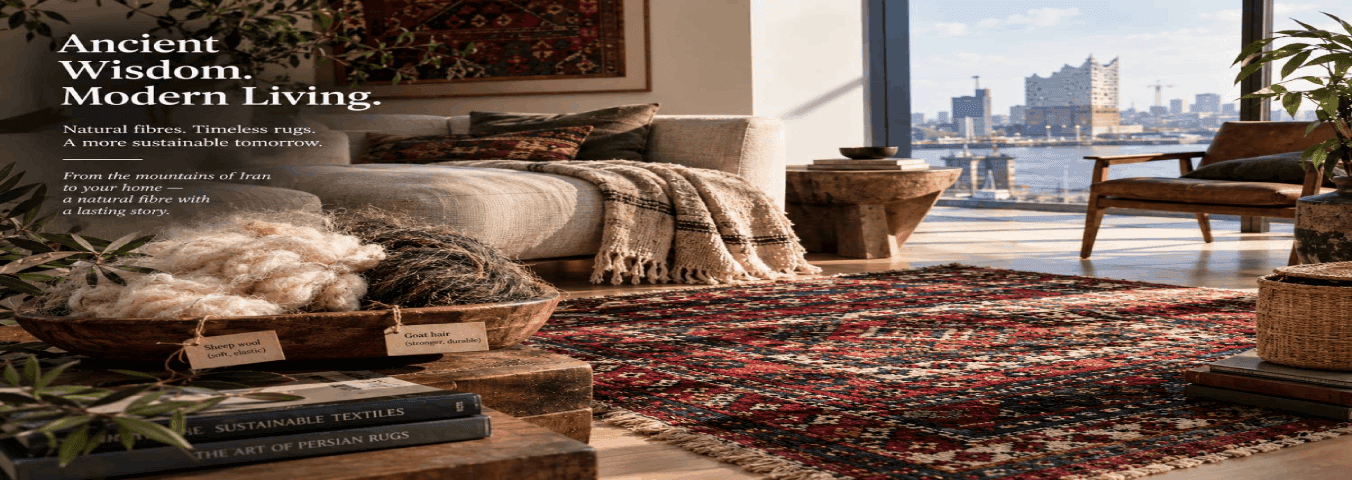
From this perspective, Iranian tribal rugs are more than decorative objects. They are also records of material knowledge, regional craftsmanship and everyday life.
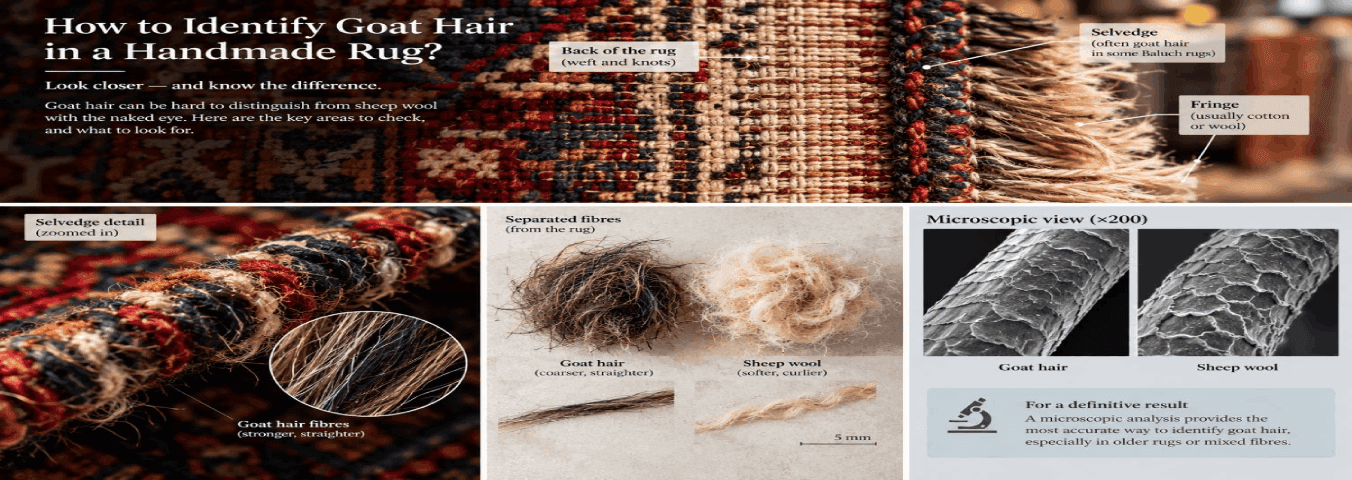
10. How Can You Identify Goat Hair in a Handmade Rug?
For collectors and enthusiasts, identifying the materials used in an older rug can be an interesting part of understanding its construction and history.
However, distinguishing goat hair from sheep’s wool by appearance alone is not always straightforward.
Some visual characteristics may offer clues. Certain types of goat guard hair can appear relatively straight and coarse, while many sheep’s wool fibres have a more pronounced natural crimp. But there is considerable variation within both groups.
A careful examination may include:
- The reverse of the rug.
- The side selvedges.
- The warp and weft, where accessible.
- Loose fibres from an existing damaged or detached area.
Even then, visual inspection cannot always provide a reliable identification. Older rugs may contain different fibres, blends or repairs carried out at different times.
For a more dependable result, microscopic examination and specialist textile analysis are preferable.
It is also important not to damage a rug by pulling out fibres or cutting threads simply to identify their material. A qualified textile specialist should be consulted when accurate identification is important.
Conclusion: A Small Fibre with a Remarkable Place in Weaving History
Goat hair has played a documented role in several Iranian nomadic textile traditions.
Its use in the warps of certain tribal rugs, the selvedges of some coarser Baluch rugs and the woven coverings of traditional black tents reveals how different materials were selected for different practical purposes.
These choices reflect generations of experience. Weavers and nomadic communities worked with the resources available to them, developing ways to turn natural fibres into objects that supported everyday life.
Modern textile research now allows us to investigate some of the physical and mechanical properties of these materials in greater detail. At the same time, careful historical research helps distinguish documented practices from claims that remain unproven.
Goat hair should not be described as universally moth-proof, snake-repellent or completely waterproof. Its real significance is already fascinating enough: it is a natural fibre with a long history of practical use in traditional Iranian textiles.
At Rugeast, we believe that understanding a handmade rug means looking beyond its pattern and colour. Every rug has a structure, a material history and a connection to the people and places that produced it.
Learning about fibres such as goat hair helps us appreciate not only the beauty of traditional rugs, but also the knowledge and craftsmanship woven into them.
Frequently Asked Questions About Goat Hair in Iranian Rugs
Is goat hair used in Persian rugs?
Yes. Historical sources document goat hair in certain Iranian tribal weaving traditions, including some rug warps and the selvedges of particular coarser Baluch rugs. Its use was regional and was not universal.
Are all Baluch rugs made with goat hair?
No. Baluch rugs vary in their materials and construction. Some examples may contain goat hair in particular structural elements, but many are made using other fibres, especially sheep’s wool.
Why did Iranian nomads use goat hair in black tents?
Goat hair was traditionally spun and woven into strips that could be sewn together to form tent coverings. Its suitability depended on the fibre, yarn construction and weaving technique, as well as the design of the tent.
Are traditional goat-hair tents waterproof?
They should not be described as completely waterproof. Their ability to withstand rain depends on the fibres, yarn, weave density, seams, roof design and weather conditions.
Does goat hair naturally repel moths?
There is not enough evidence to establish that goat hair is inherently moth-repellent. Both goat hair and sheep’s wool are keratin-based animal fibres and should be protected through appropriate textile-care practices.
Does goat hair repel snakes?
There is insufficient scientific evidence to support this claim. It may be discussed as a local belief, but it should not be presented as an established property of the fibre.
How can I tell goat hair from sheep’s wool in an old rug?
Visual inspection may provide clues, but it is not always conclusive. Microscopic examination and specialist textile analysis are more reliable ways to identify fibres.