
Handmade Runner Rugs: A Complete Guide to Choosing, Styling and Using Narrow Persian Rugs
A runner rug is a long, relatively narrow carpet designed to cover a linear area of floor rather than a large square or rectangular room. It is particularly useful in hallways, corridors, entrance areas, kitchens, beside beds, dressing rooms and certain staircases.
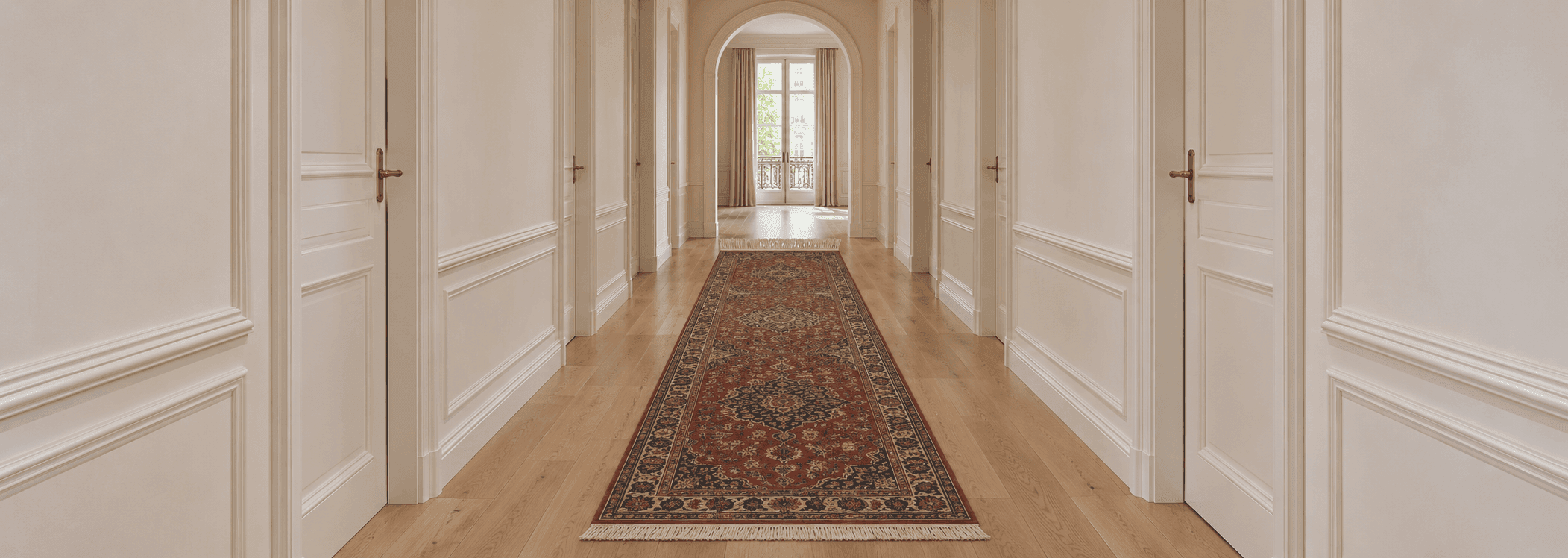
1. What Is a Runner Rug?
A runner rug is a long, relatively narrow carpet designed to cover a linear area of floor rather than a large square or rectangular room. It is particularly useful in hallways, corridors, entrance areas, kitchens, beside beds, dressing rooms and certain staircases.
Unlike a conventional area rug, which is often selected to anchor a seating arrangement or define a room, a runner is frequently chosen to guide movement through a space. It introduces colour, texture, rhythm and visual continuity along an architectural line.
In the handmade rug trade, runners are not necessarily a separate weaving tradition. They are primarily a format or shape. A runner can be made using different weaving techniques, materials, regional styles and decorative traditions.
A Persian runner, for example, may be:
- Hand-knotted from wool.
- Woven with wool pile and cotton foundation.
- Made using traditional tribal weaving techniques.
- Produced in a city-style design with a central medallion.
- Flatwoven without pile.
- A vintage or antique piece.
- A contemporary handmade rug inspired by traditional patterns.
Therefore, the word runner describes the rug's proportions and intended spatial application rather than its geographical origin, weaving technique or artistic style.
Runner, hallway rug and carpet runner: what is the difference?
The terms are frequently used interchangeably, although their usage can vary between retailers, designers and countries.
Runner rug
A long, narrow rug; the most widely used general term
Hallway runner
A runner specifically selected for a corridor or hallway
Carpet runner
A broad term that may describe a narrow rug or carpet supplied in a continuous length
Persian runner
A runner made in a Persian or Iranian rug tradition
Oriental runner
A runner with an Oriental rug origin or design tradition
Stair runner
A carpet runner installed and secured on stairs
Flatweave runner
A runner made without a conventional raised pile
Vintage runner
An older runner, often with signs of age and wear or a vintage finish
The distinction is important when shopping online. A customer searching for a hallway runner is generally looking for a practical, narrow floor covering. Someone searching for a Persian runner may be interested in craftsmanship, patterns, origin and cultural heritage as much as the shape itself.
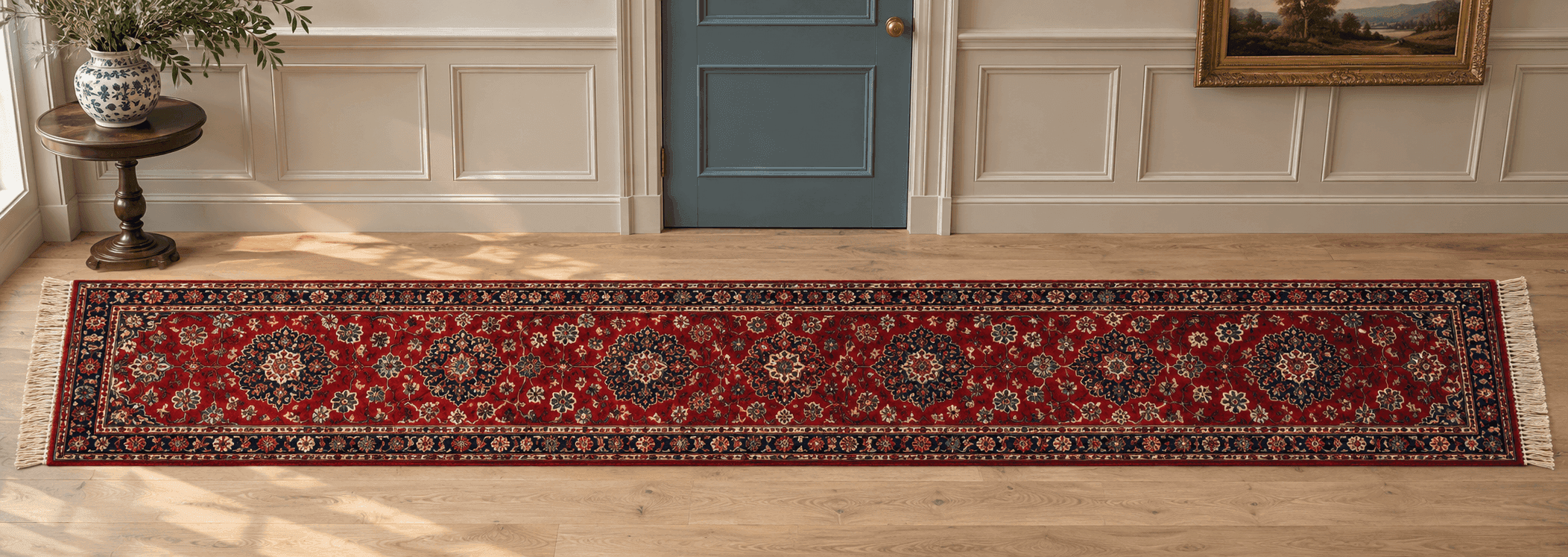
2. Understanding the Persian Term "Kenareh"
In Persian rug terminology, the word کناره (Kenareh) traditionally refers to a long, narrow rug. The name is associated with its historical use in elongated spaces and alongside walls, particularly in corridors, passages and the sides of rooms.
However, the modern understanding of a runner is broader than its traditional Persian name.
A handmade Persian Kenareh may be used in:
- Hallways and corridors.
- Alongside beds.
- Along the sides of larger carpets.
- In narrow passages between rooms.
- In entrance areas.
- In front of kitchen work surfaces.
- In long living spaces.
- As decorative accents in contemporary interiors.
The term should not be interpreted too literally as a carpet that must be placed at the edge of a room. In contemporary European interior design, runners are frequently positioned centrally in hallways, used as a visual pathway, or placed beside furniture to create a deliberate decorative composition.
Is Kenareh a separate type of Persian rug?
Not in the same sense as a Qashqai rug, a Bidjar rug or a Kashan rug.
Those names may identify regional traditions, production centres, weaving communities, stylistic characteristics or combinations of these factors. Kenareh primarily describes the narrow elongated format.
A rug can simultaneously be:
- A Qashqai runner.
- A Bidjar runner.
- A Baluch runner.
- A Turkmen runner.
- A Heriz-style runner.
- A Gabbeh runner.
- A vintage Persian runner.
This distinction allows buyers to understand that choosing a runner does not mean sacrificing artistic diversity. A narrow format can contain an equally rich visual language as a large Persian carpet.
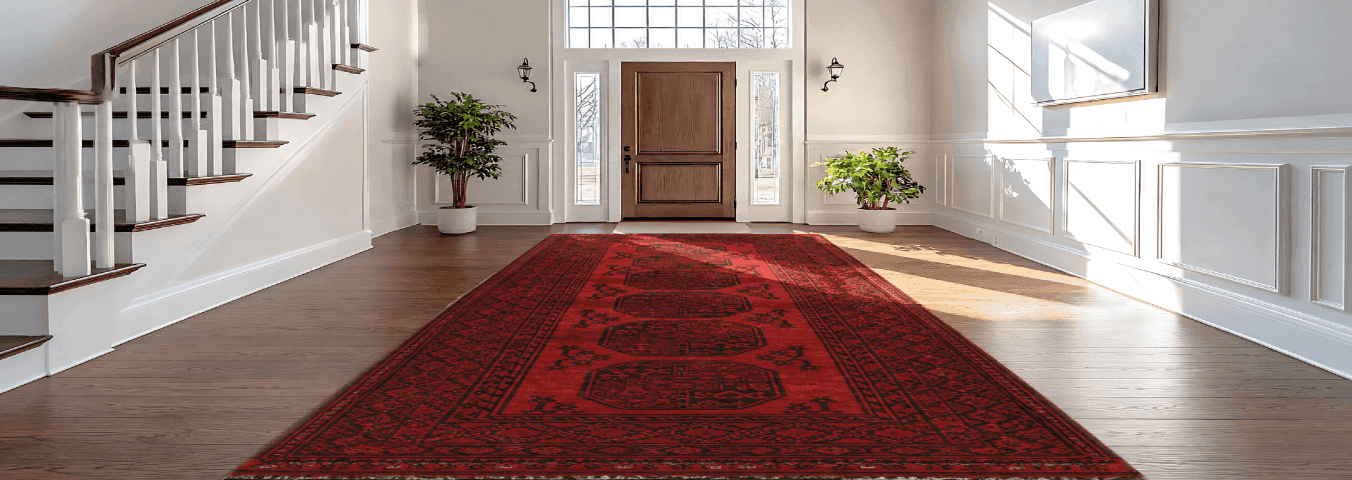
3. Why Runner Rugs Are So Important in European Interior Design
European homes often contain spaces that are architecturally functional but visually underdeveloped. Hallways, entrance corridors, transitional areas and narrow kitchen passages are frequently treated as secondary spaces.
A runner can transform these areas without requiring furniture, extensive decoration or structural changes.
3.1 Creating visual continuity
A long corridor naturally directs the eye toward its end. A runner reinforces this architectural direction.
When its pattern, colour and proportions are selected carefully, the rug creates a coherent visual path between rooms. This is particularly effective in homes where the hallway connects the living room, bedrooms and entrance.
The runner can either reinforce the existing architecture or introduce a contrasting visual element.
For example:
- A quiet geometric runner can complement a modern, minimalist hallway.
- A traditional Persian runner can introduce craftsmanship into a contemporary apartment.
- A muted vintage runner can soften a hallway dominated by white walls and hard flooring.
- A bold tribal runner can give a simple corridor a strong identity.
3.2 Making narrow spaces feel intentional
A hallway does not need to be wide to become attractive.
The important design principle is proportion. A rug that is too wide can make a corridor feel crowded, while one that is too narrow may appear disconnected from the space.
Leaving a visible border of flooring around the runner helps frame the carpet and makes the placement look deliberate.
3.3 Introducing colour without overwhelming a room
A runner is a useful way to experiment with colour and pattern.
In a living room, a large carpet can dominate the furniture arrangement. In a hallway, however, a narrower carpet can introduce stronger colours or more intricate designs without competing with a large seating area.
This makes runners particularly useful for people who prefer restrained interiors but still appreciate handmade objects with character.
3.4 Adding texture and warmth
Wood, stone, ceramic tile and polished floors can feel visually cold or acoustically hard.
A wool runner introduces a soft textile surface and a different tactile experience. The contrast between the rug and the floor can make the corridor feel more welcoming.
The effect depends on the material, pile structure, thickness, floor type and overall design.
3.5 Protecting the floor
Entrance halls and corridors receive concentrated foot traffic.
A runner can reduce direct abrasion on the floor surface, particularly in frequently used pathways. It can also help collect some dust and particles before they spread further into the house.
However, the rug itself must be maintained. Grit trapped beneath a rug may contribute to abrasion, particularly on sensitive wooden flooring. Regular cleaning of both the rug and the floor underneath is therefore essential.
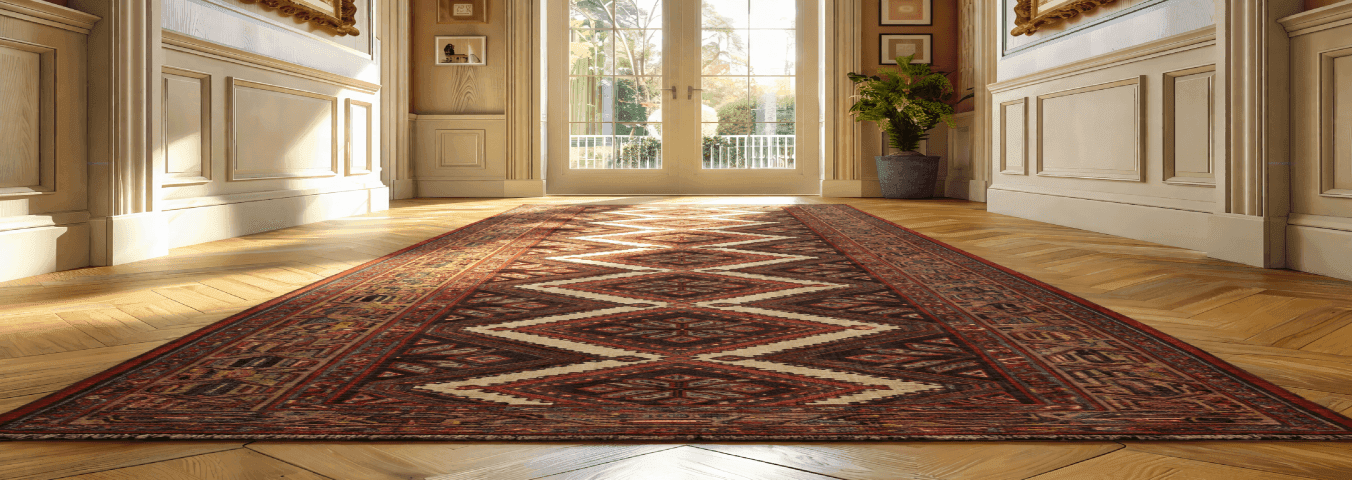
4. How to Choose the Correct Runner Rug Size
Size is one of the most important decisions when buying a hallway runner.
A beautiful rug can look awkward if it is too short, too wide, poorly centred or positioned directly against doorways.
There is no single universal size that works for every hallway. The appropriate dimensions depend on the corridor's width, length, door positions, furniture, floor pattern and visual preferences.
Common runner dimensions
Handmade runners come in a variety of dimensions because weaving traditions, loom widths and individual production methods differ.
Common approximate sizes include:
50–60 cm and 150–250 cm: Small passages and compact spaces
60–70 cm and 200–300 cm: Narrow hallways
70–80 cm and 250–350 cm: Standard European corridors
80–100 cm and 300–400 cm: Wider hallways and entrances
80–100 cm and 400 cm and longer: Long corridors and larger transitional spaces
These are practical examples, not fixed industry standards.
Traditional handmade Persian runners may have different proportions, including particularly narrow formats or unusually long pieces.
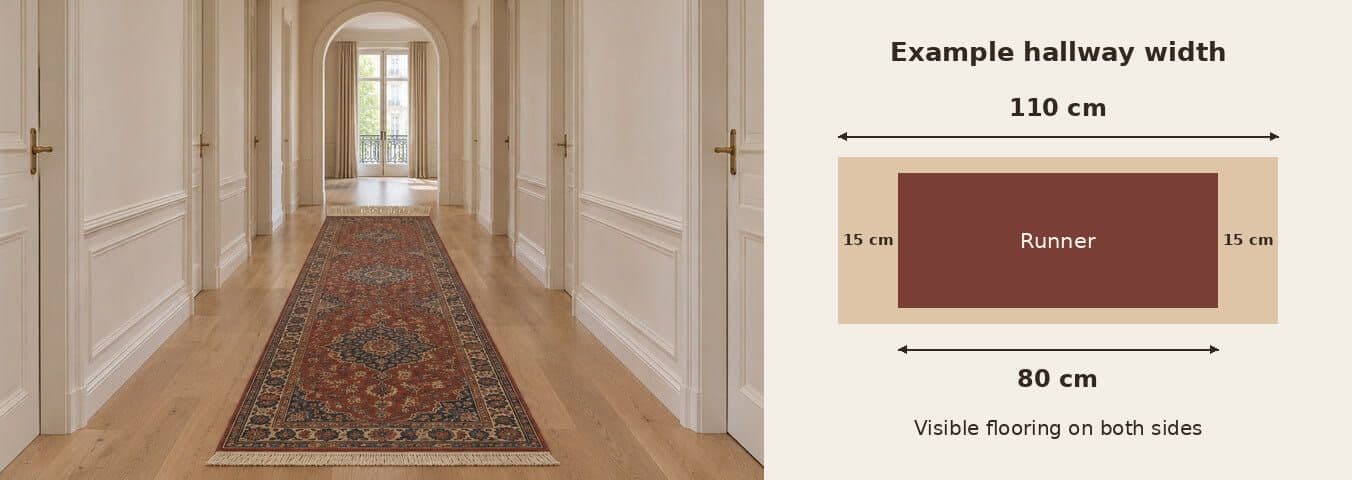
How much flooring should remain visible?
A common design approach is to leave approximately 10–20 cm of visible flooring on each side, depending on the width of the hallway.
This creates a frame around the rug.
For example, if a hallway is 110 cm wide, a runner measuring 70–80 cm wide may create an attractive proportion, leaving approximately 15–20 cm of flooring on either side.
But this is only a starting point.
In a very narrow hallway, a smaller border may be preferable. In a wide corridor, a wider runner may feel more balanced.
Should the runner cover the entire hallway length?
Not necessarily.
A runner that extends wall-to-wall may look like fitted carpeting rather than a decorative rug. Leaving visible flooring at the ends often creates a more refined appearance.
The amount of space depends on:
- The hallway length.
- Door openings.
- The location of the entrance.
- Furniture.
- The position of adjoining rooms.
- The rug's pattern and proportions.
A runner should not obstruct doors or create an awkward transition at an entrance.
Measuring before buying
Measure the hallway at its narrowest point, including any protruding furniture, radiators, door frames or other obstacles.
Then:
- Measure the total hallway width.
- Decide how much visible flooring you want on both sides.
- Measure the available length.
- Check door swing clearance.
- Identify the position of entrances and intersections.
- Consider whether the runner should begin near the entrance or farther inside.
- Compare your measurements with the actual rug dimensions.
For handmade rugs, the stated dimensions may be approximate, and slight variations can occur. Always check the dimensions of the individual rug rather than assuming every rug listed under the same category has identical measurements.
5. Handmade Runner Rugs Versus Machine-Made Runners
The difference between handmade and machine-made runners is not simply a matter of price. It involves production method, construction, materials, artistic character, durability, repairability and the way the rug ages.
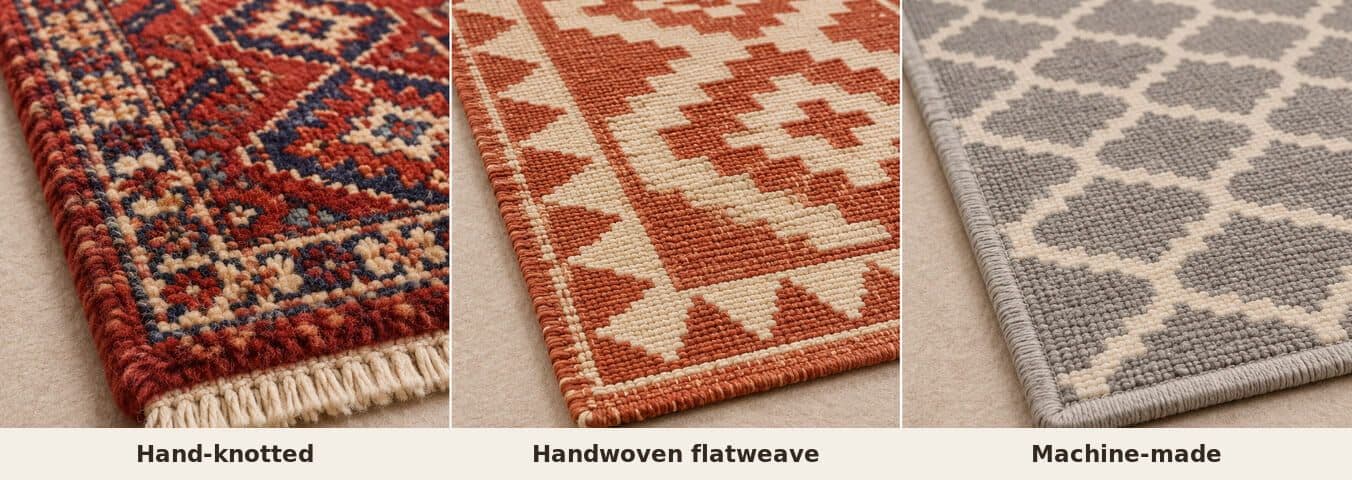
Hand-knotted runners
In a hand-knotted rug, individual knots are tied around the warp threads, creating the pile. The knots are secured through the structure of the rug, and rows of knots are built gradually during weaving.
Hand-knotted runners can be made in a wide variety of knotting traditions, materials and designs.
Their characteristics may include:
- Individual variation in knot structure.
- Complex pattern development.
- A distinctive handmade surface.
- Variation in colour and texture.
- Potential for professional repair.
- A long service life when properly maintained.
A handmade runner is not automatically superior in every practical situation. The correct choice depends on the quality of construction, material, intended use and buyer's expectations.
Handwoven flatweave runners
Flatwoven rugs are produced without the conventional raised pile found in most hand-knotted carpets.
They may be created through different weaving structures, including kilim-style techniques.
Their relatively flat construction makes them useful in certain spaces where a thicker rug would interfere with doors or furniture.
Flatweave runners are often appreciated for:
- A relatively low profile.
- Lightweight construction.
- Geometric designs.
- Reversible construction in some types.
- Suitability for contemporary and rustic interiors.
Not every flatweave is reversible, and not every flatweave is suitable for every high-traffic environment. Construction, edge finishing and material remain important.
Machine-made runners
Machine-made runners are produced using industrial manufacturing processes. They can provide consistent dimensions, uniform patterns and lower prices.
Some are practical choices for customers who prioritise a standardised appearance, easy replacement or a particular maintenance requirement.
The choice between handmade and machine-made should therefore be based on the buyer's priorities rather than on an assumption that one category is universally suitable for every household.
6. Which Materials Are Best for Handmade Runner Rugs?
The material affects appearance, comfort, resilience, maintenance, cost and the way the rug behaves under regular foot traffic.
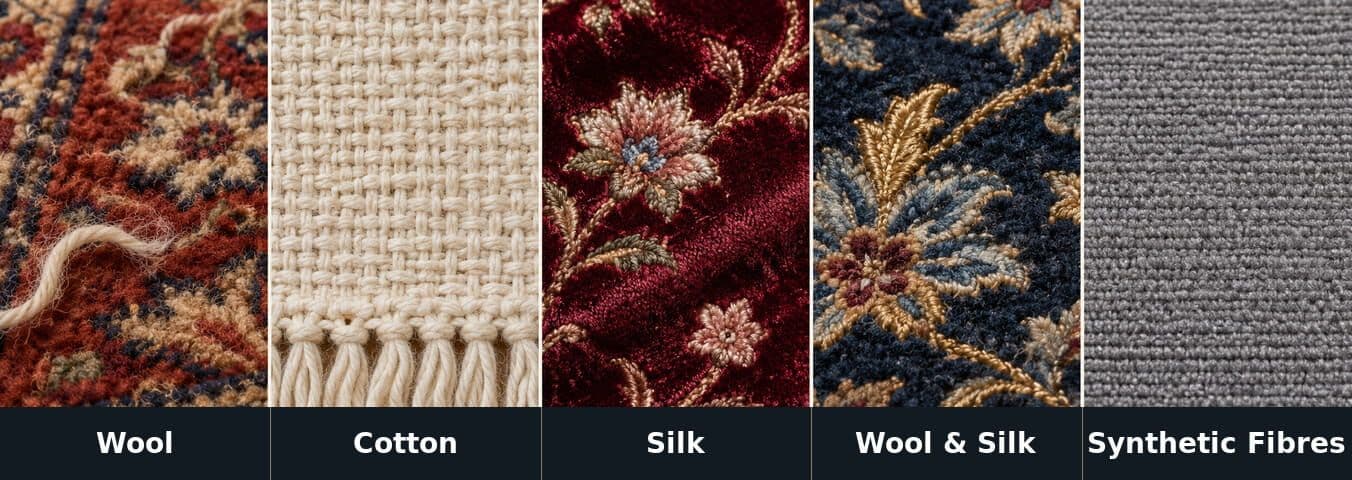
Wool: a particularly versatile choice
Wool is one of the most widely used materials in traditional handmade rugs.
Its physical properties make it particularly suitable for many residential applications.
Wool fibres have a natural degree of elasticity. They can compress under pressure and partially recover their shape, depending on the fibre quality, pile structure, yarn preparation and use.
Wool also provides a tactile surface that many people find comfortable underfoot.
For hallway runners, wool is often a sensible choice because it combines:
- Resilience.
- A comfortable surface.
- Natural texture.
- A wide range of colours.
- Compatibility with traditional hand-knotting.
- Potential for long-term use and repair.
However, wool quality is not uniform. Fibre length, diameter, processing, yarn construction and finishing influence performance.
A rug described as wool should not automatically be assumed to have identical durability or quality to another wool rug.
Cotton
Cotton is frequently used in the foundation of handmade rugs, particularly in warp and weft threads.
It may also be used in the pile of some rugs or in flatwoven constructions.
Cotton foundations provide structural support, but their performance depends on yarn quality, weaving density and the construction of the complete rug.
Cotton flatweaves may be suitable for certain interior applications where a lightweight rug is preferred.
Silk
Silk is valued for its lustre, fine texture and ability to display intricate details.
Silk runners can create elegant visual effects, especially in formal interiors.
However, silk and silk-rich rugs generally require more careful consideration in areas exposed to heavy foot traffic, moisture, abrasion and staining.
A silk runner is often better suited to a carefully selected decorative location than to a busy family entrance.
Wool and silk combinations
Some handmade rugs combine wool and silk to balance texture, durability and visual refinement.
Silk may be used selectively in the design to highlight outlines, floral details or areas that reflect light differently.
The exact proportion and location of silk matter. A rug containing small silk highlights does not necessarily behave like a rug made predominantly from silk.
Synthetic fibres
Synthetic materials such as polypropylene, polyester and nylon are used in many contemporary rugs.
Their characteristics vary considerably.
Some offer practical advantages in stain resistance, moisture handling or ease of cleaning. Others may be selected primarily for affordability or manufacturing consistency.
A synthetic rug is not automatically low quality, just as a handmade rug is not automatically maintenance-free.
For a customer choosing a runner, the most important question is whether the material and construction suit the intended location.
7. The Best Persian Rug Styles for Hallways
One of the greatest advantages of handmade Persian runners is the variety of artistic traditions available.
The rug can be selected according to the architectural style of the home, the desired atmosphere and the level of visual contrast.
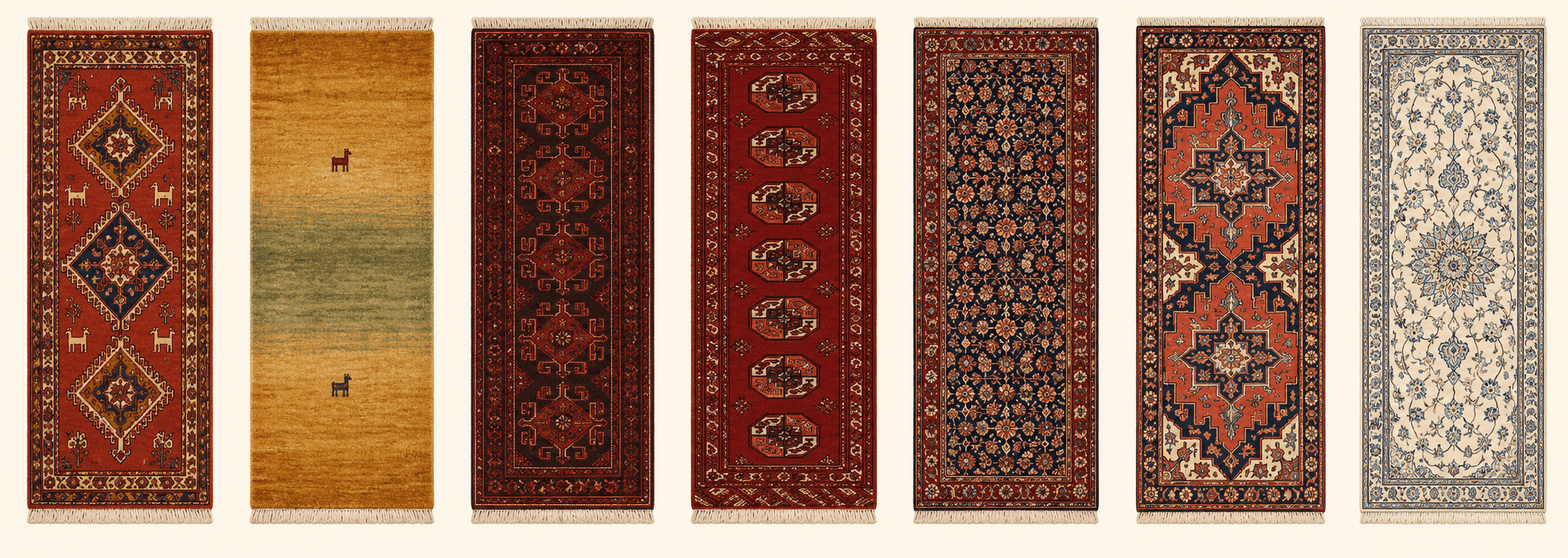
7.1 Qashqai runners
Qashqai rugs are associated with the weaving traditions of communities in southwestern Iran.
Many feature geometric motifs, bold compositions, warm colours and a distinctive tribal visual language.
A Qashqai runner can work particularly well in:
- Rustic interiors.
- Scandinavian interiors with natural wood.
- Modern homes with neutral colours.
- Eclectic spaces.
- Interiors where a handmade object becomes a focal point.
The individual rug should be evaluated according to its actual design and construction. Not every Qashqai rug follows the same palette or pattern.
7.2 Gabbeh runners
Gabbeh rugs are often associated with relatively simple compositions, expressive colour fields, geometric motifs and a tactile wool surface.
Their visual simplicity can be particularly effective in modern European interiors.
A Gabbeh runner may introduce colour without creating the dense visual complexity associated with some traditional floral rugs.
Depending on its pile height and construction, it may be suitable for certain hallways, bedrooms and other residential areas.
7.3 Baluch runners
Baluch rugs are associated with weaving traditions across parts of eastern Iran and neighbouring regions.
Many feature dark reds, deep blues, brown tones and compact geometric patterns.
These designs may be attractive in hallways because their visual rhythm complements long architectural spaces.
However, dark colours should not be selected solely because they supposedly hide dirt. Dust, light-coloured debris, pet hair and certain stains may remain visible depending on the colour and texture.
7.4 Turkmen runners
Turkmen weaving traditions are known for strong geometric structures and distinctive repeated motifs.
Turkmen runners can be particularly effective where the interior benefits from repetition and rhythm.
Their designs may complement:
- Industrial-style interiors.
- Contemporary spaces.
- Natural wood furniture.
- Minimalist architectural environments.
- Traditional European homes.
7.5 Bidjar runners
Bidjar rugs are historically associated with Kurdistan in western Iran and are widely appreciated for certain dense and robust weaving traditions.
Some Bidjar rugs have compact structures and substantial physical characteristics.
Nevertheless, durability must be evaluated from the individual rug rather than inferred from the name alone.
A Bidjar runner may suit a formal corridor, a traditional entrance or an interior where a rich Persian pattern is desired.
7.6 Heriz and geometric designs
Heriz-related designs are often characterised by bold geometric forms, angular floral elements and strong central compositions.
Their visual strength can help a hallway feel more architectural.
They may be particularly appealing to buyers who want traditional craftsmanship without an overly delicate floral appearance.
7.7 Nain, Isfahan and other refined city styles
Some runners feature finer floral designs, lighter colour palettes, elegant borders and intricate pattern details.
These may complement more formal European interiors, particularly where the furniture and architecture are restrained.
The selection should consider the contrast between the rug's detail and the surrounding surfaces.
8. Colour: How to Select a Runner for Your Interior
Colour is one of the most influential factors in choosing a runner.
Because runners are relatively narrow, the colour relationship between the rug, flooring and walls can be particularly noticeable.
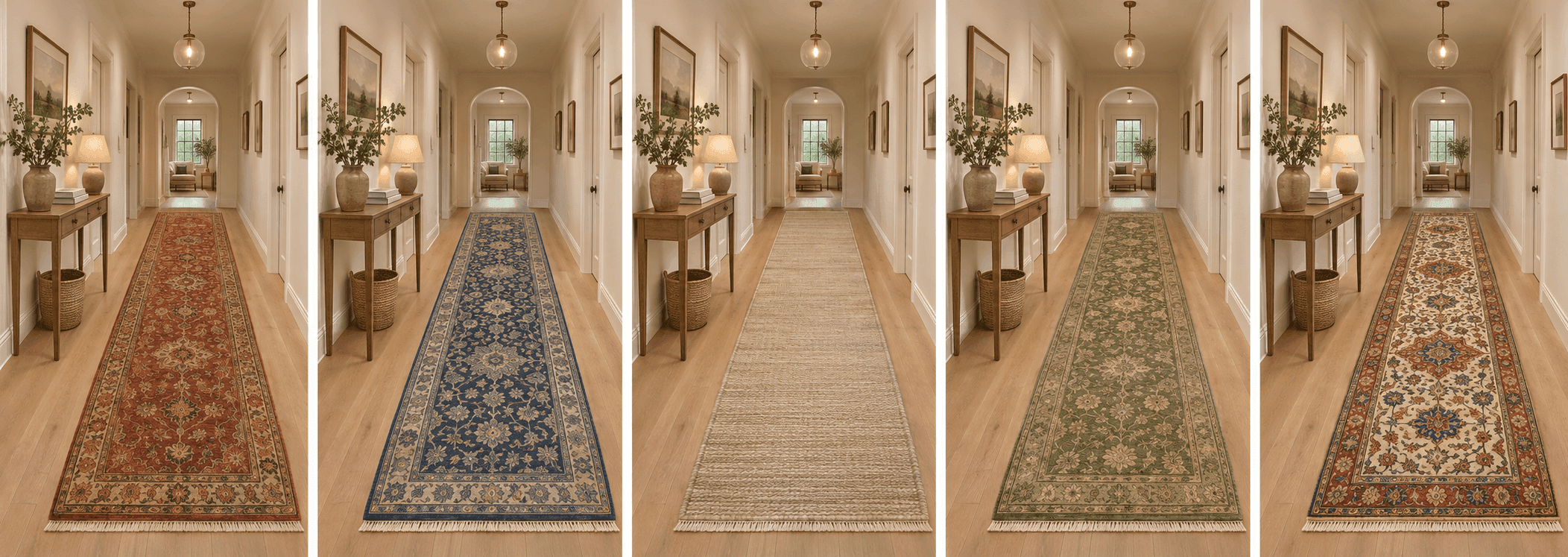
Red and terracotta
Red Persian runners can introduce warmth and visual energy.
They may work well with:
- Natural oak.
- Beige and cream walls.
- White interiors.
- Dark wood.
- Neutral furniture.
A traditional red runner can also create an interesting contrast in a minimalist interior.
Navy and blue
Blue runners can create a calmer appearance, particularly when paired with white, beige, grey or natural wood.
Deep navy may provide contrast, while lighter blues can create a more relaxed atmosphere.
Beige and natural tones
Neutral runners are useful when the homeowner wants texture without strong colour contrast.
These tones may suit Scandinavian, Japandi, contemporary and warm minimalist interiors.
Green
Green rugs can connect interior spaces visually with plants and natural materials.
Olive, sage, forest green and muted botanical tones can work differently depending on the flooring and light.
Multicoloured designs
Traditional Persian rugs frequently combine multiple colours.
Rather than matching every colour in the runner to the room, it is often more effective to identify one or two colours already present in the furniture, artwork or textiles.
This creates a relationship between the rug and the interior without making the room feel artificially coordinated.
A practical colour-selection method
Before buying:
- Identify the dominant flooring colour.
- Observe the wall colour in daylight.
- Consider the furniture and lighting.
- Decide whether the rug should blend in or stand out.
- Identify one or two colours that can connect it to the existing interior.
- Review the rug's photographs and, if available, a video in natural light.
Colour reproduction on screens can vary. A rug may appear warmer, cooler, brighter or darker depending on the lighting and display.
9. Runner Rugs in Different Areas of the Home
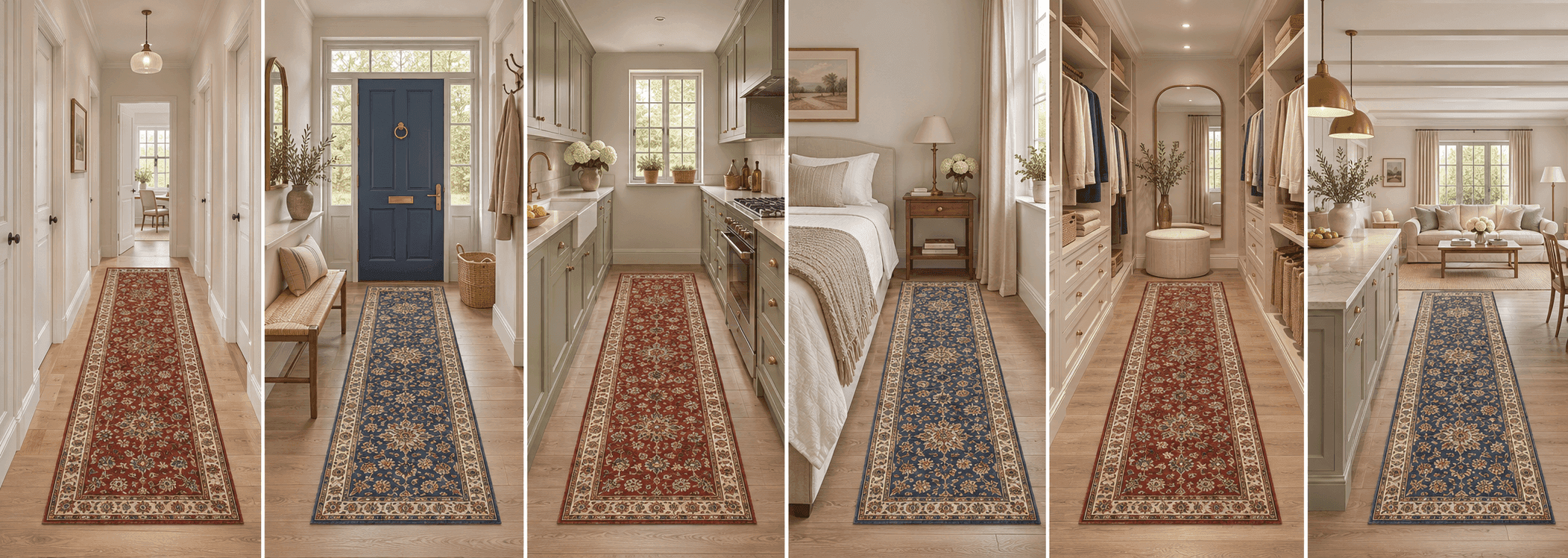
Runner rugs are not limited to hallways. Their elongated shape makes them adaptable to many residential spaces.
9.1 Hallways and corridors
This is the classic application.
A runner can:
- Create a welcoming entrance.
- Establish a visual pathway.
- Connect adjoining rooms.
- Add warmth to hard flooring.
- Introduce colour and pattern.
- Protect a frequently used walking zone.
The most successful placement usually respects the corridor's architectural proportions and leaves adequate clearance around doors and other obstacles.
9.2 Entrance areas
The entrance is one of the most demanding locations for a rug because it receives dirt, moisture, grit and frequent foot traffic from outside.
A runner in this location should be selected with maintenance in mind.
Consider:
- The distance from the exterior door.
- Whether shoes are worn indoors.
- The presence of pets.
- Seasonal rain and snow.
- The type of flooring.
- How easily the rug can be cleaned.
A valuable or delicate handmade rug may be better placed farther inside the entrance rather than directly at the door where it receives the heaviest contamination.
9.3 Kitchens
A runner can add warmth to a kitchen, particularly between cabinets, alongside an island or in front of a work surface.
The practical considerations are different from those in a hallway.
The rug may be exposed to:
- Food spills.
- Oil.
- Water.
- Frequent cleaning.
- Movement from chairs.
- Uneven wear.
Low-profile runners may be easier to use in kitchens, particularly where cabinet doors, drawers or appliances are close to the floor.
A handmade wool runner can be a beautiful choice in a kitchen that is maintained carefully, but it should not be treated as a stain-proof surface.
9.4 Beside the bed
A runner beside the bed offers a soft surface when getting up in the morning.
It can be particularly useful in smaller bedrooms where a large area rug may not fit comfortably.
A runner may be placed:
- Along one side of the bed.
- Along both sides of the bed.
- At the foot of the bed.
- Alongside a bed positioned against a wall.
The choice depends on available space, the bed's dimensions and the desired visual balance.
9.5 Dressing rooms and walk-in wardrobes
A runner can introduce softness into a dressing area and connect the visual appearance of storage units, mirrors and furniture.
In these spaces, low or medium pile may be convenient where drawers, wardrobe doors and movement are important.
9.6 Open-plan interiors
In open-plan homes, runners can help define pathways between different functional areas.
For example, a runner may establish a route between a kitchen and living room without physically dividing the space.
The rug should complement the larger interior composition rather than create an isolated strip of decoration.
10. Runner Rugs on Staircases: Design, Installation and Safety
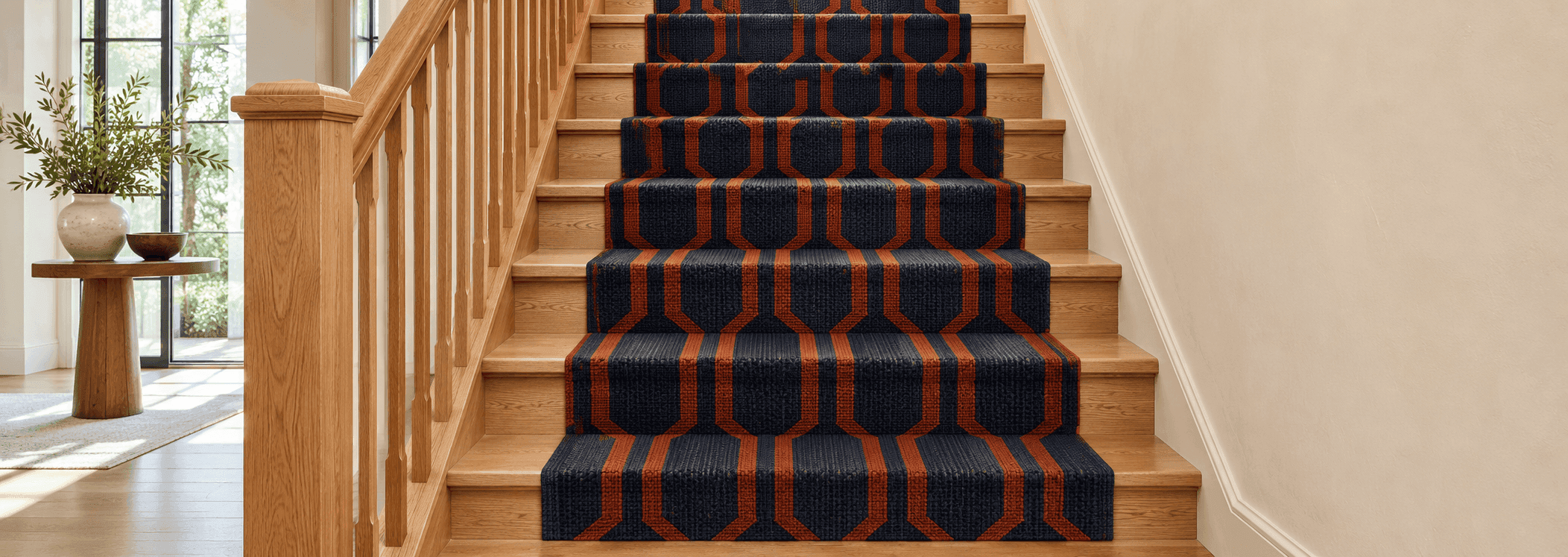
Stair runners require significantly more care than hallway runners.
A staircase is a high-risk location because an incorrectly installed rug can move, curl, loosen or interfere with the way a person places their feet.
What makes a stair runner different?
A stair runner must cover a sequence of horizontal treads and vertical risers.
It needs to accommodate the geometry of the staircase while remaining securely fixed.
The selection process should consider:
- Stair width.
- Tread depth.
- Riser height.
- Stair nosing shape.
- Landing dimensions.
- Carpet thickness.
- Flexibility of the rug.
- Installation method.
- Material and pile construction.
Choosing the right construction
Low-profile and flexible constructions are generally easier to fit across stair treads and risers than thick, bulky rugs.
High-pile, loose or excessively thick rugs can interfere with foot placement and may create hazards if they are not suitable for stair installation.
How to measure a staircase
The length of a stair runner is not simply the horizontal length of the staircase.
The measurement needs to account for the horizontal tread and vertical riser.
For a straight staircase, a basic estimate is:
\[ L = n(t+r) \]
Where:
- \(L\) = approximate runner length.
- \(n\) = number of steps.
- \(t\) = tread depth.
- \(r\) = riser height.
For example, if a staircase has 13 steps, with a tread depth of 27 cm and a riser height of 18 cm:
\[ 13(27+18)=585\text{ cm} \]
This gives approximately 5.85 metres before additional allowances for installation, the top and bottom transitions, landings or the specific fitting method.
Important safety advice
A loose rug must never be placed on stairs as though it were a hallway runner. Stair rugs require appropriate professional installation and secure attachment. The suitability of fastening methods, underlay and carpet construction should be assessed for the staircase and the rug itself.
A runner may improve comfort or traction under certain conditions, but it does not guarantee fall prevention.
For a valuable handmade Persian runner, professional installation should be discussed before purchase. Not every handmade rug is suitable for cutting, bending or permanent attachment to a staircase.
11. Pattern and Design: Why the Runner's Motifs Matter
A runner creates a long visual sequence. The viewer may encounter its design from one end and follow it toward the other.
This makes pattern selection particularly interesting.
Central medallion designs
Some runners feature a central medallion or repeated medallion elements.
The design can create visual focal points and establish symmetry.
All-over patterns
An all-over design distributes motifs across the surface rather than concentrating attention in a single central element.
This can be useful in a corridor because the pattern continues along the entire walking path.
Geometric patterns
Geometric designs often work well in narrow spaces because their shapes can reinforce the architectural lines of the corridor.
They may complement modern interiors with straight furniture lines, simple wall finishes and restrained decoration.
Floral designs
Floral patterns can soften spaces dominated by straight lines and hard materials.
Traditional Persian floral runners can introduce a more decorative or classical character without requiring the entire interior to be furnished in a traditional style.
Tribal and nomadic motifs
Tribal runners often contain repeated geometric symbols, stylised animals, plants and abstract forms.
These patterns can create a sense of individuality and craftsmanship.
The interpretation of specific symbols should be approached carefully. Not every motif has a universally established meaning, and interpretations may vary according to region, community, period and the particular rug.