
How to Style a Persian Rug in a Modern European Interior
A Persian rug can transform a modern European home without making it feel traditional. The secret is understanding how colour, proportion, pattern, materials and furniture interact.
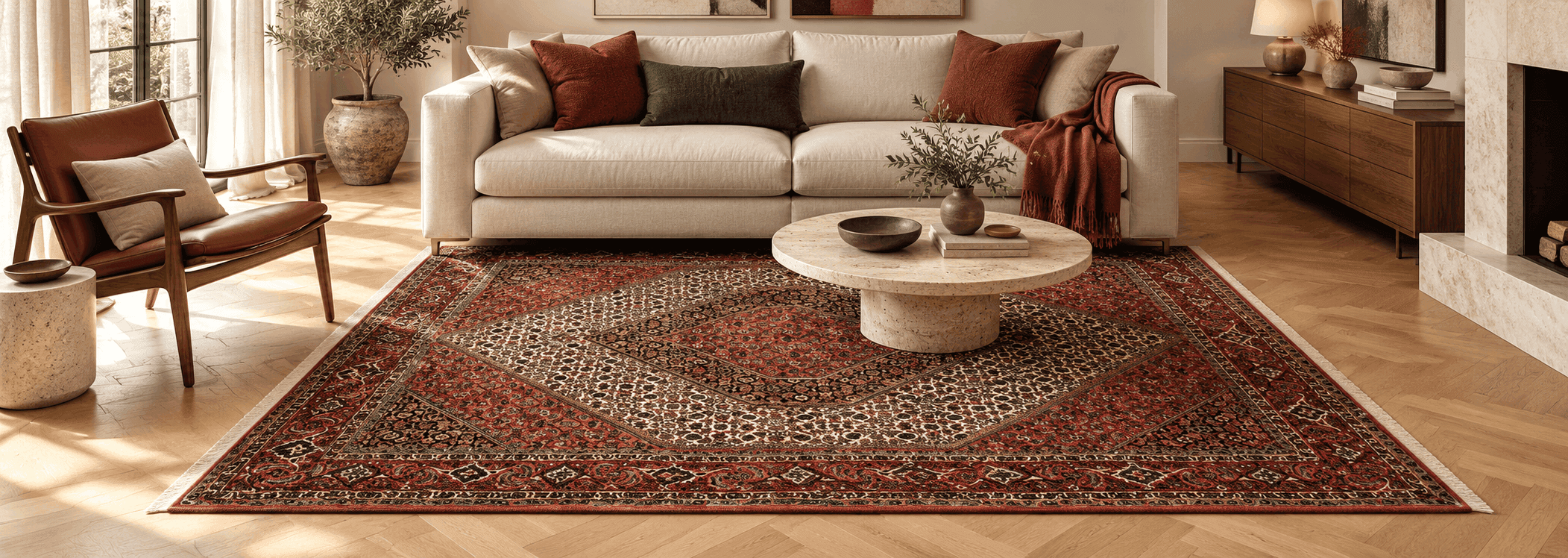
A Persian rug can transform a modern European home without making it feel traditional. The secret is understanding how colour, proportion, pattern, materials and furniture interact. Whether your home features Scandinavian minimalism, warm oak flooring, a grey sofa, contemporary architecture or an open-plan living space, the right handmade Persian rug can bring warmth, personality and a sense of craftsmanship to the interior.
1. Why Persian Rugs Work So Well in Modern European Interiors
Contemporary European interiors often rely on clean architectural lines, relatively simple furniture, open spaces and carefully controlled colour palettes.
These characteristics can create beautiful rooms. However, when every surface is smooth, every piece of furniture is understated and every colour belongs to the same neutral family, the result can sometimes feel impersonal.
A handmade Persian rug introduces a different kind of visual information.
It brings together colour, texture, geometry, floral ornament, irregularities of handcraftsmanship and, depending on the particular piece, a distinctive sense of history.
The contrast can make the entire room more interesting.
The balance between simplicity and detail
Imagine a living room with:
- Pale oak flooring.
- A cream-coloured sofa.
- White walls.
- A simple wooden coffee table.
- Black metal lighting.
- Very few decorative objects.
This is a suitable foundation for a traditional Persian rug.
A rug featuring muted red, indigo, ivory and warm brown can introduce colour without requiring changes to the architecture or furniture.
The rug becomes the visual anchor of the room, while the furniture provides the calm background that allows its design to be appreciated.
The opposite approach can also work. A relatively restrained rug with simplified geometric motifs can complement a more expressive interior featuring colourful furniture, sculptural lighting or contemporary artwork.
The fundamental principle is balance: the more visually complex one major element becomes, the more carefully you should consider the visual weight of the others.
This does not mean that every other object must be plain. Texture, subtle stripes, natural materials and selected decorative patterns can coexist with a Persian rug. The important consideration is whether the elements contribute to a coherent composition.
A rug is more than a decorative accessory
A Persian rug can perform several functions simultaneously:
- Visual: Introduces colour, pattern and contrast.
- Spatial: Defines a seating area within a larger room.
- Tactile: Adds a softer surface beneath the feet.
- Acoustic: Can help reduce some reflected sound, depending on its construction and the surrounding surfaces.
- Material: Connects wood, upholstery, stone and metal through colour and texture.
- Personal: Gives a contemporary home an individual character rather than the appearance of a furniture showroom.
These qualities make handmade rugs particularly useful in apartments with hard flooring, open-plan living spaces and interiors that otherwise rely heavily on neutral colours.
2. Traditional Patterns Meet Contemporary Furniture
One of the most effective ways to style a Persian rug is to combine it with furniture that has a different visual character.
A traditional rug may contain a central medallion, floral motifs, an elaborate border or an all-over pattern. A contemporary sofa, by comparison, may have straight lines, simple upholstery and little ornamentation.
These elements do not need to share the same style.
Their differences can be precisely what makes the room successful.
Why contrast works
A detailed rug provides visual complexity at floor level. Simple furniture introduces larger, calmer shapes above it.
The eye can appreciate the rug without being distracted by several competing decorative elements.
Consider three possible combinations:
Rug
Furniture
Overall effect
These are starting points rather than strict rules. A traditional rug with a classic sofa can also look excellent, particularly when the room has sufficient space and a deliberate sense of formality.
The important question is whether the rug and furniture reinforce one another or compete for attention.
Modern furniture does not need to be expensive
A handmade Persian rug can work with a straightforward contemporary sofa, an unpretentious wooden coffee table and simple lighting.
There is no requirement to purchase designer furniture to make the combination successful.
Often, the rug provides the individuality while relatively uncomplicated furniture maintains the room's visual clarity.
Choose furniture by shape and material
When evaluating a rug for a contemporary room, consider more than the colour of the sofa.
Look at its shape, height, upholstery and visual weight.
- Low-profile sofas can complement detailed rugs by creating a clear horizontal line above the floor.
- Rounded armchairs can soften the geometry of rugs with angular borders.
- Glass coffee tables preserve the visibility of the pattern beneath them.
- Simple wooden tables connect the rug to the floor and other natural materials.
- Black metal furniture can provide a crisp contemporary contrast.
- Plain linen upholstery introduces texture without adding another dominant pattern.
None of these choices is mandatory. They are useful ways of thinking about the relationship between objects rather than a fixed set of decorating rules.
3. How to Choose a Persian Rug for a Neutral Interior
Neutral interiors are among the easiest environments in which to introduce a patterned handmade rug.
White, beige, cream, taupe, grey and natural wood provide a relatively quiet background. The challenge is deciding whether the rug should introduce a strong contrast or maintain the room's understated character.
Both approaches can work.
Option A: Make the rug the focal point
Choose a rug with a clearly defined colour palette, a strong central design or a distinctive geometric composition.
For example, a traditional rug with a deep red field and indigo details can become the principal decorative element in a room with white walls and a beige sofa.
In this arrangement, avoid automatically adding red cushions, red curtains and red artwork. One or two subtle references to the rug's colours are generally sufficient.
The rug does not need to be repeated everywhere to belong in the room.
Option B: Create a softer, tonal interior
If you prefer a quieter atmosphere, look for a rug with softer contrasts, muted colours or an open design.
Cream, sand, faded blue, warm grey, muted green and soft rust can all work in contemporary interiors, depending on the existing materials and lighting.
A rug does not have to be pale to feel understated. A dark blue rug with a restrained pattern can also provide a calm foundation for a room.
Option C: Introduce colour without overwhelming the room
A rug can provide the principal colour in an otherwise neutral interior.
Suppose your room contains:
- A light grey sofa.
- Natural oak flooring.
- Off-white walls.
- A walnut coffee table.
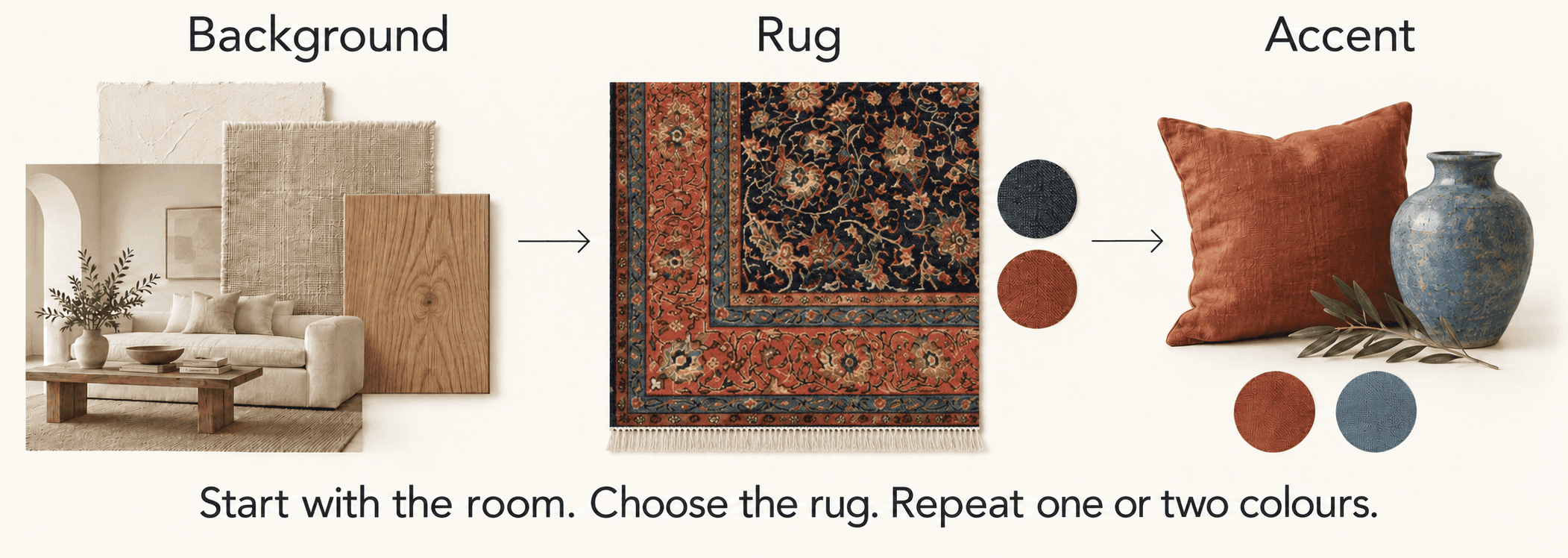
A rug featuring muted blue, terracotta and ivory introduces three colours that can be selectively repeated elsewhere.
You might use a terracotta cushion, a small blue ceramic object and artwork containing a similar shade of blue.
The connections are enough to make the room feel coordinated without making every object match.
A practical colour-selection framework
Before choosing a rug, identify three elements:
- The dominant background: Usually the walls, floor or largest piece of furniture.
- The rug's principal colour: The colour that occupies the greatest visual area or attracts the most attention.
- The accent colour: A secondary colour that can connect the rug to one or two accessories.
This is not a mathematical formula. It is a decision-making tool that helps prevent unnecessary complexity.
4. Which Persian Rug Colours Work with Different Sofa Colours?
The sofa is often the largest upholstered object in a living room. Its colour therefore has a considerable influence on how a rug appears.
However, a sofa colour does not determine a single correct choice. Pattern, lighting, flooring and the rug's proportions all matter.
Persian rugs with a white or cream sofa
White and cream sofas provide considerable flexibility.
They work particularly well with:
- Traditional Persian rugs featuring red, navy and ivory.
- Vintage rugs with faded colours.
- Geometric Gabbeh rugs.
- Rugs with terracotta, olive or muted blue details.
- More restrained rugs in warm neutral colours.
A cream sofa and a richly coloured rug can create a classic contemporary contrast. A pale sofa and a softly coloured rug produce a quieter result.
Pay attention to undertones. A warm cream sofa may work more naturally with an ivory-and-rust rug than with a strongly blue-grey rug, although the surrounding materials can change the relationship.
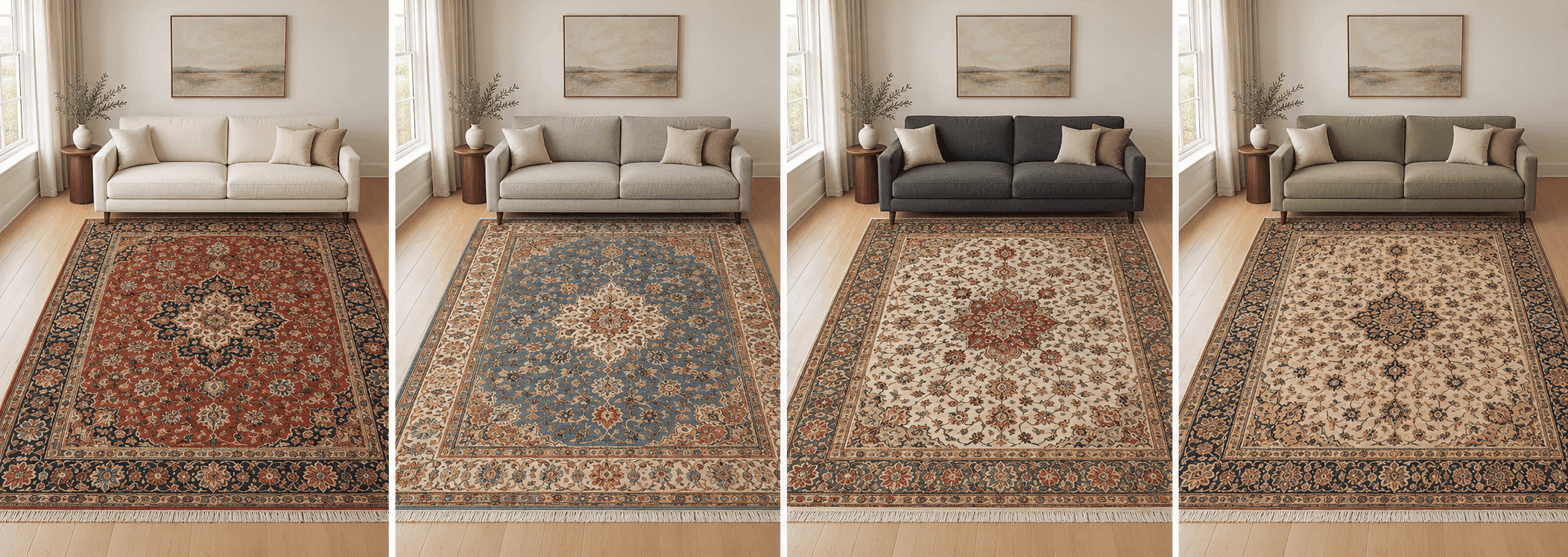
Persian rugs with a grey sofa
Grey sofas are common in contemporary European homes, but grey is not a single colour.
A warm grey with brown undertones behaves differently from a cool grey with blue undertones.
If the sofa is cool grey and the room feels cold, a rug containing rust, warm brown or muted red can introduce visual warmth.
If you prefer a cooler, more restrained palette, indigo, grey-blue and ivory may be more suitable.
Persian rugs with a beige or taupe sofa
Beige and taupe furniture pairs naturally with many rugs containing earth tones.
Consider:
- Rust and brick red.
- Warm brown and ivory.
- Olive and muted green.
- Indigo balanced with cream.
- Geometric rugs featuring natural wool colours.
The main risk is choosing a rug whose colours are too similar to the sofa and floor, leaving the entire room visually flat.
Some contrast in tone, pattern or texture usually helps define the seating area.
Persian rugs with a black or dark sofa
Dark furniture can create a strong contemporary foundation for a Persian rug.
A lighter rug may make the seating area feel more open, while a richly coloured rug can produce a more dramatic effect.
For example:
- A dark sofa with an ivory-ground rug can create a clear contrast.
- A charcoal sofa with muted red and navy can feel sophisticated and grounded.
- A black sofa with a warm geometric Gabbeh can introduce an informal, artistic character.
Consider the room's natural light before choosing a very dark rug and dark furniture together. In a small room with limited daylight, the combination may feel heavier than intended.
What if the sofa is already colourful?
A colourful sofa does not rule out a Persian rug.
The key is to decide which element should dominate.
If you have a green sofa, for example, a rug with a quieter ivory, blue or warm brown field may create a balanced composition. A more colourful rug can also work, provided its palette relates to the sofa rather than competing with it in several unrelated directions.
5. How to Combine a Persian Rug with Wooden Floors
Wood flooring is one of the most natural partners for a handmade Persian rug.
Both materials have visible texture, variation and warmth. When combined carefully, they can make a contemporary room feel more welcoming without losing its modern character.
The best combination depends on the wood's colour, grain, finish and the rug's own palette.
Light oak flooring
Light oak is common in Scandinavian-inspired and contemporary European interiors.
It works well with rugs containing:
- Muted red and ivory.
- Indigo and cream.
- Terracotta and warm brown.
- Olive and natural wool colours.
- Soft geometric patterns.
A colourful rug can introduce contrast against pale oak, while a quieter rug can preserve a minimalist appearance.
Avoid assuming that a pale floor requires a pale rug. A darker rug may be precisely what gives the room definition.
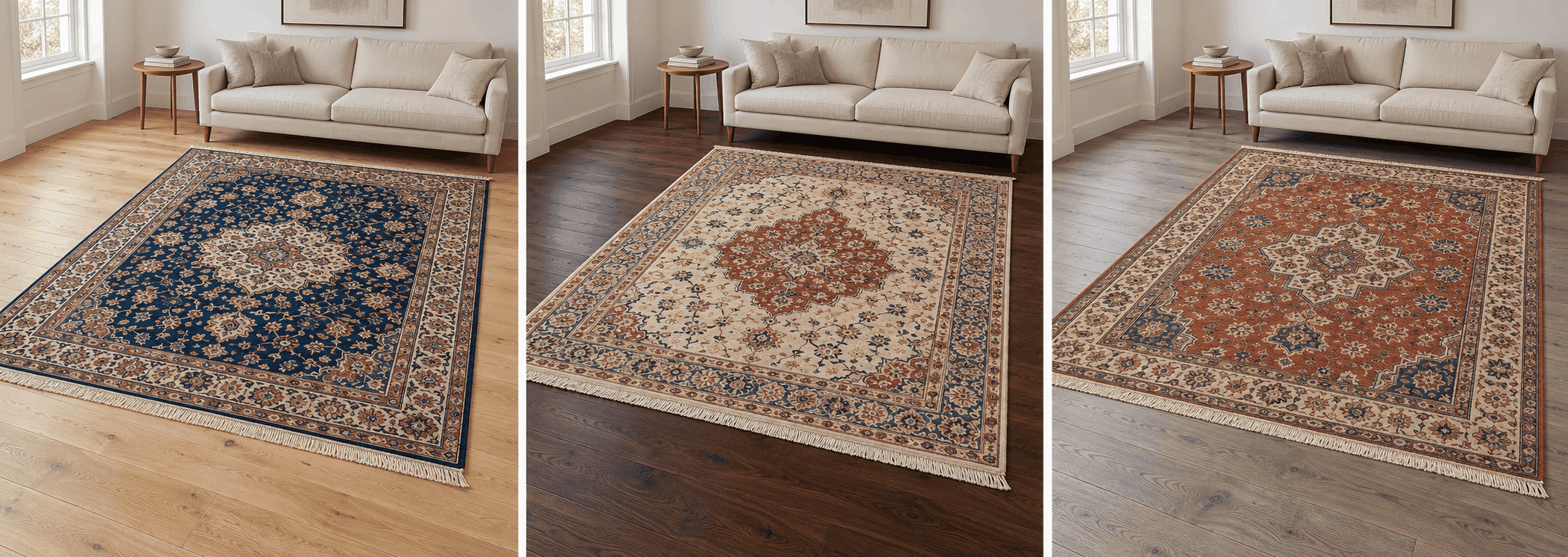
Walnut and darker wooden floors
Walnut and other dark woods often have a rich, warm appearance.
Rugs containing ivory, rust, faded red, muted blue or contrasting geometric designs can work particularly well.
A traditional rug with a darker field may also be effective, especially when the room contains lighter upholstery or sufficient daylight.
The important consideration is whether the floor and rug have enough tonal separation for their boundaries to remain visible.
Grey-toned or washed wood
Grey-toned wood can create a cooler foundation.
Rugs containing muted blue, ivory, rust or subtle green may help introduce warmth and visual complexity.
If the flooring has strong grey undertones, pay attention to the colours of the walls and sofa as well. Three or four cool surfaces can make a room feel less inviting than intended.
Stone, marble and porcelain flooring
Persian rugs can be particularly useful in rooms with hard stone, marble or porcelain floors.
These surfaces often have a visually cool and relatively smooth appearance. A handmade wool rug introduces a different texture and helps define the areas where people sit, walk or relax.
Consider a rug that creates a clear contrast with the floor while remaining compatible with the furniture.
For smooth flooring, use a suitable non-slip underlay and ensure that the rug lies flat. This is a practical safety consideration as well as a styling decision.
Should the rug match the wood?
No. Exact matching is unnecessary.
Instead, consider three relationships:
- Warmth: Do the wood and rug feel compatible in their overall temperature?
- Contrast: Can you clearly distinguish the rug from the floor?
- Texture: Do the two materials complement one another without creating visual monotony?
A walnut floor and an ivory-and-rust rug can work beautifully even though they do not share the same colour.
Likewise, pale oak and a dark blue Persian rug can create a more distinctive interior than a perfectly matched combination.
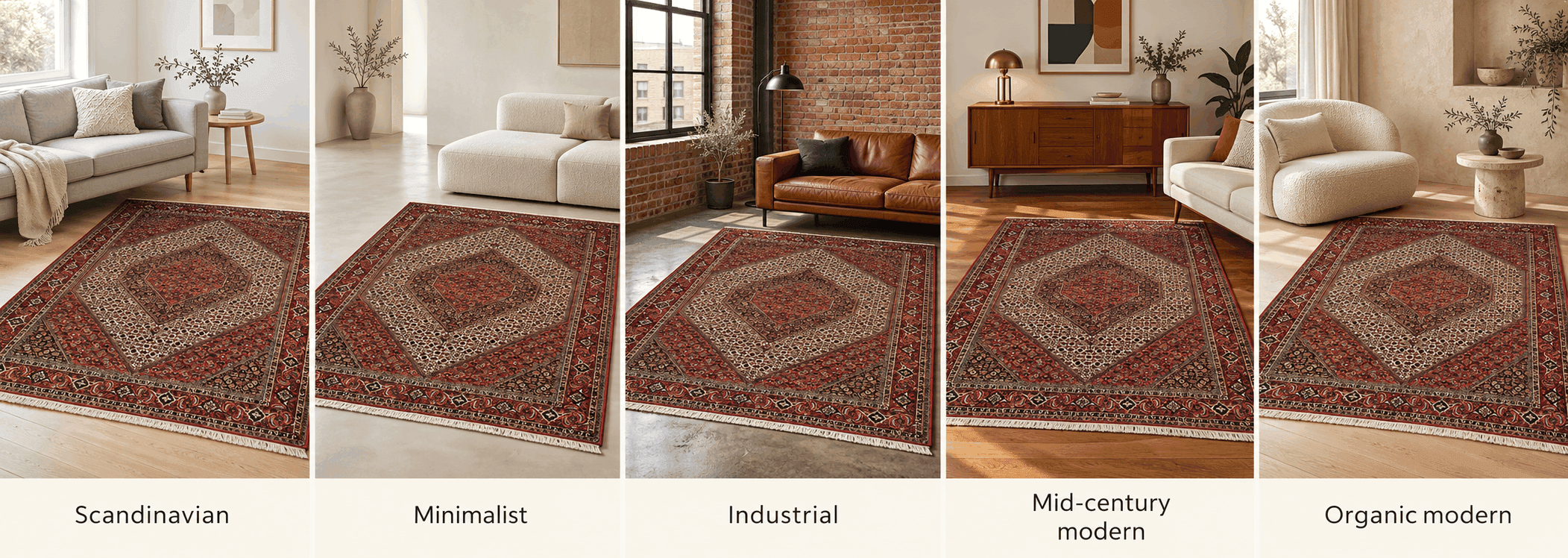
6. How to Style Persian Rugs with Different Interior Design Styles
A Persian rug is not limited to one decorating style. Its suitability depends on the individual design, colour palette, size and the way it relates to the rest of the room.
Scandinavian interiors
Scandinavian-inspired interiors often feature natural wood, pale walls, functional furniture, soft textiles and restrained decoration.
A Persian rug can introduce colour and craftsmanship without disrupting this simplicity.
Recommended approach:
- Choose a rug with a clear composition.
- Consider muted red, ivory, faded blue or natural wool colours.
- Use simple wooden furniture.
- Keep the larger upholstery relatively understated.
- Allow enough visible flooring to preserve the room's lightness.
A geometric Gabbeh can suit this setting particularly well, although a classic Persian design can also create a beautiful contrast.
The objective is not to reproduce a stereotypical Scandinavian room. It is to balance natural materials with a rug that contributes individuality.
Minimalist interiors
Minimalism depends on proportion, material quality and deliberate restraint.
A Persian rug can provide the principal decorative element in a room with plain walls, simple furniture and little visual clutter.
Two approaches are particularly effective.
A quiet rug in a quiet room: Choose a restrained palette and a design that adds texture without becoming the dominant feature.
A statement rug in a quiet room: Choose a more expressive design and allow it to become the centre of attention.
Both are valid. The second approach is especially effective when the rug has an interesting central medallion, a strong geometric composition or a distinctive combination of colours.
Industrial interiors
Industrial-style spaces may contain exposed brick, concrete, dark metal, large windows and robust furniture.
A handmade Persian rug can soften the harder materials and introduce a more intricate surface.
Consider:
- Rust and dark blue against concrete.
- Ivory and warm brown against dark flooring.
- Geometric rugs with leather furniture.
- Traditional patterns beneath a simple black metal coffee table.
A richly coloured rug can also create a strong contrast with exposed brick. The key is to consider the dominant colours already present in the room.
Mid-century modern interiors
Mid-century-inspired interiors often feature tapered furniture legs, sculptural chairs, walnut or teak finishes and distinctive silhouettes.
A Persian rug can complement this style because both can have strong visual identities without requiring ornate decoration throughout the room.
Try a geometric rug with a wooden sideboard, a simple sofa and a sculptural floor lamp.
Alternatively, a traditional rug can create a more layered interior when paired with understated mid-century furniture.
Contemporary luxury interiors
Contemporary luxury interiors may use stone, marble, glass, carefully selected metals and high-quality upholstery.
A Persian rug can provide a softer, more tactile counterpoint to these materials.
A detailed traditional rug may create a sophisticated contrast beneath a restrained sofa. A more subtle rug may be suitable when the room already contains dramatic stone veining, statement lighting or expressive artwork.
Luxury does not necessarily mean choosing the most elaborate rug. It means choosing a piece that is appropriate to the scale and character of the room.
Bohemian and eclectic interiors
Eclectic interiors can accommodate a wider variety of colours, patterns and materials.
A Persian rug may serve as the foundation for a composition containing vintage furniture, contemporary artwork, plants, books and varied textiles.
However, an eclectic room still benefits from some underlying order.
Repeat selected colours, vary the scale of patterns and leave some areas visually quiet. Without these connections, the room can become crowded rather than expressive.
Organic modern interiors
Organic modern design combines contemporary forms with natural materials and earthy colours.
A Persian rug with rust, muted green, cream, warm brown or soft blue can complement oak, walnut, linen, stone and leather.
Gabbeh rugs are particularly worth considering because many feature simplified geometric or abstract compositions, although individual designs vary considerably.
7. Which Type of Persian Rug Should You Choose?
Not every Persian rug creates the same atmosphere.
The term Persian rug encompasses a wide variety of designs, weaving traditions, materials and colour palettes. Choosing the right type for a modern home begins with understanding the visual character of the individual piece.
Geometric Gabbeh rugs
Gabbeh rugs are often associated with simplified geometric compositions, expressive colour fields and relatively uncomplicated motifs.
Many feature squares, diamonds, stylised figures, animals or abstract elements, although their designs vary.
They can work particularly well in:
- Scandinavian-inspired rooms.
- Contemporary apartments.
- Informal living spaces.
- Rooms with natural wood and simple furniture.
- Interiors where a bold but uncomplicated design is preferred.
A Gabbeh can introduce a handmade character without the density of ornament found in some traditional floral carpets.
Luri and Loribaft rugs
Luri and Loribaft rugs can offer a distinctive combination of geometric expression, tribal-inspired designs and rich or restrained colour palettes, depending on the individual rug.
They may suit interiors that benefit from a more personal, less formal character.
Look at the specific design rather than relying on the category name alone. Some examples are visually bold; others are relatively quiet.
Classic Persian rugs
Traditional Persian rugs may feature floral compositions, central medallions, intricate borders or repeated patterns.
Different weaving centres have their own design histories and visual characteristics, but there is considerable variation within every category.
For a modern interior, a classic rug can be particularly effective when the surrounding furniture has simple shapes and relatively calm upholstery.
If the rug contains several strong colours, use the room's existing materials to determine which colours should be repeated elsewhere.
Vintage and antique rugs
Vintage and antique rugs can have softened colours, visible signs of age and distinctive surface character.
These qualities can create an interesting contrast with new furniture and contemporary architecture.
However, an older rug is not automatically more suitable for a modern interior than a newer one. Condition, colour, size, pattern and personal preference remain important.
Age should be established from credible information rather than inferred solely from an intentionally faded appearance.
Traditional rugs with a lighter palette
Some traditional rugs have ivory, beige, muted blue or other relatively restrained backgrounds.
These can be suitable for homeowners who appreciate intricate designs but prefer a lighter overall appearance.
A traditional pattern does not need a dark red field to feel distinctive.
How should you decide?
Use the following comparison as a starting point.
Rug type
Visual character
Interior styles worth considering
Geometric Gabbeh
Simplified, graphic, expressive
Scandinavian, minimalist, organic modern
Luri or Loribaft
Often geometric or tribal-inspired
Contemporary, eclectic, natural-material interiors
Classic floral Persian
Detailed, ornamental, traditional
Minimalist contrast, contemporary luxury, classic-modern
Vintage Persian
Potentially softened, varied, individual
Eclectic, mid-century, contemporary
Light-ground traditional rug
Detailed but visually lighter
Scandinavian, neutral, contemporary luxury
These are design associations, not strict classifications. A particular rug may work beautifully outside the suggested styles.
8. Choosing the Right Rug Size and Placement
Colour and design attract attention, but proportion often determines whether the final arrangement looks intentional.
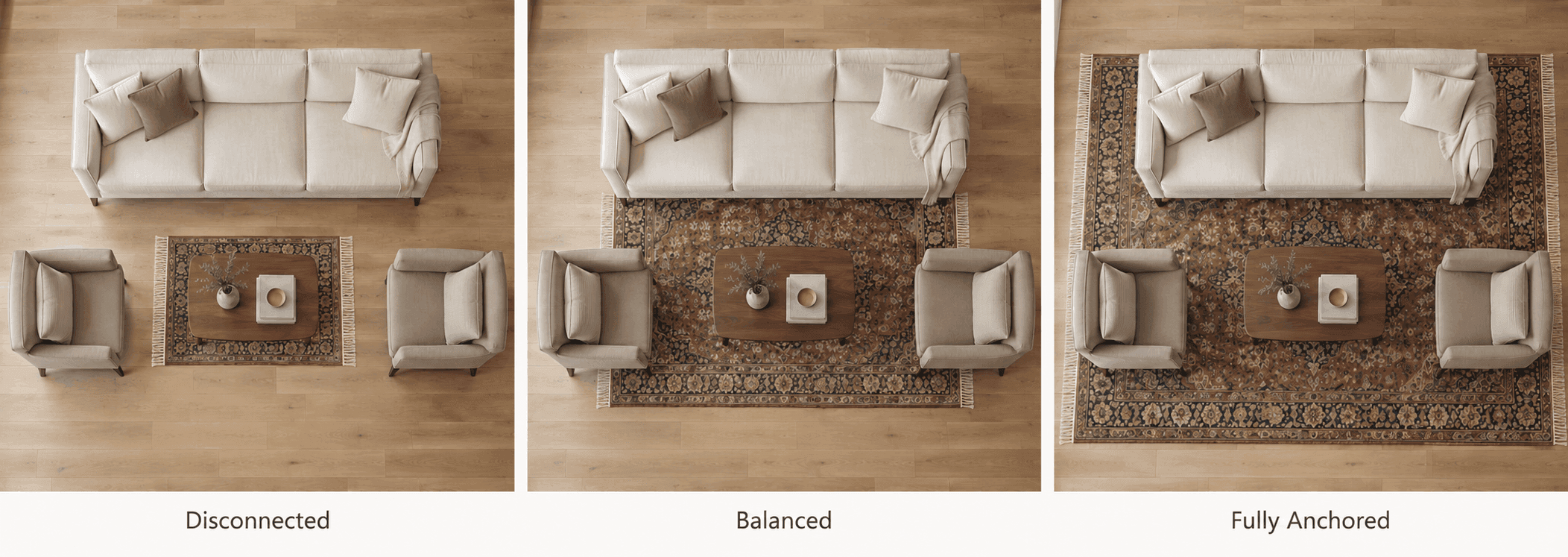
One of the most common problems in contemporary living rooms is a rug that is too small for the furniture arrangement.
When a small rug sits alone beneath a coffee table while the sofa and armchairs remain entirely outside it, the seating area can appear fragmented.
A larger rug often creates a more coherent composition, provided it suits the room's dimensions.
Interior design guidance similarly emphasises the relationship between rug size, furniture placement and the amount of flooring left visible.
Three common living-room arrangements
Option 1: Front legs on the rug
Position the rug so that the front legs of the sofa and armchairs rest on it.
This is a practical solution for many European living rooms because it visually connects the furniture without requiring every piece to sit entirely on the rug.
Option 2: All major seating furniture on the rug
A larger rug can accommodate the entire seating arrangement.
This often works well in spacious living rooms, open-plan interiors and rooms with several armchairs.
Option 3: A small rug as an intentional accent
A smaller rug can be suitable beneath a reading chair, beside a bed or in a compact corner.
It should look intentionally placed rather than like an undersized version of the rug the room requires.
Common European rug sizes
The following dimensions are useful starting points, not universal rules.
Rug dimensions
Potential application
60 × 90 cm
Small accent areas, depending on placement
120 × 180 cm
Compact seating areas or smaller rooms
140 × 200 cm
Small living rooms and selected furniture arrangements
160 × 230 cm
Compact or medium-sized seating areas
200 × 300 cm
Many standard living-room arrangements
250 × 350 cm
Larger seating areas
300 × 400 cm and above
Spacious rooms and large furniture arrangements
The right size depends on the room, the sofa's dimensions, the number of chairs and how you want the furniture to sit on the rug.
A 200 × 300 cm rug may work in one living room and feel too small in another of similar dimensions because the furniture arrangement is different.
How much floor should remain visible?
There is no single ideal border for every room.
In many interiors, leaving approximately 20–45 cm of visible flooring around the rug creates a balanced appearance, but the appropriate amount depends on the room's size and proportions.
A small room may need a narrower border. A large room with beautiful wooden flooring may benefit from more visible floor.
The objective is to avoid both extremes: a rug that appears squeezed into the room and a rug that looks disconnected from the furniture.
How to measure before purchasing
Before choosing a rug:
- Arrange the sofa and armchairs as you intend to use them.
- Measure the complete seating arrangement.
- Decide whether the front legs or all the legs should rest on the rug.
- Mark the proposed rug dimensions on the floor using painter's tape.
- Walk around the marked area and check the distance from doors, walkways and other furniture.
- Confirm the measurements against the actual dimensions of the rug you plan to purchase.
This simple exercise can prevent an expensive sizing mistake.
A note about dining rooms
Dining-room rugs require a different calculation because chairs move in and out.
The rug needs to accommodate the chairs when they are pulled away from the table, not just when they are pushed underneath it. A commonly used design guideline is to allow approximately 60–75 cm beyond the table edges, although the appropriate allowance depends on the chairs and available space.
If the room cannot accommodate a sufficiently large rug, leaving the floor uncovered may be the more practical solution.
9. Styling Persian Rugs in Different Rooms
The principles of contrast, proportion and colour remain relevant throughout the home, but each room has different practical requirements.
Living room
The living room is often the best place to begin because the rug can connect the main seating furniture and establish the room's visual identity.
Choose a rug that relates to the sofa, chairs, flooring and coffee table.
If the room is relatively neutral, a more expressive rug can provide the principal decorative feature.
If the room already contains several strong colours or patterns, consider a rug with a more restrained palette.
Bedroom
A Persian rug can add warmth and visual interest to a bedroom with simple bedding, wooden furniture and neutral walls.
A large rug placed beneath the bed can extend beyond the sides and foot of the bed, creating a generous surface around the sleeping area.
Alternatively, a runner or smaller rug beside the bed may be more appropriate for a compact room.
Choose the arrangement according to the available floor area, door clearances and the position of bedside tables.
Hallway and entrance
A runner can introduce colour and character into a hallway while creating a visual connection between adjoining rooms.
Consider the length and width of the corridor, the direction of door openings and the amount of regular foot traffic.
The rug should not obstruct doors or create a tripping hazard. A suitable non-slip underlay can be especially important on smooth flooring.
Home office
A handmade rug can make a home office feel more comfortable and individual.
Consider the position of the desk, the movement of the chair and whether the chair's castors will travel across the rug's surface.
A low-profile rug may be more practical beneath a frequently used rolling chair than a thick, high-pile rug. Check the construction and care requirements of the specific piece.
Dining room
A Persian rug can create a visually distinctive dining area, particularly in an open-plan interior.
However, practical suitability matters as much as appearance.
A rug beneath a dining table should be large enough for chairs to remain on the rug when pulled out. Spills, food particles, cleaning requirements and the type of flooring also need consideration.
Are kilims suitable beneath dining tables?
They can be, but they are not always the most practical choice.
Kilims are flat-woven rugs, and some lightweight examples can shift or gather when chairs move, particularly on smooth flooring. This can become frustrating in a dining area used every day.
A suitable underlay may help, but it does not eliminate every issue. Consider the rug's weight, construction, condition and the way the chairs move.
If the room is small and cannot accommodate an adequately sized rug, leaving the floor uncovered may be preferable.
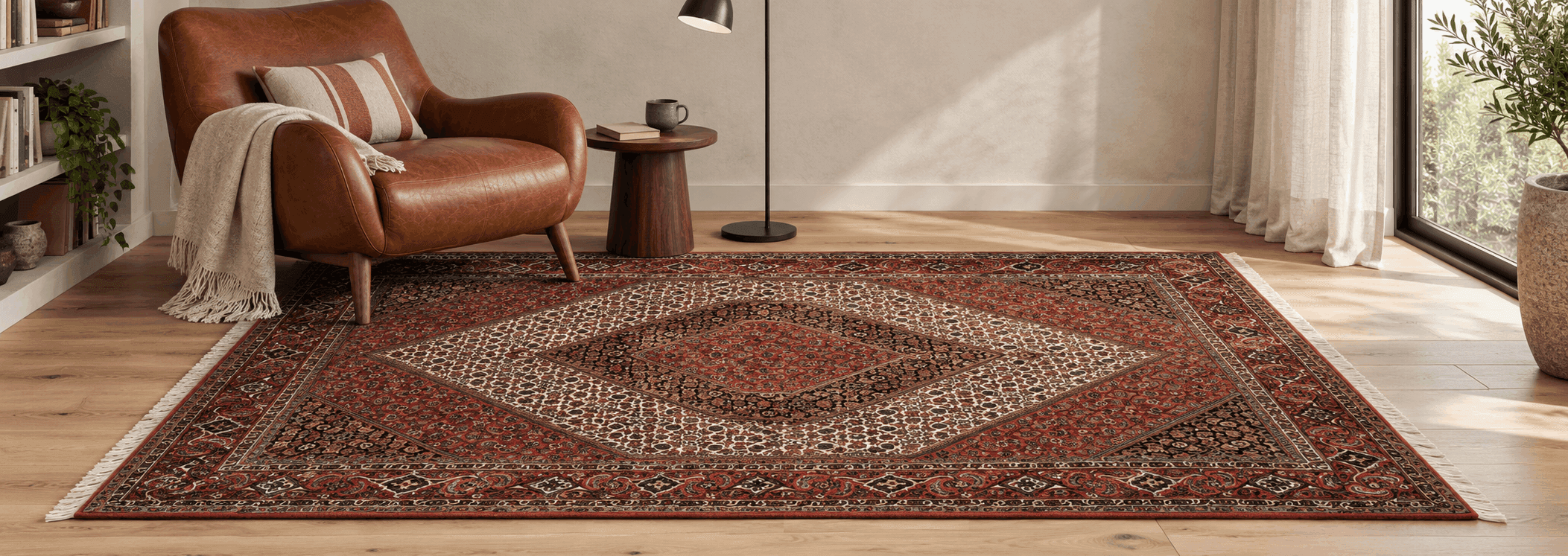
Reading corner
A reading corner is an excellent place for a smaller handmade rug.
Place it beneath or in front of an armchair, add a floor lamp and consider a small side table.
The rug can introduce a different colour or pattern without needing to coordinate with every object in the room.
Open-plan living spaces
In an open-plan apartment, rugs can help define different functional areas without adding walls.
A larger Persian rug beneath the living-room seating arrangement can visually distinguish it from the dining area.
If you use a second rug elsewhere, the two do not need identical designs. They should, however, have some relationship through colour, scale, texture or overall visual weight.
10. How to Combine Patterns, Textures and Accessories
A Persian rug does not require a completely plain room.
It can coexist with other patterns, but the combination benefits from deliberate choices.
Mix textures before introducing more patterns
A patterned rug can be paired with:
- Linen upholstery.
- Bouclé cushions.
- Leather chairs.
- Wool throws.
- Natural wood.
- Smooth stone.
- Glass.
- Black or brushed-metal details.
These materials provide contrast through texture, reflectivity and surface quality without introducing several competing patterns.
For example, a richly patterned Persian rug, a linen sofa and a walnut coffee table may provide sufficient visual variety on their own.
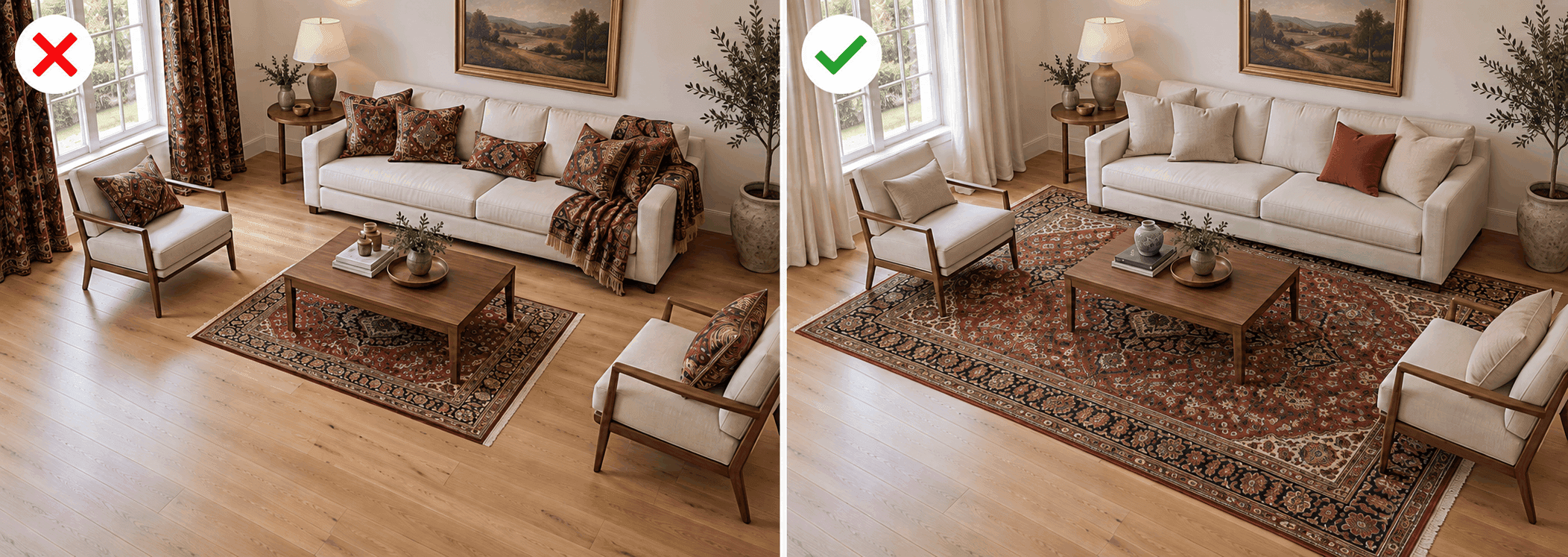
Can you combine a Persian rug with patterned cushions?
Yes.
The easiest approach is to vary the scale and intensity of the patterns.
If the rug has an intricate design, cushions with broad stripes, subtle checks or a restrained geometric motif may complement it.
If the rug has a relatively simple geometric composition, a more expressive cushion pattern may be appropriate.
Try to establish a visual connection through colour or material rather than requiring every pattern to match.
Should curtains match the rug?
Not necessarily.
Plain curtains in a compatible neutral colour are often a useful choice because they allow the rug to remain a focal point.
You can also choose curtains that repeat a subtle colour from the rug. Exact duplication is rarely necessary.
Consider how much visual attention the windows already attract. Heavy patterned curtains combined with a richly patterned rug may be appropriate in an eclectic interior, but they can overwhelm a smaller or more restrained room.
What kind of coffee table works best?
Wooden coffee tables introduce warmth and can connect the rug with the flooring.
Glass coffee tables allow more of the rug's design to remain visible.
Black metal tables provide a strong contemporary contrast.
Round tables can soften a room dominated by rectangular furniture and rug borders.
Simple rectangular tables can reinforce a clean architectural arrangement.
The best choice depends on the shape of the seating area and the rug's design.
Should artwork repeat the rug's colours?
It can, but it does not have to.
A contemporary painting can create an interesting contrast with a traditional rug. Alternatively, artwork that contains one or two colours from the rug can help establish a visual connection between the floor and walls.
Avoid assuming that the rug, cushions, curtains and artwork must all repeat the same colour combination.
A successful interior can feel coordinated without looking like a matching set.
11. Seven Common Mistakes to Avoid
Mistake 1: Choosing a rug that is too small
A rug that sits disconnected from the seating arrangement can make the furniture feel visually fragmented.
Better approach: Measure the complete furniture arrangement before choosing the rug.
Mistake 2: Matching every colour exactly
Matching cushions, curtains, artwork and furniture to every colour in the rug can make the room feel overly coordinated.
Better approach: Repeat one or two colours selectively and allow other materials to remain independent.
Mistake 3: Assuming that every Persian rug looks traditional
Persian rugs vary enormously in design. Some are densely patterned and richly coloured; others have simplified geometric motifs and relatively restrained palettes.
Better approach: Choose according to the individual rug's design, colours and proportions rather than relying only on its regional name.
Mistake 4: Ignoring the flooring
A rug can look very different on pale oak, dark walnut, grey wood or polished stone.
Better approach: Consider the rug and floor together, including their undertones, contrast and textures.
Mistake 5: Adding too many competing patterns
A Persian rug may already contain considerable visual detail.
Better approach: Introduce additional patterns selectively, varying their scale and keeping some surfaces visually quiet.
Mistake 6: Choosing a rug without considering daily use
A beautiful rug may be unsuitable for a particular location if it obstructs a door, shifts underfoot or requires more maintenance than the household can manage.
Better approach: Consider foot traffic, chair movement, cleaning, rug construction and underlay requirements before making a decision.
Mistake 7: Judging a rug by its online photograph alone
Screens can alter colour perception, and the appearance of a rug changes with lighting and viewing direction.
Better approach: Review the product photographs, measurements, construction details and condition information. Where possible, examine the rug under different lighting conditions before making a final decision.
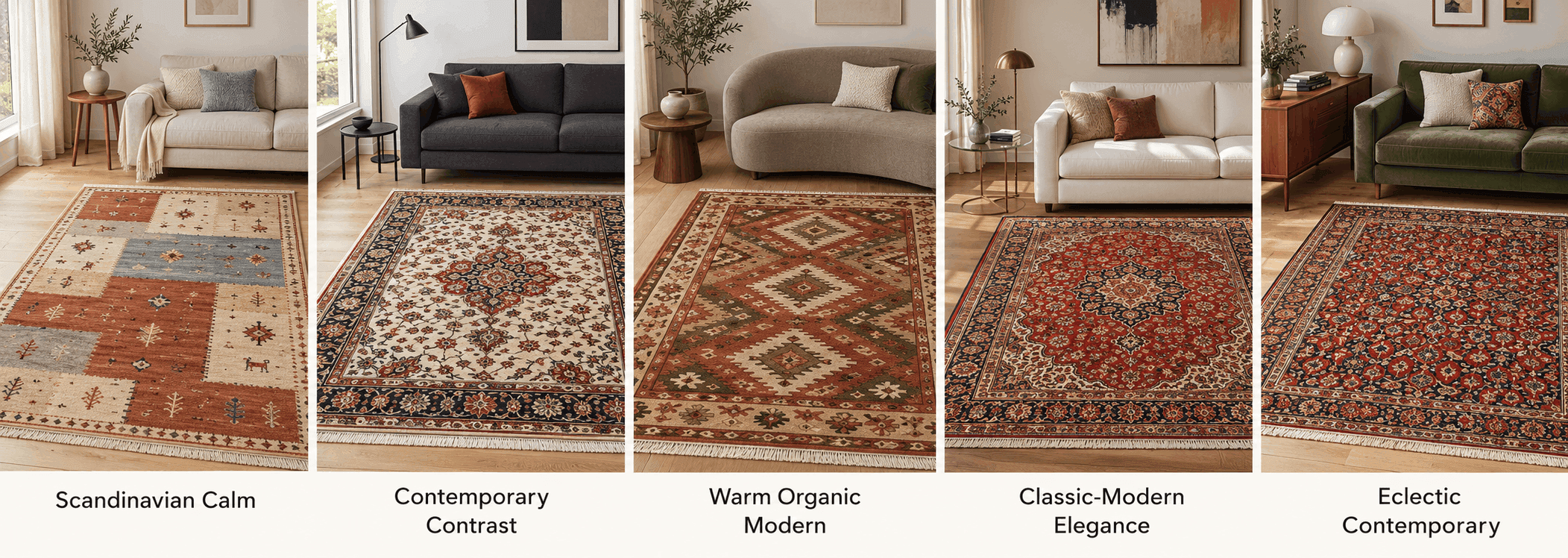
12. Five Complete Styling Schemes for Modern European Homes
The following examples show how the principles can be applied in real interiors. They are illustrative design concepts rather than universal formulas.
Scheme 1: Scandinavian calm
Interior: Pale oak flooring, off-white walls, a light beige sofa and a simple coffee table.
Rug: A handmade Gabbeh or a restrained Persian rug with muted rust, ivory and soft blue.
Accessories: Linen curtains, a small wooden side table and one or two ceramic objects.
Why it works: The rug introduces pattern and colour while the natural materials preserve the room's understated character.
Best for: Apartments and homes with Scandinavian-influenced furniture.
Scheme 2: Contemporary contrast
Interior: White walls, a charcoal sofa, a black metal floor lamp and a dark coffee table.
Rug: A Persian rug with an ivory field, muted red details and dark blue accents.
Accessories: Simple artwork and a small cushion that repeats one of the rug's colours.
Why it works: The rug introduces warmth and visual complexity against the darker furniture without requiring additional decorative elements.
Best for: Contemporary interiors with strong architectural lines.
Scheme 3: Warm organic modern
Interior: Oak flooring, a taupe sofa, a walnut coffee table and natural linen.
Rug: A geometric rug with terracotta, warm brown, cream and muted olive.
Accessories: Natural ceramics, soft lighting and a small number of plants.
Why it works: The materials and colours share a warm character, while the rug adds a distinct handmade element.
Best for: Relaxed living rooms that combine contemporary furniture with natural materials.
Scheme 4: Classic-modern elegance
Interior: A cream sofa, walnut furniture, contemporary artwork and warm neutral walls.
Rug: A traditional Persian rug featuring a central medallion or detailed floral pattern.
Accessories: A simple glass or wooden coffee table and restrained lighting.
Why it works: The rug introduces ornament and history, while the contemporary furniture prevents the room from becoming overly formal.
Best for: Homeowners who appreciate traditional craftsmanship but prefer modern architecture.
Scheme 5: Eclectic contemporary
Interior: A muted green sofa, wooden furniture, mixed artwork and carefully selected vintage objects.
Rug: A distinctive handmade Persian rug with a considered combination of red, indigo, cream or green.
Accessories: A few patterned cushions, books and sculptural lighting.
Why it works: The rug connects the different objects through colour and texture while retaining its own identity.
Best for: Interiors where personal expression is more important than strict minimalism.
13. How to Choose a Persian Rug Online for Your Modern Home
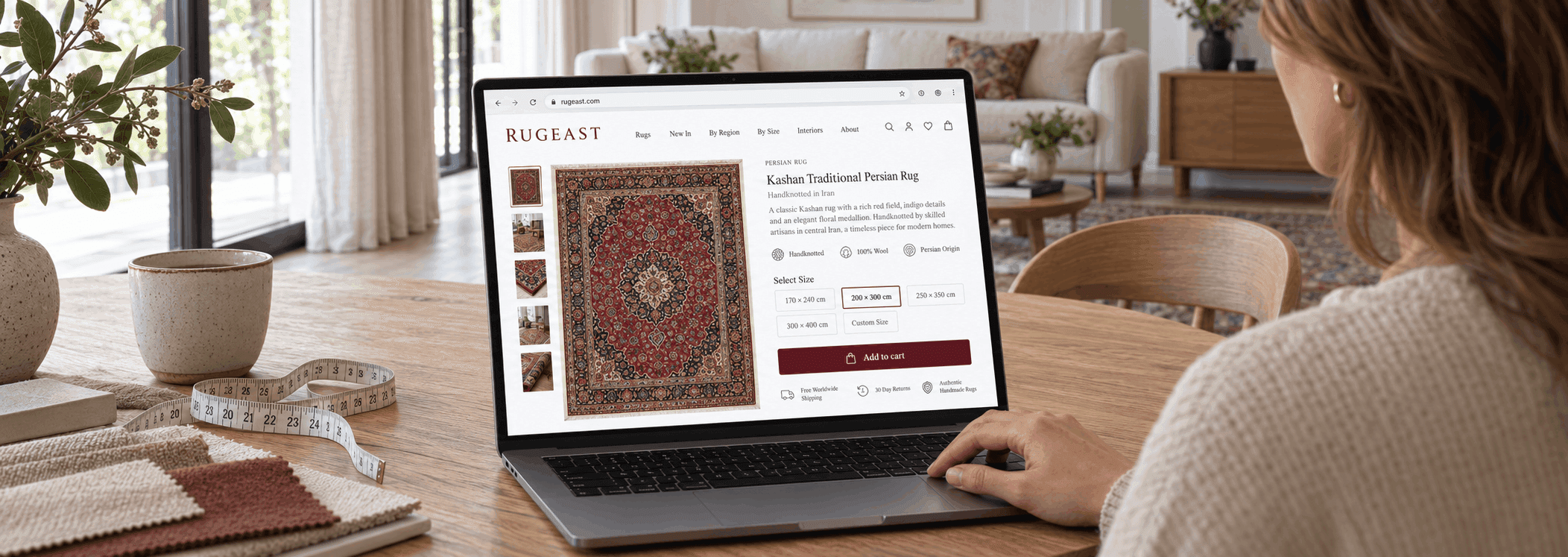
Choosing a rug online can be challenging because you cannot immediately assess its texture, exact colour, weight or visual scale in person.
A systematic approach makes the process easier.
Step 1: Start with the room, not the rug category
Identify the room's existing characteristics:
- Floor colour and material.
- Wall colour.
- Sofa colour.
- Main furniture dimensions.
- Available natural light.
- Desired atmosphere.
Decide whether the rug should create a strong contrast or contribute to a quieter palette.
Step 2: Establish the correct dimensions
Measure the area where the rug will sit.
Do not rely only on the room's total floor area. The dimensions of the furniture arrangement are usually more useful when choosing a living-room rug.
Step 3: Evaluate the actual colours
Review several photographs if available.
A rug may appear more red, blue, muted or saturated depending on the lighting, camera settings and display.
If colour is particularly important to your decision, request additional photographs or clarification from the seller where possible.
Step 4: Understand the rug's construction
Check whether the rug is hand-knotted, flat-woven or made using another construction method.
These categories have different physical characteristics, textures and maintenance requirements.
A handmade rug should be described accurately. Avoid assuming that every rug marketed as Persian is hand-knotted or that every product with a traditional pattern has the same construction.
Step 5: Consider how the room will be used
A rug for a quiet sitting room may have different requirements from one placed in a busy hallway or dining area.
Consider foot traffic, furniture movement, cleaning and the suitability of an underlay.
Step 6: Review the practical purchase information
Before purchasing, check:
- Exact dimensions.
- Material and construction.
- Product condition.
- Care instructions.
- Delivery arrangements.
- Return policy.
- Any relevant import or customs charges for your destination.
These details are part of choosing the right rug, not merely administrative considerations.
Step 7: Visualise the complete arrangement
Use the measurements to mark the proposed rug size on the floor.
If you are uncertain about colour, place fabric samples or cushions near the marked area and observe them in daylight and evening lighting.
This helps you evaluate the rug as part of the room rather than as an isolated product image.
Explore handmade rugs at Rugeast
Rugeast offers handmade Persian and Oriental rugs in a variety of designs, sizes and colour palettes.
Explore the collection and compare the individual rugs according to your room's dimensions, materials and desired atmosphere.
The most suitable rug is not necessarily the most colourful or the most elaborate. It is the one that works with your space and that you will enjoy living with over time.
Frequently Asked Questions
Can you put a Persian rug in a modern living room?
Yes. A Persian rug can complement contemporary furniture by introducing pattern, colour, texture and craftsmanship. A particularly effective approach is to combine a detailed rug with simple furniture and a considered colour palette. However, geometric and more restrained Persian rugs can also work well in minimalist interiors.
Do Persian rugs go with modern furniture?
Absolutely. Modern furniture and traditional rugs often work well together because they offer different visual qualities. Straight furniture lines can balance the ornamentation of a traditional rug, while the rug softens the appearance of contemporary materials such as glass, metal and stone.
What colour Persian rug goes with a grey sofa?
It depends on the shade of grey and the room's other materials. Muted red, rust, ivory, indigo and olive are all worth considering. A warm grey sofa may work well with terracotta and warm brown, while a cooler grey can complement blue, ivory and burgundy. Always consider the floor colour and natural light as well.
Which Persian rug colours work best with beige furniture?
Beige furniture can complement rugs featuring rust, muted red, indigo, olive, warm brown and cream. The best choice depends on whether you want a noticeable contrast or a quieter, tonal appearance. Some difference in colour, pattern or texture can help prevent the room from looking flat.
Can I use a Persian rug with white walls and light wood flooring?
Yes. This combination provides a flexible foundation for many Persian rugs. A rug with a stronger colour palette can create a focal point, while a lighter or more muted design can preserve a calm, Scandinavian-inspired atmosphere.
Do Persian rugs make a modern room look old-fashioned?
Not necessarily. A rug's effect depends on its design, colour, proportions and relationship to the surrounding furniture. A richly patterned traditional rug can look distinctly contemporary when paired with simple furniture, while a geometric Gabbeh can create a more informal atmosphere.
Should the rug match the sofa?
No. Exact matching is unnecessary. Instead, consider how the rug's colours relate to the sofa, flooring and other materials. Repeating one or two colours in cushions or artwork is often sufficient to create a visual connection.
Should a Persian rug be darker or lighter than the floor?
Neither is universally better. A lighter rug can stand out against dark flooring, while a darker rug can create contrast against pale wood. The important factors are the rug's pattern, its visual weight and how clearly it is distinguished from the floor.
What size Persian rug should I choose for my living room?
The correct size depends on the room and furniture arrangement. In many living rooms, placing the front legs of the sofa and armchairs on the rug creates a coherent seating area. Larger arrangements may benefit from a rug that accommodates all the main seating furniture. Measure before purchasing rather than relying on the room's total area alone.
Can I place a Persian rug over wooden flooring?
Yes. Wooden floors and handmade rugs can complement one another through their natural textures and contrasting colours. Use a suitable underlay where necessary, especially if the floor is smooth and the rug tends to move.
Can I place a Persian rug on tiles or marble?
Yes. A handmade rug can introduce warmth and texture to hard flooring and help define a seating area. On smooth surfaces, ensure that the rug lies flat and use an appropriate non-slip underlay to reduce movement.
Can I mix a Persian rug with other patterns?
Yes. The key is to vary the scale and visual intensity of the patterns. A detailed rug can work with restrained stripes, subtle checks or textured upholstery. Keep some surfaces relatively quiet if the room begins to feel visually crowded.
Are Gabbeh rugs suitable for minimalist interiors?
Many Gabbeh rugs are well suited to minimalist interiors because their geometric or simplified designs can introduce colour and craftsmanship without excessive ornamentation. However, Gabbeh rugs vary, so evaluate the specific design, palette and dimensions rather than relying on the name alone.
Are Persian rugs suitable for dining rooms?
They can be, provided the size, construction and maintenance requirements suit the space. The rug should accommodate chairs when they are pulled away from the table, and the household should be comfortable with the cleaning requirements. If the room cannot accommodate a sufficiently large rug, leaving the floor uncovered may be more practical.
Are kilims a good choice beneath a dining table?
Sometimes, but the decision requires care. Some lightweight flat-woven kilims can shift or gather when chairs move, particularly on smooth flooring. Consider the rug's weight, underlay, construction and the amount of space available around the table before choosing one.
How can I make a Persian rug the focal point of a room?
Place it where it connects visually with the principal furniture. Keep the largest surrounding surfaces relatively restrained, then repeat one or two colours from the rug in carefully selected accessories. Good proportions and adequate visibility are usually more important than adding additional decoration.
How do I choose a Persian rug when buying online?
Begin with the room's measurements, flooring, furniture colours and lighting. Then compare the rug's dimensions, pattern, construction, material and product photographs. Check delivery, return and care information before purchasing. If colour accuracy is especially important, seek additional photographs or clarification from the seller.
15. Final Thoughts: Let the Rug Bring the Room Together
A Persian rug does not have to make a contemporary European home look traditional. It can do something more interesting: introduce craftsmanship, colour, texture and individuality into an otherwise modern space.
The best results usually come from considering the room as a whole.
Think about the relationship between the rug and the sofa, the warmth of the wood, the amount of natural light, the scale of the furniture and the colours already present. Choose a rug that contributes something meaningful to that arrangement without requiring every other object to match it.
Sometimes the right choice is a richly coloured traditional carpet beneath a minimalist sofa. In another room, it may be a geometric Gabbeh beside pale oak furniture or a softly coloured Persian rug against warm neutral walls.
There is no single formula that works for every interior.
Our advice at Rugeast is simple: choose a rug you genuinely appreciate, give it enough space to be seen, and let the rest of the room support its character rather than compete with it.
A well-chosen handmade rug can remain relevant even as furniture, accessories and interior design trends change.
Explore the handmade rug collections at Rugeast to discover designs that suit your space, preferences and everyday life.