
What are nomadic and tribal carpets, and what are their characteristics?
Nomadic handwoven carpets express living traditions shaped by migration, pastoral life and cultural exchange. Made with varied materials, looms, motifs and techniques, they served practical and artful roles. Their future depends on fair pay, accurate attribution, responsible sourcing and teaching.
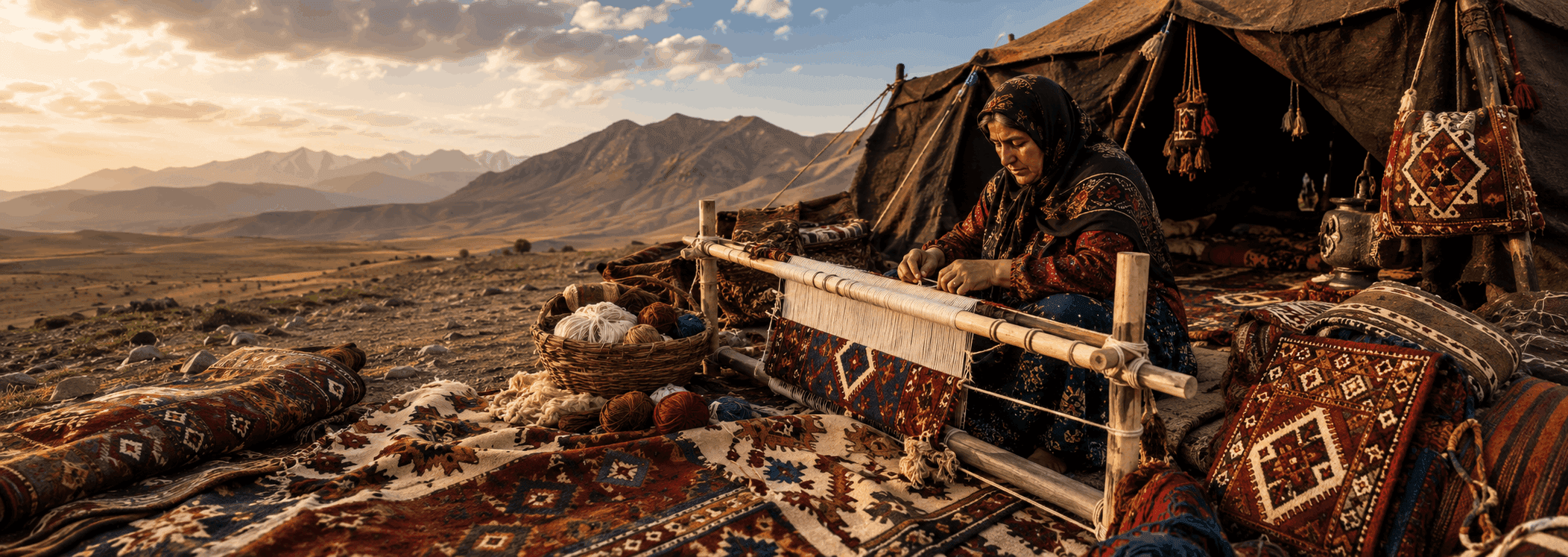
Nomadic and semi-nomadic carpets are more than decorative textiles. They embody practical knowledge, artistic creativity, community identity, and ways of life shaped by seasonal migration and pastoral environments.
Although the term “nomadic carpet” covers many distinct traditions, these works commonly combine locally available materials, inherited weaving techniques, and designs adapted by individual weavers.
Materials and Weaving Techniques
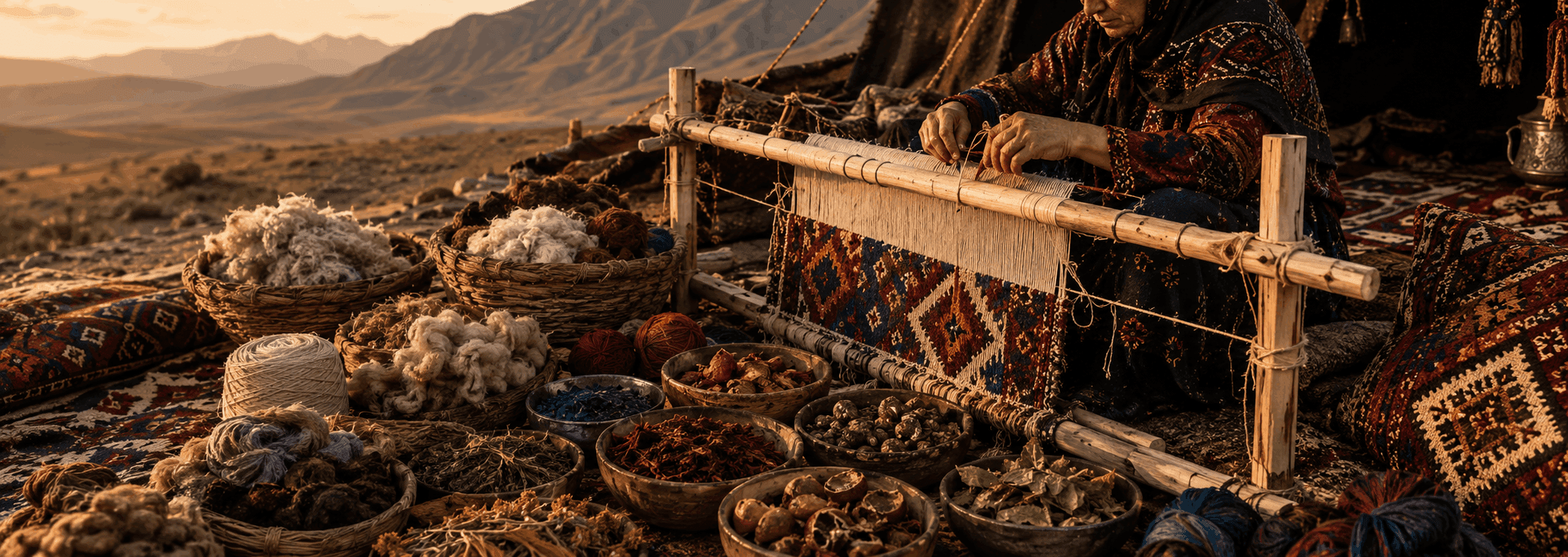
Pastoral communities traditionally obtained wool from their own sheep, goats, and—less commonly for carpet pile—camels. Wool was particularly suitable for mobile life because it was accessible, resilient, warm, and relatively easy to spin.
Natural dyes historically came from sources such as:
- Madder root
- Indigo
- Walnut husks
- Pomegranate rind
- Local leaves and flowers
- Certain dye-producing insects
Natural dyes were not used exclusively. Commercial synthetic dyes entered many weaving communities during the nineteenth and twentieth centuries and became part of both village and nomadic production.
Nomadic weavers frequently worked on simple horizontal looms that could be dismantled and transported during migration. However, Iranian flat weaves were produced on both horizontal and vertical looms, depending on the community and circumstances.
Pile rugs were formed by tying successive rows of knots around the warps and securing them with wefts. Nomadic communities also created kilims, bags, tent bands, bedding containers, animal trappings, and other textiles using several flat-weaving techniques.
Patterns as Cultural Expression
Many nomadic carpets were woven without full-scale paper cartoons. Weavers relied on learned structures, familiar motifs, memory, repetition, and improvisation.
Common forms include:
- Lozenges and diamonds
- Stars
- Hooks and stepped polygons
- Birds and other animals
- Flowers and plants
- Human figures
- Tree-like compositions
- Tribal or clan emblems
- Protective and amuletic forms
These designs can reflect local customs, family traditions, trade contacts, and the weaver’s artistic choices. Variations and irregularities are not necessarily errors; they may reveal the handmade process and distinguish one textile from another.
Interpreting Symbols with Caution
Carpet motifs are often assigned meanings such as fertility, protection, abundance, water, life, or good fortune. Some interpretations are supported by local terminology or ethnographic evidence, but others are later commercial explanations.
A tamgha was historically an emblem, seal, or identifying mark associated with a ruler, clan, family, or tribal group. Not every geometric carpet motif should therefore be classified as a tamgha.
Similarly, an S-shaped device may have different names and meanings in different weaving traditions. It has variously been interpreted as flowing water, a dragon, a hook, or a protective sign. The claim that a particular “A Tamgha” can be traced continuously through Sumerian and Çatalhöyük art for more than 10,000 years is not supported by sufficient evidence. Visual resemblance alone cannot establish an uninterrupted cultural lineage.
Durability and Practical Uses
Nomadic textiles were designed for active use. Depending on their form, they served as:
- Floor coverings
- Sleeping and bedding materials
- Storage sacks
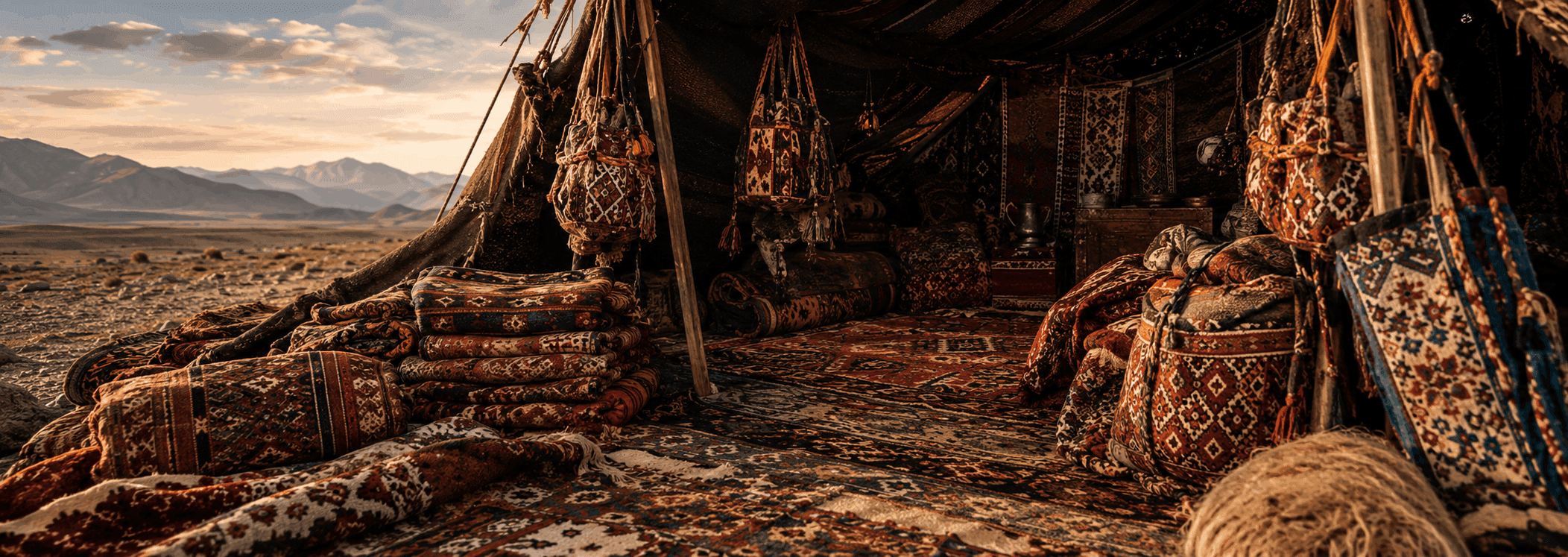
- Tent furnishings
- Door coverings
- Saddle covers
- Animal decorations
- Containers for food, clothing, and household goods
Good wool and sound construction can produce highly durable textiles. Nevertheless, age alone does not guarantee strength. Sunlight, moisture, insects, dirt, repairs, and previous use all affect condition.
Their environmental impact must also be assessed carefully. Local wool, plant dyes, manual production, and long service lives can reduce dependence on industrial materials. However, natural production is not automatically sustainable: grazing pressure, water consumption, dyeing practices, transportation, and working conditions must also be considered.
Regional Diversity
There is no single nomadic carpet style. Iranian weaving alone includes traditions associated with Qashqai, Afshar, Shahsevan, Kurdish, Khamseh, Luri, and other communities.
These groups differ in:
- Knot structure
- Weave density
- Color palette
- Border arrangement
- Motif selection
- Materials
- Textile function
- Finishing methods
Attribution can be difficult because communities migrated, traded materials, borrowed designs, intermarried, and sometimes produced carpets for commercial markets. Dealer labels do not always correspond precisely to the identity of the weaver.
Modern Challenges and Adaptation
Nomadic weaving has changed significantly because of settlement, formal education, wage employment, altered migration routes, commercial demand, and reduced access to traditional materials.
These developments may cause:
- Loss of specialized weaving knowledge
- Declining use of portable looms
- Replacement of local materials
- Simplification or standardization of designs
- Dependence on dealers and export markets
- Inadequate compensation for weavers
Yet the tradition has not simply disappeared. Some settled and semi-settled communities continue weaving, while cooperatives, cultural organizations, designers, and individual artisans have created new markets and forms of production. Encyclopaedia Iranica emphasizes both the diversity of Iranian tribal weaving and the profound changes affecting the communities that produce it.
Preservation should therefore support living weavers—not merely collect older carpets. Fair payment, accurate attribution, documentation of techniques, responsible sourcing, and intergenerational teaching are essential.
Nomadic Carpets in Western Art and Interiors
Oriental carpets have circulated internationally for centuries as commercial goods, diplomatic gifts, furnishings, and works of art. Their appearance in European paintings and historic interiors demonstrates the extensive cultural connections linking pastoral communities, weaving centers, merchants, and collectors.
Sigmund Freud’s study provides a well-known modern example. Freud surrounded himself with antiquities and richly patterned textiles, and his psychoanalytic couch was covered with a Qashqai carpet. The Freud Museum’s collection contains more than twenty carpets, illustrating his strong interest in Oriental textiles.
The presence of these objects in Freud’s study reflects Western collecting and interior design as well as the international circulation of Middle Eastern textiles. It should not be treated as evidence that every rug in the room was necessarily made by a nomadic Iranian community.
Cultural and Artistic Significance
Nomadic carpets preserve knowledge embedded in materials, technique, design, and use. They can record the movement of people, exchange of motifs, changing economic conditions, and creative decisions of individual weavers.
Their importance lies not in the romantic idea that nomadic art remained unchanged for millennia, but in its adaptability. These textiles are products of living cultures that continually responded to migration, environment, commerce, family tradition, and artistic invention.
FAQs
1. What materials were traditionally used in nomadic carpets?
Weavers commonly used locally sourced sheep or goat wool and dyes derived from plants, insects or commercial synthetic products.
2. Do nomadic carpet motifs have universal meanings?
No. Meanings vary among communities, periods and weavers, while some popular interpretations lack sufficient historical or ethnographic evidence.
3. How can nomadic weaving traditions be preserved?
Preservation requires fair payment, accurate attribution, responsible sourcing, technical documentation and intergenerational teaching that supports living weavers.