
Persian Rug or Persian Design?
A practical guide to origin, design, weaving structure, craftsmanship and documentation for today’s rug buyer When you see a beautiful hand-knotted rug described as a “Persian rug,” what does that actually mean?
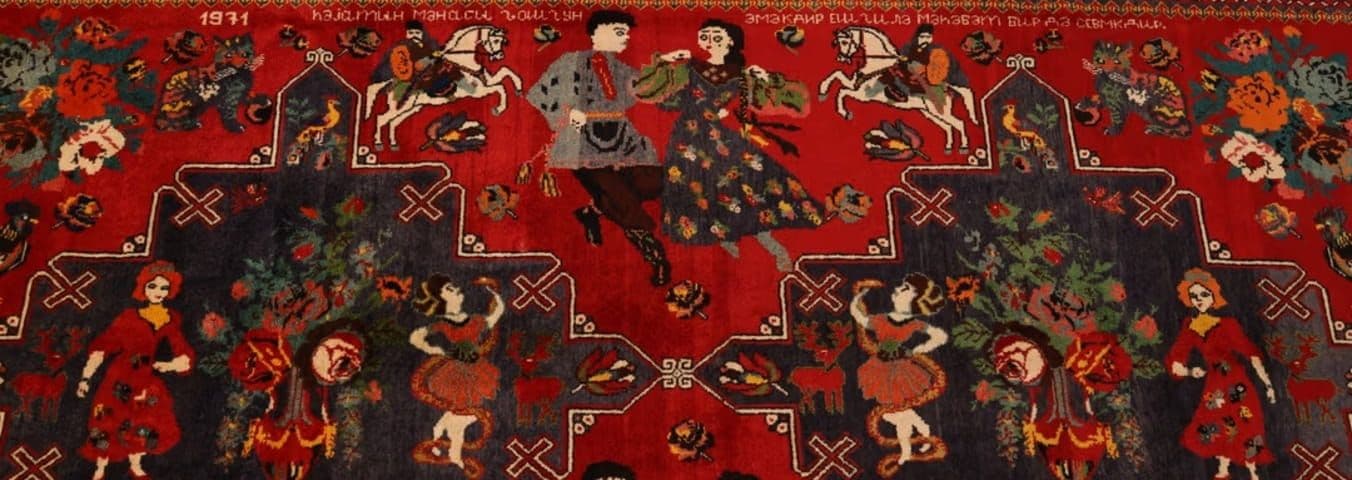
How to Tell Where a Handmade Rug Really Comes From
A practical guide to origin, design, weaving structure, craftsmanship and documentation for today’s rug buyer
When you see a beautiful hand-knotted rug described as a “Persian rug,” what does that actually mean?
Was it made in Iran?
Was it simply inspired by traditional Persian patterns?
Was it made in India, Nepal, Pakistan, Turkey or another country using a Persian-inspired design?
And when a seller describes a rug as “authentic,” “original,” “genuine” or “Persian style,” what evidence should you expect?
These questions matter because the appearance of a rug can tell you a great deal about its design language—but not necessarily where it was made.
A rug can look unmistakably Persian and still have been woven outside Iran. Conversely, a rug made in Iran does not have to look traditional at all. Contemporary Iranian workshops produce modern, minimalist and experimental designs as well as traditional patterns.
The central principle is simple:
Design tells you what a rug looks like. Origin tells you where it was made.
Understanding the difference can help you make a more informed purchase and ask better questions before paying for a handmade rug.
The Short Answer
A Persian rug traditionally refers to a rug associated with the Persian/Iranian carpet-making tradition, and in commercial use the term is often intended to indicate Iranian origin.
A Persian design rug, however, describes a rug whose visual language is inspired by Persian carpet traditions.
Those are not necessarily the same thing.
A hand-knotted rug made in India with a traditional Persian floral design is still a handmade Indian rug.
A hand-knotted rug made in Nepal with a Persian-inspired medallion is still a Nepalese-made rug.
And a contemporary rug made in Iran with an abstract design is still an Iranian-made rug.
The design may travel.
The country of manufacture does not.
This distinction becomes especially important when a rug is being sold at a premium because it is described as “Persian,” “Iranian,” “original” or “authentic.”
Persian Rug vs Persian Design
The easiest way to understand the difference is to separate origin from appearance.
Description
What it primarily tells you
Persian / Iranian rug
Intended to communicate connection to Iranian origin or tradition
Persian design
Describes the visual language or inspiration
Persian-inspired rug
Design influenced by Persian carpet traditions
Hand-knotted rug
Describes construction
Handmade rug
Describes production method, but may require clarification
Oriental rug
A broad commercial/historical category that does not identify one country
Authentic rug
Requires clarification: authentic in what sense?
This distinction is important because several different characteristics are often mixed together in online product descriptions.
A rug can be:
- hand-knotted,
- made from wool,
- densely knotted,
- made with a Persian-style design,
- beautifully finished,
and still not have been made in Iran.
None of those characteristics alone is a passport.
Why Does the Difference Matter?
The distinction is not about declaring one country’s rugs “better” than another’s.
Indian, Nepalese, Pakistani, Turkish, Moroccan and other handmade rugs can be exceptionally well made.
The issue is accurate description.
If a buyer believes that a rug was woven in Iran when it was actually woven elsewhere, the buyer is making a decision based on incorrect or incomplete information.
Country of origin can affect:
- cultural significance,
- regional identity,
- collectability,
- historical context,
- construction traditions,
- market value,
- provenance,
- and the meaning attached to the rug.
For that reason, origin should be treated as a separate question from design.
Persian Design Has Travelled Across Borders for Generations
Persian carpet design is not confined to modern political borders.
Floral patterns, medallions, arabesques, boteh motifs, garden compositions, all-over patterns and other design traditions associated with Persian carpets have influenced rug production in many countries.
This is one reason the international rug market can be confusing.
A manufacturer may legitimately produce a hand-knotted rug inspired by Persian visual traditions.
There is nothing inherently wrong with that.
The important thing is that the rug should be described accurately.
A simple example
Imagine three rugs:
Rug A
- Made in Iran
- Traditional Persian design
- Hand-knotted
Rug B
- Made in India
- Persian-inspired design
- Hand-knotted
Rug C
- Made in Iran
- Contemporary geometric design
- Hand-knotted
All three can be beautiful handmade rugs.
But their descriptions should not be interchangeable.
The Most Important Question: Where Was It Made?
When someone tells you:
“This is a Persian rug.”
your next question should be:
“Where was it made?”
If the answer is Iran, you can continue investigating the rug's regional identity, construction and provenance.
If the answer is India, Nepal, Pakistan or another country, the rug may still be an excellent handmade product—but it should be understood as a rug made in that country, potentially using Persian-inspired design.
This is why country of origin should be established before regional attribution.
You cannot reliably determine that a rug is from Kashan, Tabriz, Nain, Isfahan, Bidjar or another Iranian region simply because the design looks familiar.
A Rug Has a Hidden Structure
One of the most fascinating aspects of handmade rugs is that much of the information specialists examine is not immediately visible from the front.
A pile rug is constructed from several interacting elements.
Warp
The warp threads run longitudinally through the rug and form an essential part of its foundation.
Weft
The weft passes across the warp, helping bind the foundation together.
Each passage of weft is commonly described as a shoot or pass.
Knots
The pile yarn is tied around the warp threads.
The cut ends become the visible pile of the rug.
Pile
The pile is the raised surface that gives the rug much of its tactile character.
These components work together to create the rug's structure.
Technical carpet literature identifies factors such as fibre characteristics, number of weft shoots, weft tension, knot type and knot density as important structural characteristics.
Why the Back of a Rug Can Tell You More Than the Front
The front of a rug is dominated by colour, pattern and pile.
The back can reveal something else:
how the rug was constructed.
When specialists examine a rug, the reverse may provide useful information about:
- knot structure,
- warp arrangement,
- weft passages,
- foundation density,
- knot consistency,
- structural irregularities,
- selvedge construction,
- and other technical characteristics.
This does not mean that anyone can identify a rug's origin simply by looking at its back.
It means that the back provides additional evidence.
That distinction is important.
A knot is evidence—not a passport.
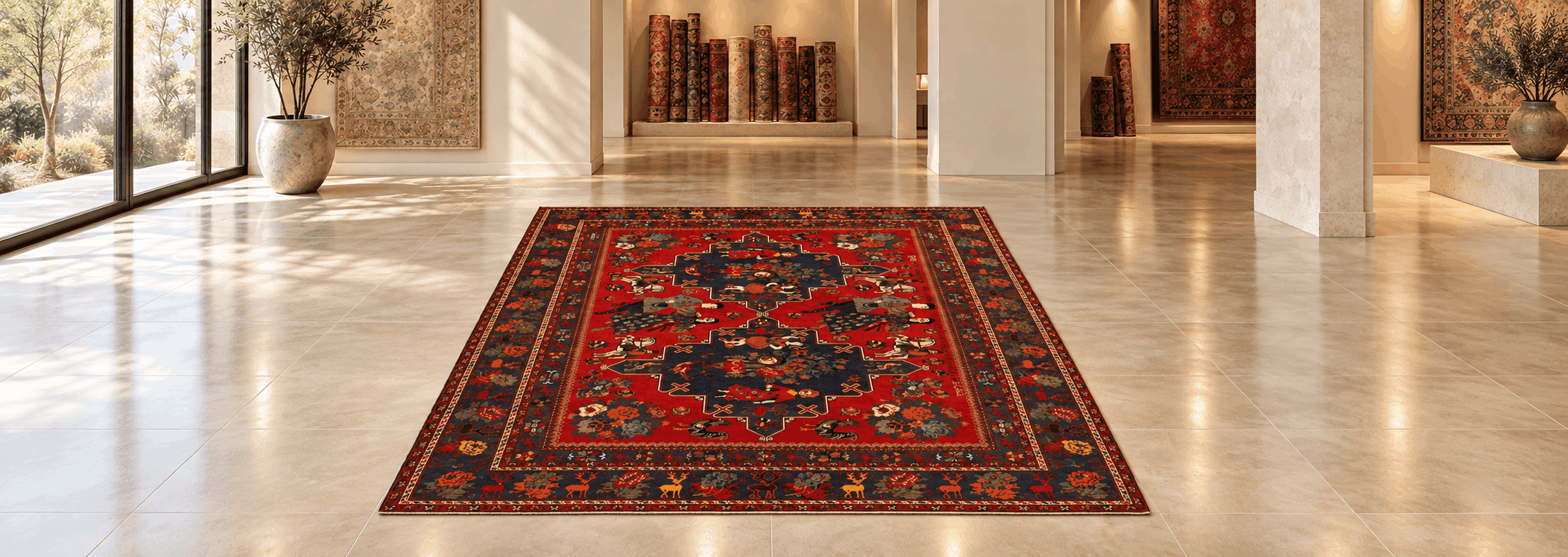
Weft Tension: A Small Detail With a Big Structural Effect
One of the most interesting technical characteristics of a hand-knotted carpet is weft tension.
The way weft threads are inserted and tensioned can influence the position of the warp threads.
In some structures, differences in tension can cause alternate warp threads to sit at different levels, producing what textile specialists describe as depressed warp structures.
In other structures, the warps remain more level.
This is not simply an academic detail.
It is part of the physical language of a woven object.
Specialist literature identifies the number of weft shoots and the degree of weft tension as factors that influence carpet structure.
The Metropolitan Museum of Art also documents historical Persian carpets in which dense warps and multiple weft passes create distinctive structural characteristics.
Why this matters to origin identification
Different weaving communities developed different construction traditions.
Therefore, structural analysis can sometimes help specialists compare a rug with known regional traditions.
But it should never be used in isolation.
Persian Knot Does Not Automatically Mean Iran
You may encounter terms such as:
- Persian knot
- Senna knot
- Turkish knot
- Ghiordes knot
These terms are useful when discussing construction.
But they should not be treated as simple geographic labels.
The old terminology can be misleading because both major knot types occur across different parts of the Near and Middle East.
Therefore:
Persian knot ≠ automatic proof of Iranian origin.
And:
Turkish knot ≠ automatic proof of Turkish origin.
The knot is one structural characteristic among many.
Knot Density Is Important—but It Is Not an Origin Certificate
Knot density is often used to describe the fineness of a rug.
Higher density can allow a weaver to render more detailed designs, although quality is not determined by density alone.
A high-knot-density rug can be made outside Iran.
A lower-density Iranian rug can still be an authentic and culturally significant Iranian handmade rug.
So if a seller says:
“This rug has 800,000 knots per square metre, therefore it is Persian.”
that conclusion does not follow.
Knot density tells you something about construction.
It does not, by itself, tell you the country of manufacture.
Materials Tell a Story—but Not the Whole Story
You may also hear:
- “It is made from Persian wool.”
- “It uses natural silk.”
- “It has traditional Iranian wool.”
- “The cotton foundation proves it is Persian.”
Materials are important.
Wool, silk, cotton and other fibres influence the appearance, feel, durability and construction of a rug.
But materials alone generally cannot establish country of origin.
The same fibre can be used by weavers in different countries.
Again, the principle is:
One characteristic can provide evidence. A reliable attribution requires a combination of evidence.
How Specialists Think About Rug Origin
Rather than looking for one magical feature, a specialist may consider several layers of information.
1. Country of manufacture
Where was the rug actually woven?
2. Regional characteristics
Does its construction correspond with known regional traditions?
3. Weaving structure
What can be observed in the warp, weft, knots and foundation?
4. Materials
What fibres and dyes were used?
5. Design
Does the design correspond with a known regional or workshop tradition?
6. Finishing
What can the selvedges, ends and fringes tell us?
7. Condition and age
Are the claimed age and physical evidence consistent?
8. Provenance
Is there a documented ownership or sales history?
9. Documentation
Is there a certificate, invoice, appraisal or other evidence?
10. Seller's claim
What exactly is the seller claiming?
The last point is important.
A seller's statement is part of the information available to the buyer—but it is not automatically independent evidence.
Claim vs Evidence
This is one of the most useful concepts for anyone buying an expensive handmade rug.
Consider the difference:
Claim
“This is an authentic antique Persian rug.”
Evidence
Country of origin, documented age, construction analysis, provenance, photographs, previous ownership records, specialist assessment and supporting documentation.
The first is a statement.
The second is evidence.
A professional buyer should learn to distinguish between the two.
What Does “Original” Actually Mean?
The word original is surprisingly ambiguous.
It can mean:
- original design,
- original condition,
- authentic historical piece,
- not a reproduction,
- genuine handmade construction,
- or simply “not copied” in a marketing context.
Therefore, when you see:
“100% Original Persian Rug”
ask:
Original in what sense?
A useful seller should be able to explain exactly what the term means.
What Does “Authentic” Mean?
The same problem exists with authentic.
Authentic can refer to:
- country of origin,
- handmade construction,
- traditional production,
- age,
- regional attribution,
- material,
- design,
- or provenance.
These are different claims.
A rug can be genuinely handmade but incorrectly described as Iranian.
A rug can genuinely be made in Iran but have a modern design.
A rug can genuinely be old but have an uncertain regional attribution.
That is why “authentic” should never replace a precise description.
Certificates: Useful, But Read the Certificate
A certificate can be valuable.
But the existence of a certificate does not automatically prove every statement made about a rug.
Before relying on a certificate, ask:
Who issued it?
Is the issuer identifiable?
What does it actually certify?
Origin?
Age?
Material?
Handmade construction?
Design?
Is the information verifiable?
Can the certificate number, issuer or record be checked?
Does the certificate describe this specific rug?
The certificate should correspond to the rug being offered.
Does the certificate distinguish fact from opinion?
For example:
“Made in Iran”
is a different type of statement from:
“Attributed to Kashan.”
The second may indicate an attribution rather than absolute certainty.
Five Red Flags Worth Investigating
None of these automatically proves dishonesty.
But each should encourage you to ask more questions.
Red Flag 1
The rug is called Persian, but the country of manufacture is not clearly stated.
Red Flag 2
The listing spends a great deal of space describing the design but says little about construction.
Red Flag 3
The rug is described as “antique” without explaining its approximate age or provenance.
Red Flag 4
Words such as “rare,” “original,” “genuine” or “authentic” appear repeatedly without supporting information.
Red Flag 5
The seller cannot explain why the rug has been attributed to a particular country or region.
The appropriate response is not necessarily:
“This rug is fake.”
The appropriate response is:
“What evidence supports this claim?”
A Better Way to Describe a Handmade Rug
A transparent product description should separate different types of information.
For example:
Origin
Iran
Regional attribution
Attributed to Kashan
Construction
Hand-knotted
Pile
Wool
Foundation
Cotton warp and weft
Design
Traditional Persian floral design
Approximate age
Contemporary / circa 2010
Documentation
Certificate supplied
This is much more useful than simply writing:
“Authentic Original Persian Carpet – Rare!”
The first description gives the buyer information.
The second relies heavily on adjectives.
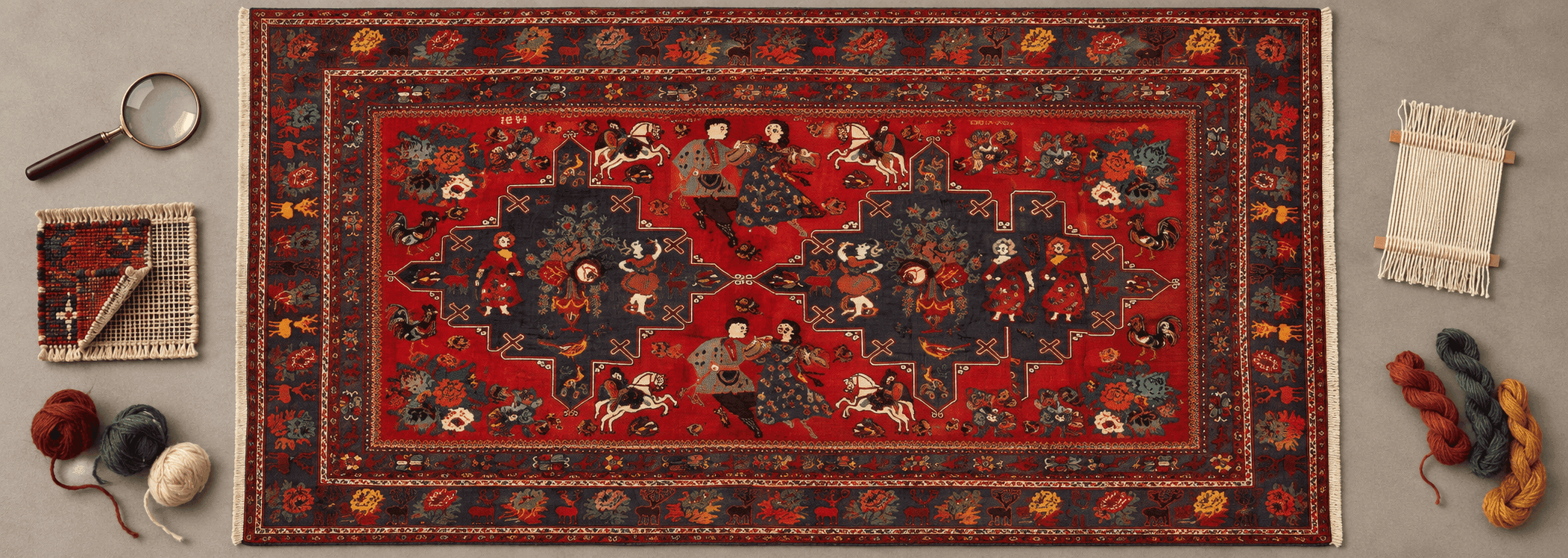
A Practical Example
Imagine an online listing showing a beautiful floral rug.
The title says:
“Authentic Persian Handmade Rug – Rare Original.”
Instead of immediately accepting the description, ask:
Question 1
Where was it made?
Question 2
Which region is it attributed to?
Question 3
What is the knot type?
Question 4
What are the warp and weft materials?
Question 5
How many weft shoots occur between knot rows?
Question 6
Is the warp level or depressed?
Question 7
What is the knot density?
Question 8
Is there documentation?
Question 9
What does the certificate actually certify?
Question 10
What evidence supports the stated origin?
These questions transform you from a passive customer into an informed buyer.
Can a Persian-Inspired Rug Be Better Than a Persian Rug?
Absolutely—depending on what the buyer values.
A rug made in India, Nepal, Pakistan or another country can be:
- beautifully designed,
- carefully hand-knotted,
- made from excellent materials,
- technically sophisticated,
- durable,
- and visually exceptional.
The purpose of identifying origin is not to create a hierarchy of countries.
It is to ensure that the buyer knows what they are purchasing.
A transparent description of a Persian-inspired Indian rug is more useful than a misleading description of the same rug as Iranian.
RUGEAST EXPERT RULE
The Rugeast Expert Rule
Never identify a rug by its design alone.
Look at origin, construction, materials, regional characteristics and documentation together.
This principle is particularly important when buying online, where the buyer may not be able to physically inspect the rug.
The Five Questions to Remember
When you see a rug described as Persian, remember these five questions:
WHERE?
Where was the rug made?
HOW?
How was it constructed?
WHAT?
What materials, knots, warp and weft were used?
WHICH?
Which regional or workshop tradition is it associated with?
EVIDENCE?
What supports the seller's claim?
These five questions are more useful than simply asking:
“Does it look Persian?”
RUGEAST DIGITAL BUYING GUIDE
How to Examine a Rug Online
Buying online does not mean that you have to buy blindly.
Ask the seller for photographs of:
1. The full front
2. The full back
3. A close-up of the pile
4. A close-up of the reverse
5. One or more corners
6. The selvedges
7. The fringes
8. The label
9. The certificate
10. Any available provenance documentation
For valuable rugs, these details can be much more informative than another photograph of the living-room setting.
The Back Is a Second Story
The front of a rug tells its visual story.
The back often tells part of its structural story.
Look closely and you may see:
- rows of knots,
- warp alignment,
- weft passages,
- changes in density,
- irregularities caused by hand production,
- structural details associated with particular weaving traditions.
But remember:
Structural evidence should be interpreted together, not as a single magic test.
This is especially important because Persian carpet structures are highly varied and can be associated with different producing regions and groups. Specialist literature therefore considers structure alongside stylistic features and documentary or historical evidence.
Why Regional Knowledge Matters
Iranian carpet production has never been one uniform system.
Different regions and weaving communities developed their own combinations of:
- materials,
- knotting,
- warp and weft arrangements,
- weaving tension,
- finishing,
- colour traditions,
- patterns,
- proportions,
- and production practices.
That is why two rugs can look similar at first glance while revealing important differences when examined technically.
This is also why a serious regional attribution should not be based on one visual motif.
Design Is a Language—Not a GPS Coordinate
A Persian-inspired floral design can travel thousands of kilometres.
A medallion does not have a passport.
A boteh does not have a passport.
A floral border does not have a passport.
Even a familiar regional-looking composition does not automatically prove where a rug was woven.
Design is evidence.
But design alone is not sufficient evidence of origin.
RUGEAST BUYER'S GUIDE
The Buyer's Quick Checklist
Before purchasing a rug advertised as Persian or Iranian, ask:
☐ Is the country of manufacture clearly stated?
☐ Is the regional attribution explained?
☐ Is the rug actually handmade?
☐ Is the construction described?
☐ Are the warp and weft materials identified?
☐ Is the knot type identified?
☐ Is knot density stated when relevant?
☐ Can I see the back of the rug?
☐ Is the age documented if it is described as antique or vintage?
☐ Is there provenance?
☐ Is there a certificate?
☐ What exactly does the certificate certify?
☐ Can the seller explain the origin claim?
☐ Are claims such as "authentic," "original" and "rare" supported by specific information?
The Three Levels of Confidence
Not every rug can be attributed with absolute certainty.
A professional description can therefore use different levels of confidence.
Documented
There is clear supporting documentation.
Attributed
The rug is believed to belong to a particular region or tradition based on available evidence.
Uncertain
The available information is insufficient to make a reliable attribution.
This language is much more useful than pretending every attribution is 100% certain.
Why This Matters More Online
In a physical rug shop, you can turn the rug over.
You can touch the pile.
You can examine the back.
You can look at the selvedge.
You can ask questions.
Online, much of that information disappears unless the seller deliberately provides it.
That is why good online rug sellers should show more than a beautiful front photograph.
A professional online listing should make the rug easier to understand—not simply easier to desire.
A More Transparent Future for the Rug Market
Digital commerce is changing how handmade rugs are bought.
A modern buyer increasingly wants to know:
- where something was made,
- who made it,
- what materials were used,
- how it was produced,
- whether the description can be verified,
- and whether the product's story is supported by evidence.
This creates an opportunity for responsible rug businesses.
Instead of relying on vague words such as:
Authentic. Original. Rare. Genuine.
the future belongs to descriptions that explain:
Origin. Construction. Materials. Attribution. Documentation.
Rugeast Buyer Principle
At Rugeast, we believe that a handmade rug should be described through information that helps the buyer understand what they are actually purchasing.
A rug does not become Iranian simply because its design looks Persian.
A rug does not become authentic simply because a seller calls it authentic.
And a rug does not become valuable simply because a listing uses impressive adjectives.
The more meaningful questions are:
Where was it made?
How was it made?
What evidence supports its attribution?
That is the beginning of an informed rug purchase.
Symmetrical and asymmetrical knot types are used across different geographic areas. Knot type should be treated as one structural characteristic rather than a geographic passport.
Does high knot density prove that a rug is Persian?
No.
Knot density describes an aspect of construction. It does not independently establish country of origin.
Frequently Asked Questions
1) Is every Persian-style rug made in Iran?
No.
Persian-style or Persian-inspired rugs can be produced in many countries. The design language does not necessarily identify the country of manufacture.
2) Does a Persian knot prove that a rug was made in Iran?
No.
Symmetrical and asymmetrical knot types are used across different geographic areas. Knot type should be treated as one structural characteristic rather than a geographic passport.
3) Does high knot density prove that a rug is Persian?
No.
Knot density describes an aspect of construction. It does not independently establish country of origin.