
How Age, Light and Time Transform the Character of a Persian Rug
Persian rugs naturally change over time as light, use, cleaning and the environment affect their wool, colours and surface. Understanding patina, wear and ageing helps you recognise the difference between beautiful character and serious damage.
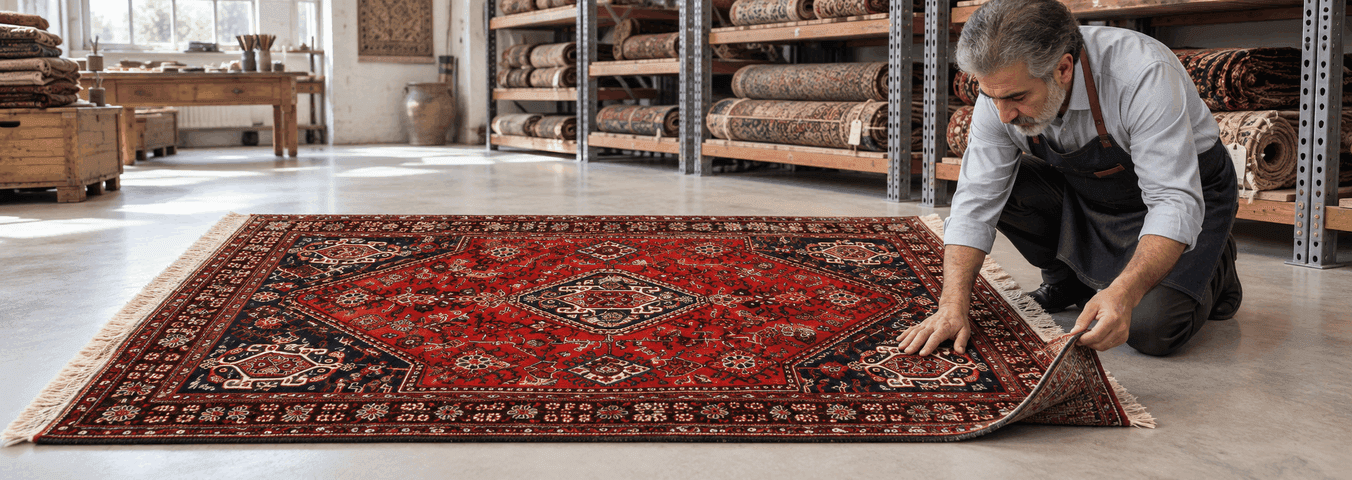
A handmade Persian rug does not remain exactly the same throughout its life.
From the moment it leaves the loom, its colours, wool, pile and surface begin to respond to the world around it. Sunlight touches the dyes. Feet slowly polish the pile. Wool becomes softer. Colours may become gentler and more harmonious. Washing can refresh the surface, while years of use can create subtle variations that were never visible when the rug was new.
This gradual transformation is one of the most fascinating characteristics of a genuine handmade rug.
A Persian rug can therefore become more than an object placed on the floor. With time, it can acquire patina, character and visual depth—a record of where it has been and how it has lived.
But ageing is not always positive.
There is an important difference between beautiful natural ageing and damaging wear. A well-preserved antique rug may have remarkable character, while another rug of the same age may have serious structural damage.
Understanding this difference is essential when buying, selling, restoring or evaluating an old Persian rug.
1. Age Is Not the Same as Wear
One of the first things to understand about an old Persian rug is that age and condition are two different things.
A rug may be 100 years old and still have:
- strong wool
- stable colours
- a healthy foundation
- a substantial pile
- good knot integrity
- attractive natural wear
Another rug may be only 40 years old but have:
- severe pile loss
- weakened warp
- damaged edges
- unstable repairs
- moth damage
- water damage
- excessive fading
Therefore, simply saying that a rug is "old" tells us very little about its actual condition.
For collectors and experienced buyers, the important question is not:
How old is the rug?
It is:
How has the rug survived its age?
This distinction becomes particularly important when assessing antique and vintage Persian rugs.
2. What Is Patina in a Persian Rug?
The word patina is often used when discussing old carpets, furniture, paintings and other objects with a long history.
In a Persian rug, patina refers broadly to the visual and tactile character that develops through age, use, light, handling, cleaning and natural material transformation.
A beautiful patina can make an old rug feel remarkably alive.
The wool may become smoother under years of contact. Colours may soften. The relationship between different shades can become more subtle. The surface may develop a gentle variation that gives the rug depth.
Importantly, patina is not simply another word for damage.
A rug can show considerable age while remaining structurally sound.
That is why experienced buyers often look beyond the question of whether a rug looks "new."
Sometimes the most attractive feature of an antique Persian rug is precisely the evidence that it has lived a long life.
3. Why Do Some Persian Rugs Become More Beautiful With Age?
This is one of the most interesting questions in traditional carpet culture.
Why can an old Persian rug sometimes look more beautiful than a new one?
There is no single answer.
Several processes can work together:
3.1 Colour softening
Strong colours can gradually become softer through exposure to light and normal ageing.
3.2 Wool polishing
Repeated contact with feet and everyday use can gradually polish the surface of the wool.
3.3 Natural material development
Wool is not an inert synthetic material. Its surface and appearance can change through use, cleaning and environmental conditions.
3.4 Harmonisation of colours
Different colours may age at different rates. This can sometimes create a sophisticated visual balance.
3.5 Surface variation
Areas of different use can create subtle variations in the pile, giving an old rug a sense of movement and depth.
This is why the expression "beautifully aged" can be meaningful in the world of Persian rugs.
4. Light: One of the Most Powerful Forces Acting on a Rug
Light is essential to how we see a carpet—but over time it can also change the carpet itself.
The most important source is usually ultraviolet radiation from sunlight.
Long-term exposure can contribute to fading or alteration of certain dyes.
This is particularly important when a rug is positioned near:
- large windows
- glass doors
- south-facing windows
- bright conservatories
- skylights
- areas receiving direct sunlight for many hours
The effect is usually gradual.
A rug does not suddenly change colour after one sunny afternoon. Instead, repeated exposure over months and years can produce visible differences.
5. Why Can the Same Rug Have Different Colours in Different Areas?
One of the easiest ways to observe the effect of light is to look at areas that have been protected from exposure.
For example, the area underneath furniture may retain a different tone from the surrounding exposed area.
Similarly, a folded section or an area covered by another object may sometimes reveal a stronger original colour.
This can provide useful information about the rug's history.
However, colour differences do not automatically prove that a rug has been damaged.
They may result from a combination of:
- light exposure
- different levels of foot traffic
- previous cleaning
- changes in dye batches
- natural colour variation
- restoration
- environmental conditions
A professional evaluation therefore considers the whole rug rather than judging one colour difference in isolation.
6. Natural Dyes and the Passage of Time
The relationship between natural dyes and ageing is particularly fascinating.
Traditional Persian rugs may contain colours produced from materials such as:
- madder
- indigo
- plants
- roots
- leaves
- bark
- insects
- other natural dye sources
The final colour depends not only on the dye itself but also on factors such as:
- wool preparation
- mordants
- water chemistry
- temperature
- dye concentration
- dyeing time
- oxidation
- the dyer's experience
The quality of the dyeing process matters enormously.
A well-dyed rug can develop beautiful colour depth over time, while poorly prepared or unstable colours can fade or bleed.
7. Synthetic Dyes Also Have a History
It is tempting to divide carpets into two simple categories:
natural = good
synthetic = bad
Reality is more complicated.
Synthetic dyes have been used in Persian carpet production for generations, and their quality has varied considerably depending on the period, chemistry and application.
Some early synthetic dyes were less stable than later formulations.
Modern high-quality synthetic dyes can, under appropriate conditions, offer excellent colour stability.
Therefore, an experienced evaluator does not determine the quality of a Persian rug simply by asking whether its colours are natural.
Instead, the questions are:
- How were the colours made?
- How were they applied?
- How stable are they?
- How have they aged?
- Do they harmonise with the rug?
- Are there signs of bleeding or chemical alteration?
Colour quality is a much more sophisticated subject than the simple label "natural."
8. Abrash: A Colour Variation With a Story
One of the most recognisable forms of colour variation in handmade Persian rugs is known as abrash.
Abrash describes visible variation or bands of colour within an area that is intended to appear relatively uniform.
It can happen for several reasons.
For example, the weaver may have run out of yarn and later continued with wool dyed in a different batch.
The replacement yarn may be extremely close to the original colour—but not exactly the same.
After years of ageing and exposure to light, the difference can become more visible.
The result may be a horizontal or irregular change in tone across the rug.
9. Is Abrash a Defect?
Not necessarily.
This is an important distinction.
In some contexts, abrash may be considered an imperfection. In others, it is valued as evidence of handmade production and authenticity.
A machine-made rug is designed to reproduce uniformity.
A handwoven rug is produced through human decisions, natural materials, changing dye batches and a long process of weaving.
Abrash can therefore tell part of that story.
For collectors of traditional village and tribal rugs, subtle abrash can sometimes contribute significantly to the character of a piece.
The key is not simply whether abrash exists.
The key is how it appears and whether it is aesthetically harmonious with the rug.
10. Natural Wear: When Use Becomes Part of the Design
A Persian rug is designed to be used.
Walking on it is not necessarily an enemy.
In fact, traditional wool rugs can develop attractive surface characteristics through normal use.
Areas that receive more traffic may become:
- smoother
- slightly lower in pile
- more polished
- visually different from less-used areas
This is often called wear.
But wear exists on a spectrum.
A small amount of gentle wear can contribute to the personality of an old rug.
Severe wear can expose the foundation and eventually threaten the structural integrity of the rug.
11. The Difference Between Beautiful Wear and Damaging Wear
This distinction is critical when evaluating an old Persian rug.
Beautiful natural wear may include:
- gentle pile reduction
- polished wool
- subtle colour variation
- softened surface
- naturally aged appearance
More serious wear may include:
- exposed warp
- exposed weft
- holes
- broken foundation
- severe pile loss
- unstable edges
- large areas worn down to the foundation
The important question is:
Has the ageing process changed the character of the rug, or has it compromised the rug's structure?
That is the difference between patina and damage.
12. Pile Height Changes With Time
The pile is the part of the rug that receives the most direct physical contact.
As discussed in Part 6, pile height is influenced by the original construction, yarn, knotting and shearing.
With use, the pile can gradually become lower.
This can happen unevenly.
A central walkway may show more wear than the edges.
A section beneath a table may remain higher than an entrance area.
A favourite seating area may develop its own visual signature.
This variation can sometimes help an expert understand how the rug was used.
13. The Back of the Rug Can Reveal the Story
The front of a rug tells us what we see.
The back can tell us how it was made and how it has survived.
When evaluating an old Persian rug, the underside can reveal:
- knot structure
- knot density
- foundation condition
- repairs
- reweaving
- changes in construction
- signs of excessive wear
- possible restoration
This is why professional rug evaluation should never depend entirely on photographs of the front surface.
The back is often one of the most informative parts of a handmade rug.
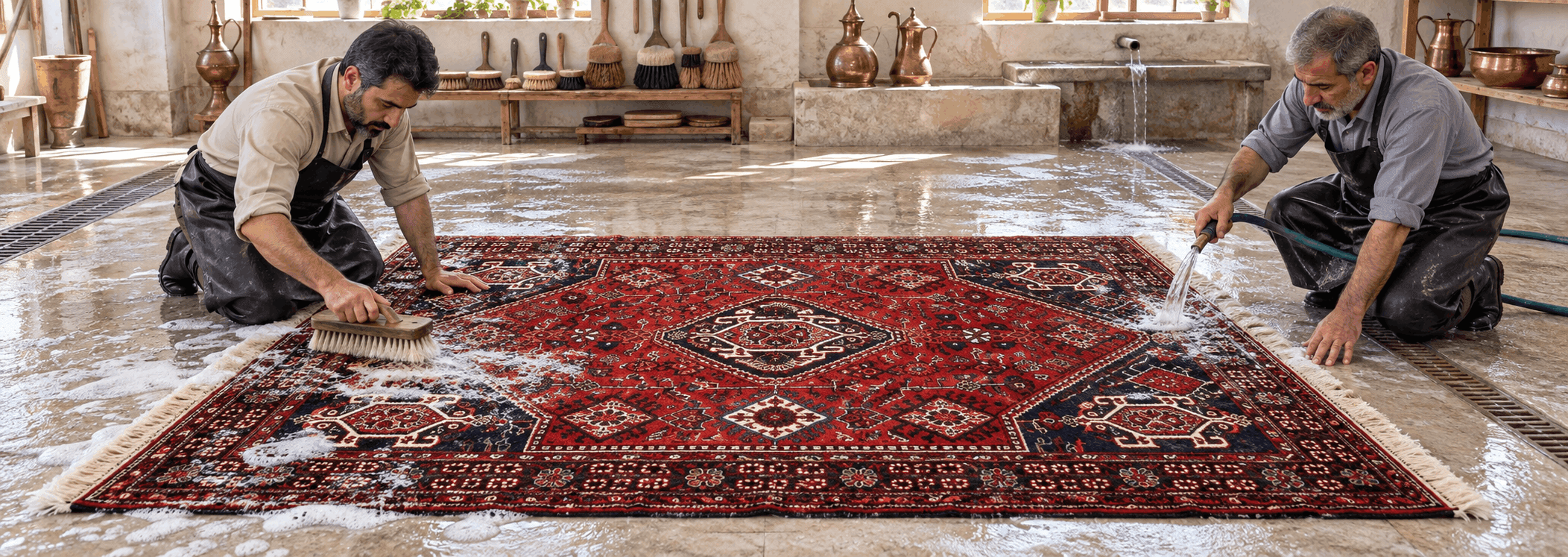
14. Washing Can Change the Character of a Rug
Traditional Persian rugs often require professional cleaning during their lifetime.
A proper wash can:
- remove accumulated dirt
- refresh the wool
- improve the clarity of the colours
- restore softness
- reveal details that were hidden beneath surface soil
But washing is not automatically harmless.
The method matters.
Factors such as:
- water chemistry
- temperature
- detergent
- agitation
- drying
- dye stability
can affect the final result.
Poor cleaning can cause:
- colour bleeding
- distortion
- shrinkage
- uneven drying
- damage to fragile fibres
- weakening of already compromised areas
This is why valuable antique and handmade rugs should be handled by people who understand traditional rug materials and construction.
15. Water Damage Is Different From Natural Ageing
A rug can look old without being damaged.
Water damage is different.
If a rug remains wet for too long, several problems can develop.
Moisture can contribute to:
- mould
- unpleasant odours
- fibre weakening
- dye migration
- foundation distortion
- biological deterioration
Flooding and prolonged damp conditions are therefore among the more serious risks for antique rugs.
A rug's environment can sometimes influence its long-term survival as much as its original quality.
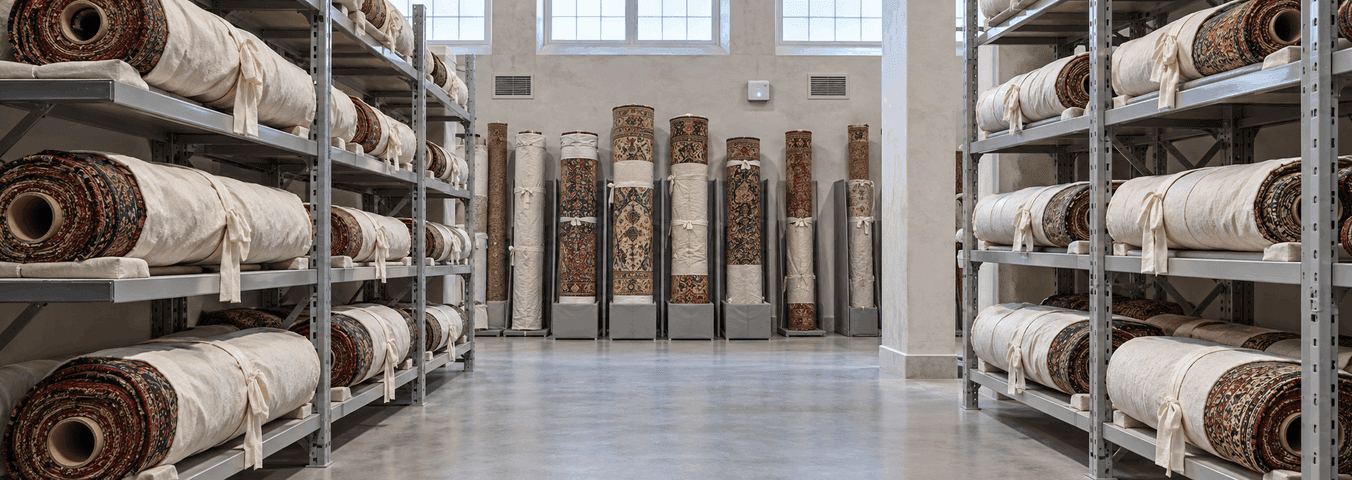
16. Humidity, Temperature and Storage
A Persian rug can spend decades in a home, warehouse, collection or storage facility.
Its environment matters.
Extreme or unstable conditions can place additional stress on natural fibres and foundations.
Long-term storage should therefore avoid:
- persistent dampness
- direct sunlight
- poorly ventilated conditions
- extreme temperature fluctuations
- contact with dirty or unsuitable surfaces
For valuable rugs, regular inspection is also important.
A rug that remains rolled and forgotten for many years may develop problems that could have been addressed much earlier.
17. Moths and Other Biological Threats
Wool is a natural protein fibre.
That makes it valuable—and also means it can be vulnerable to certain biological pests.
Moth damage is particularly important in stored wool rugs.
The most vulnerable areas can include:
- low-traffic sections
- the underside
- areas beneath furniture
- dark storage environments
- places where organic debris has accumulated
Moth damage should not be confused with normal wear.
Natural wear generally follows patterns of human use.
Moth damage can create irregular areas of fibre loss that have a different appearance.
18. When Does an Old Rug Become "Too Worn"?
There is no universal number.
One antique rug can retain substantial pile after a century of use, while another may have very little pile remaining.
The evaluation should consider:
Structural condition
Are the warp and weft stable?
Pile condition
How much original pile remains?
Edge condition
Are the sides and ends secure?
Knot integrity
Are the knots still holding properly?
Repairs
Are previous repairs stable and professionally executed?
Colour condition
Are the colours attractive and stable?
Overall appearance
Does the rug remain visually coherent?
An old rug does not need to be perfect to be valuable.
But the nature and extent of its imperfections matter.
19. Restoration: Saving the Rug Without Erasing Its History
Restoration can be an important part of preserving handmade rugs.
A skilled restorer may repair:
- damaged edges
- fringes
- holes
- worn areas
- foundation problems
- sections of lost pile
But restoration raises an important philosophical question:
Should an old rug be made to look new again?
Usually, not necessarily.
A good restoration should preserve the rug while respecting its history.
Over-restoration can sometimes remove exactly the characteristics that make an antique rug interesting.
The goal should generally be preservation, stability and visual harmony, rather than making an old handmade rug look artificially new.
20. Originality Versus "Perfect Appearance"
Modern consumers are often trained to look for perfection.
Handmade Persian rugs require a different way of looking.
A slightly irregular line, a small abrash, uneven pile or subtle variation may be completely consistent with traditional handmade production.
Trying to eliminate every trace of age can sometimes reduce the visual authenticity of the rug.
For an antique or vintage Persian rug, the question should not always be:
"Does it look new?"
A better question is:
"Does it look authentic, well preserved and appropriate to its age?"
21. The Difference Between Antique, Vintage and Merely Old-Looking
Age terminology can easily become confusing.
A rug may be genuinely old.
Another may be relatively recent but have been washed, distressed or treated to create an aged appearance.
These are not the same thing.
An authentic old rug should be evaluated through multiple clues, including:
- construction
- materials
- knotting
- colours
- pile
- foundation
- wear patterns
- repairs
- design characteristics
- provenance, when available
No single visual characteristic can reliably establish age.
22. Can You Date a Persian Rug by Its Colours?
Colour can provide clues, but it should never be used alone.
An experienced evaluator may consider colour alongside:
- design
- knotting
- materials
- construction
- regional characteristics
- weaving traditions
- condition
- known historical context
This is particularly important because Persian carpet traditions are not static.
Techniques and materials changed over time, and different regions could adopt new materials at different moments.
Therefore:
Colour is evidence—not a birth certificate.
23. How Time Changes Different Parts of a Rug
A Persian rug does not age uniformly.
Different components can respond differently.
Wool
May become softer and more polished through use.
Warp
Can remain strong for decades but may weaken through severe wear, moisture or mechanical stress.
Weft
May be affected by structural stress and restoration.
Knots
Normally remain part of the pile structure, but can become compromised if the foundation deteriorates.
Dyes
May change through light exposure, ageing, cleaning and environmental conditions.
Pile
Usually experiences the most direct physical wear.
Understanding these relationships is essential to understanding the life of the entire rug.
24. The Rug as a Record of Human Life
Perhaps the most beautiful way to understand ageing is to think of the Persian rug as a record.
Its surface can contain traces of:
- walking
- furniture
- sunlight
- cleaning
- movement
- storage
- repairs
- generations of ownership
A rug that has spent decades in a family home can therefore look different from a similar rug that has spent most of its life carefully stored.
Two rugs made at the same time, in the same region and with similar materials can eventually develop very different characters.
That is part of what makes handmade rugs so fascinating.
25. Why Handmade Rugs Age Differently From Machine-Made Rugs
Machine-made rugs are designed for controlled consistency.
Handmade rugs are constructed from natural or semi-natural materials through a human process.
Their:
- wool
- yarn
- dye
- knotting
- foundation
- pile
- finishing
can all vary.
This means that ageing can also be highly individual.
The same principle that creates individuality at the moment of weaving continues throughout the rug's life.
26. Can Age Increase the Value of a Persian Rug?
Age can contribute to value—but age alone does not create value.
Collectors and knowledgeable buyers usually consider a combination of factors.
These can include:
- rarity
- origin
- design
- craftsmanship
- materials
- colour quality
- condition
- historical significance
- provenance
- demand
- aesthetic appeal
A poorly preserved old rug is not automatically more valuable than a beautifully made younger rug.
Conversely, a rare antique with attractive age-related character may be highly desirable precisely because of its age and survival.
27. Why Provenance Matters
When available, provenance can add another layer to the understanding of an old Persian rug.
Provenance may include:
- previous ownership
- old photographs
- purchase records
- auction documentation
- family history
- exhibition records
- certificates
- restoration records
Not every rug has documented provenance.
That does not make it unimportant.
But when reliable historical documentation exists, it can help connect the physical object to its past.
28. Photography Can Misrepresent Age and Colour
This is increasingly important for online rug shopping.
A rug photographed in bright daylight may look completely different from the same rug photographed:
- under warm indoor lighting
- under cool LED lighting
- in shade
- with a phone camera
- with professional studio equipment
Digital screens also reproduce colours differently.
For this reason, a serious online rug presentation should ideally provide:
- several photographs
- close-ups
- full-rug images
- images of the back
- detail shots of the pile
- images in natural and indoor lighting where possible
- videos when useful
A short video can sometimes communicate the relationship between light, pile direction and colour better than a single photograph.
29. Why Pile Direction Changes the Appearance
Wool pile has direction.
When light strikes the pile from different angles, the rug can appear:
- lighter
- darker
- brighter
- softer
- more saturated
This is sometimes called the "shading" or "abrash-like" visual effect, although true abrash is a different phenomenon involving colour variation.
Simply changing the viewing direction can make the same rug appear to have two different colours.
This is particularly noticeable with deep-pile wool rugs.
30. The Importance of Looking at a Rug From Different Angles
When examining a Persian rug in person, do not look at it from only one direction.
Walk around it.
Look from:
- one end
- the opposite end
- the sides
- a low angle
- directly above
Observe how the pile reflects light.
This can reveal:
- pile direction
- areas of wear
- differences in colour
- surface texture
- previous restoration
- variations that are difficult to see from one position
A rug can literally change its expression as you walk around it.
31. What Experts Look For When Assessing Age
There is no single "age detector" hidden inside a Persian rug.
Experienced evaluators instead build a conclusion from multiple clues.
They may examine:
- Construction
- Knot type
- Knot density
- Warp and weft
- Wool quality
- Pile
- Dyes and colour behaviour
- Design
- Wear patterns
- Repairs
- Regional characteristics
- Provenance
The strongest evaluation is therefore holistic.
32. The Most Important Principle: Read the Whole Rug
A common mistake is to focus on one feature.
For example:
"The rug has natural colours, so it must be antique."
Or:
"The rug has a lot of knots, so it must be valuable."
Or:
"The rug has abrash, so it must be very old."
None of these statements is sufficient.
A Persian rug is a system.
Its age, materials, construction, colour, wear and history must be considered together.
This is one of the central principles running through the entire Golden Chapter series.
33. A Practical Checklist for Buyers
When considering an old or antique Persian rug, ask:
Age
- Is the claimed age supported by the rug's construction and characteristics?
Condition
- How much pile remains?
- Is the foundation stable?
- Are the edges secure?
Colour
- Are the colours harmonious?
- Is there fading?
- Is there bleeding?
- Is abrash present?
Wear
- Is the wear gentle and attractive?
- Or has the foundation become exposed?
Repairs
- Has the rug been restored?
- Where?
- How extensively?
- Are the repairs stable?
Back
- Does the back confirm the construction?
- Are there signs of extensive restoration?
Environment
- Has the rug been exposed to strong sunlight?
- Has it experienced moisture?
- Has it been properly stored?
Overall
- Does the rug feel authentically aged?
- Is its condition appropriate to its age?
- Does the ageing enhance or reduce its character?
RUGEAST
A Persian Knot Does Not Automatically Mean That a Rug Is Persian
Knotting technique is an important technical clue, but it is not by itself proof of origin.
A rug with an asymmetrical knot may come from different regions. Provenance must be evaluated through the combination of construction, materials, design, weaving tradition and regional characteristics.
RUGEAST
What We See Is Only the Surface
Much of a Persian rug's craftsmanship lies beneath the visible surface.
To truly understand a rug, we need to look beyond its pattern and colours and examine its warp, weft, knots, pile and yarn.
RUGEAST
How to Evaluate an Older Rug Online
When buying a vintage or antique Persian rug online, ask the seller for:
• Full front photograph
• Full back photograph
• Close-up of the pile
• Close-up of the corners
• Close-up of the ends and fringes
• Images of any repairs
• Photos in natural light
• Video showing the rug from different directions
• Exact dimensions
• Information about previous restoration
• Information about colour bleeding or washing, if known
A transparent seller should not be afraid to show imperfections.
In fact, showing them clearly is one of the best ways to build buyer confidence.
Frequently Asked Questions
1) Does natural ageing make a Persian rug more valuable?
Sometimes, but not automatically. Attractive ageing can enhance desirability, while excessive wear can reduce value.
2) What is the difference between patina and damage?
Patina describes desirable or neutral changes associated with age and use. Damage refers to deterioration that compromises the appearance, fibres or structure of the rug.
3) Is abrash a sign of an authentic Persian rug?
Abrash can be consistent with handmade production, but it is not by itself proof of authenticity or age.
4) Can you determine the age of a Persian rug from its colour?
Colour can provide clues but cannot establish age by itself. Construction, materials, design, wear and other characteristics must also be considered.
5) Why do old rugs sometimes have softer colours?
Long-term exposure to light, use and natural ageing can alter the appearance of dyes and wool, often producing a softer visual effect.
6) Can washing change the colour of a Persian rug?
Yes. Cleaning can refresh colours, but inappropriate washing can also cause bleeding, fading, colour migration or other changes.
7) Should an antique rug look perfect?
No. Small irregularities, abrash and natural wear may be part of its character. The important question is whether the rug is structurally sound and aesthetically appropriate to its age.
8) Does more wear always mean less value?
No. The type, location and degree of wear matter. Attractive age-related wear may be acceptable or even desirable, while severe structural wear can significantly reduce value.
RUGEAST FINAL EXPERT PERSPECTIVE
A Persian Rug Does Not Simply Get Older — It Develops a History
Perhaps the most important lesson is this:
Age is not something that happens to a Persian rug. It is something that becomes visible through the rug.
The softened colour may tell us about sunlight.
The polished wool may tell us about generations of use.
The abrash may reveal a change in yarn or dye batch.
The worn area may show where people walked.
A repaired section may tell us that someone cared enough to save the rug.
And the condition of the foundation can reveal whether the rug has survived its history successfully.
This is why two Persian rugs of the same age can look completely different.
Their materials may have been similar. Their construction may have been similar. But their lives were different.
For this reason, when looking at an antique or vintage Persian rug, do not ask only:
"How old is it?"
Ask:
"What happened to it during those years?"
That question opens the door to a much deeper understanding of Persian rugs.
A truly remarkable handmade rug is not simply an old object.
It is a combination of material, craftsmanship, colour, use, preservation and memory — a textile that continues to tell its story long after it has left the loom.