
Can You Put a Handmade Rug in a Dining Room?
A handmade rug can bring warmth, colour and character to a dining room. It can help define the dining area, soften the appearance of hard flooring and connect the table, chairs, lighting and surrounding furniture into a more coherent interior.
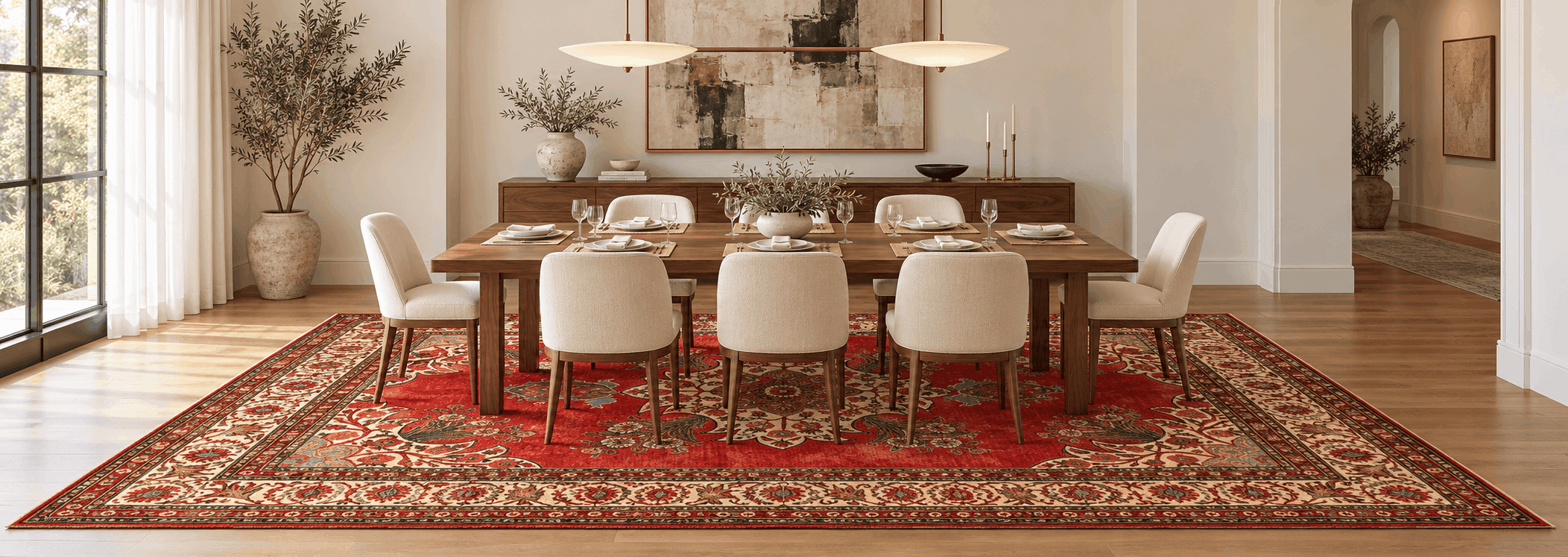
A handmade rug can bring warmth, colour and character to a dining room. It can help define the dining area, soften the appearance of hard flooring and connect the table, chairs, lighting and surrounding furniture into a more coherent interior.
But a dining room is not simply a space in which a rug needs to look beautiful. It is a working area where chairs move repeatedly, food and drinks may spill, and the floor covering must cope with regular use.
So, can you put a handmade rug in a dining room?
Yes provided you choose the right rug for the way the room is used. Size, pile height, construction, stability on the floor and ease of maintenance are at least as important as colour and design.
In this guide, we explain how to select a handmade dining room rug, how much clearance to allow around the table, which materials are worth considering, why some flatwoven rugs may not be suitable, and how to care for your rug over time.
1. Is a Handmade Rug a Good Choice for a Dining Room?
A well-chosen handmade rug can be an excellent addition to a dining room, particularly when the floor is wood, stone, ceramic tile or another hard surface.
It can offer several practical and decorative benefits:
- Defines the dining area: Particularly useful in open-plan living and dining spaces.
- Adds warmth and texture: Wool and other textile surfaces can make a room feel more welcoming.
- Improves the room's visual balance: A rug can connect the dining table with chairs, sideboards, curtains and other furnishings.
- Softens sound: A rug may help reduce some of the reflected sound produced by hard flooring and furniture.
- Introduces colour and craftsmanship: A handmade Persian or Oriental rug can become a distinctive part of the room rather than a purely functional floor covering.
However, not every handmade rug is suitable for every dining room.
If your household has frequent spills, very young children, pets, or a dining table that is used intensively throughout the day, you may need to prioritise practical maintenance over decorative appeal. In some circumstances, leaving the floor uncovered may be the more sensible choice.
The aim is not simply to find a rug that fits beneath the table. It is to find one that remains comfortable, stable and manageable when the chairs are actually being used.
2. What Size Rug Do You Need Under a Dining Table?
The rug should normally extend far enough beyond the table for the dining chairs to remain on the rug when they are pulled out.
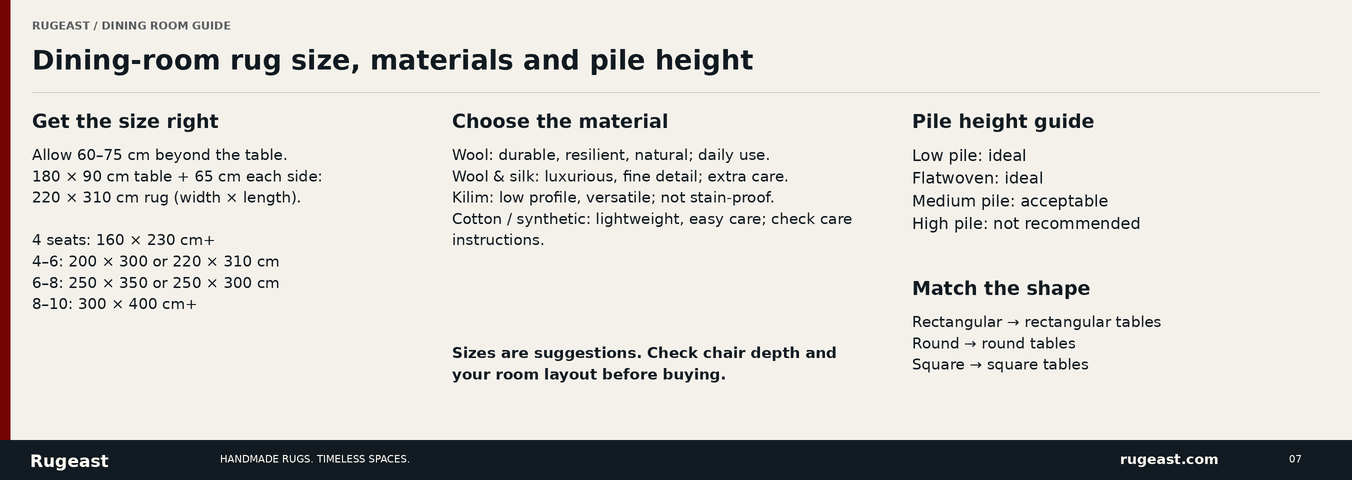
As a practical starting point, allow approximately 60–75 cm (24–30 inches) of additional rug beyond each edge of the tabletop. This is a useful planning guideline rather than a universal rule. Chair dimensions, the table's design and the available floor space may require a different allowance.
How to calculate the right size
Measure the tabletop first, then add the desired clearance to both ends of each dimension.
Formula:
Rug length = table length + twice the desired clearance
Rug width = table width + twice the desired clearance
For example, suppose your dining table measures 180 × 90 cm and you want approximately 65 cm of clearance on each side.
- Table length: 180 cm
- Additional length: 65 cm × 2 = 130 cm
- Suggested rug length: 310 cm
- Table width: 90 cm
- Additional width: 65 cm × 2 = 130 cm
- Suggested rug width: 220 cm
The resulting rug size would be approximately 220 × 310 cm.
This is a planning estimate, not a strict requirement. Before buying, check the actual chair footprint, including how far the chairs travel when someone sits down or stands up.
Suggested rug sizes for common dining arrangements
Dining arrangement
Suggested rug size
Small table for 2–4 people
Approximately 160 × 230 cm or larger, depending on the table and chairs
Table for 4–6 people
Approximately 200 × 300 cm or 220 × 310 cm
Table for 6–8 people
Approximately 250 × 350 cm or 250 × 300 cm, depending on the layout
Large table for 8–10 people
Approximately 300 × 400 cm or larger
Round table for 4 people
Often around 240–250 cm in diameter
Round table for 6 people
Often around 270–300 cm in diameter
These are starting points, not fixed size rules. The correct dimensions depend on the table, chair design, available space and rug proportions.
The chair test: a step many buyers overlook
Before ordering a rug, mark its proposed dimensions on the floor using painter's tape. Place the table within that outline and pull every chair back as if someone were getting up.
Check that:
- The chair legs remain on the rug during normal use.
- The chair does not catch on the rug's edge.
- The rug leaves sufficient walking space around the table.
- Doors, sideboards and nearby furniture can still be used comfortably.
If the rug is too small, the back legs of the chairs may repeatedly cross the rug's edge. This can make the chairs uncomfortable to move and may cause the rug to shift or curl at the edges.
A slightly larger rug that works properly is often a better choice than a smaller rug that looks proportionate only when every chair is tucked neatly beneath the table.
3. Which Rug Shape Works Best?
The shape of the rug should usually complement the shape of the table, although the room's overall layout also matters.
Rectangular dining tables
A rectangular rug is generally the easiest option for a rectangular or oval dining table. It provides a consistent area for chair movement and is available in a broad range of dimensions.
For long tables, make sure the rug extends sufficiently at both ends as well as along the sides.
Round dining tables
A round rug can create a balanced appearance beneath a round table. It works particularly well when the dining area is visually separate from the rest of the room.
However, the rug must be large enough to accommodate the chairs when they are pulled out. A round rug that is too small may leave chair legs crossing its curved edge.
A round rug can also be used under a rectangular table, but the combination requires careful planning. In most dining rooms, a rectangular rug is easier to size and arrange beneath a rectangular table.
Square dining tables
A square rug may suit a square table, particularly in a room with balanced proportions. A rectangular rug can also work if the room is narrow or if the dining area shares space with another seating zone.
Practical rule: Start with the table shape, then test the rug dimensions against chair movement and available floor space.
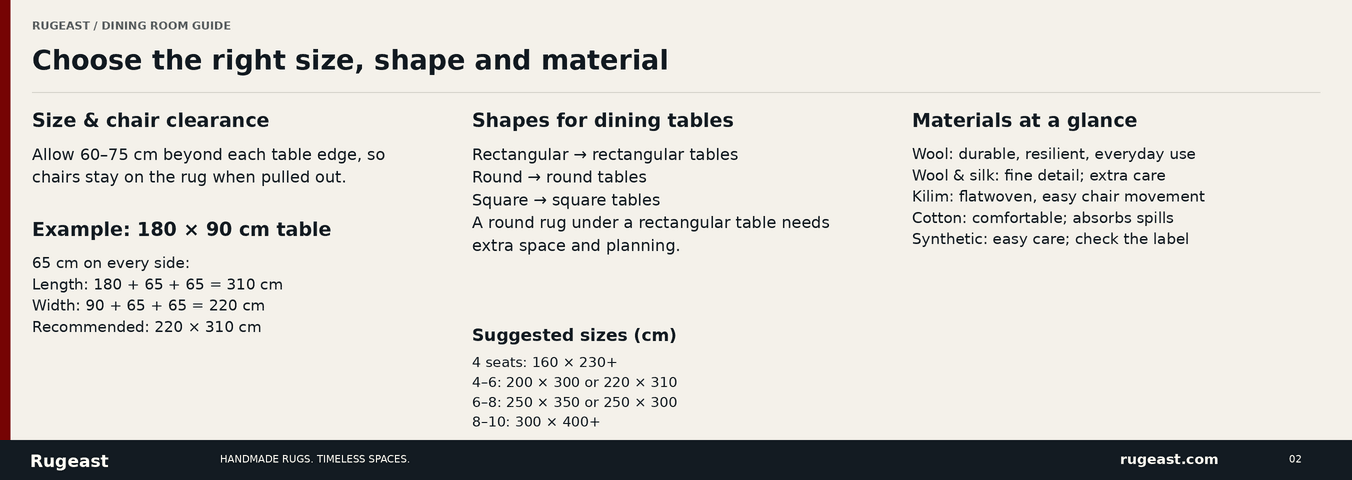
4. Which Handmade Rug Materials Are Best for a Dining Room?
Material affects how a rug feels, how it responds to daily use and how it should be maintained. Construction, knot density, pile, dyes and finishing also matter, so the fibre alone does not determine performance.
Wool: a strong all-round option
Wool is often a good choice for a dining room because it has a naturally resilient structure and a comfortable feel underfoot. Depending on the yarn, construction and finish, a well-made wool rug can cope well with regular use.
Advantages may include:
- Resilience under everyday foot traffic.
- A warm, tactile surface.
- Natural variations in colour and texture.
- A broad range of traditional and contemporary designs.
Wool is not stain-proof, waterproof or maintenance-free. Food, oils and liquids can still leave marks, and the appropriate cleaning method depends on the specific rug.
For many households, a well-constructed, low-pile wool rug is a sensible place to start.
Wool and silk: beautiful, but consider the setting
Some handmade rugs combine wool with silk or other lustrous fibres. These can offer intricate detail, subtle highlights and a more refined appearance.
However, silk and delicate decorative elements may require more careful handling. For a dining room used every day, consider whether the rug's construction and cleaning requirements match your lifestyle.
A particularly delicate or valuable rug may be better suited to a formal dining room used occasionally than to a busy family dining area.
Cotton and other fibres
Cotton rugs vary considerably in construction, weight and durability. Some are lightweight and easy to handle, while others may be less stable or less suitable for repeated chair movement.
Synthetic rugs may offer practical cleaning or cost advantages in certain settings, but their performance varies by fibre and construction. They are not automatically superior to handmade wool rugs.
When comparing materials, look beyond the fibre name. Ask about pile height, backing or foundation, edge finishing, cleaning instructions and the rug's behaviour on your type of floor.
What about kilims and other flatwoven rugs?
Kilims and other flatwoven rugs are admired for their patterns, relatively low profile and versatility. Nevertheless, a flatwoven construction does not automatically make a rug suitable for a dining room.
In practice, some kilims—especially lighter or more flexible examples—may shift, bunch or wrinkle on smooth surfaces such as polished stone, ceramic tile or parquet. Repeatedly pulling dining chairs backwards and forwards can make the problem more noticeable.
The result may be more than an inconvenience: a moving rug can interfere with chair movement, create curled edges and introduce a potential tripping hazard.
For that reason, we would not recommend choosing a kilim as the default option for a frequently used dining area simply because it has no pile.
If you love the appearance of a kilim, assess the particular rug carefully. Its dimensions, weight, flexibility, weave, edge finish and interaction with the floor all matter. A suitable non-slip underlay may help, but its compatibility with the rug and flooring should be checked first.
For many everyday dining rooms, a stable, dense, low-pile hand-knotted rug is often the more practical starting point. Even a heavier knotted rug can move on a smooth floor, however, so stability should never be assumed from weight or construction alone.
If the rug continues to move despite appropriate precautions, it may not be the right choice for that location.
5. Why Pile Height Matters
Pile height is one of the most important considerations when selecting a dining room rug.
Low-pile rugs
Low-pile rugs generally allow chairs to move more easily than rugs with long, loose fibres. They are often easier to vacuum and are less likely to trap crumbs deep within a thick surface.
A well-made, low-pile hand-knotted rug is therefore a strong option for many dining rooms.
Medium-pile rugs
Medium-pile rugs may work well when the yarn, density and construction allow the chairs to move without excessive resistance.
The only reliable way to judge suitability is to consider the particular rug and how it performs under the intended chairs.
High-pile and shag rugs
High-pile and shag rugs are usually less convenient beneath dining tables. Chair legs can catch in the pile, crumbs may be harder to remove and routine cleaning can become more demanding.
They may look comfortable in a lounge or bedroom, but they are generally not the first choice for a frequently used dining area.
The goal is a surface that allows chairs to move smoothly without compromising the rug's stability.
6. Choosing Colours and Patterns
A dining room rug has a large visual presence. Its colour and pattern can influence the entire atmosphere of the room.
Darker colours and detailed patterns
Deep reds, navy, brown and multicoloured traditional patterns can work beautifully with wooden tables and neutral upholstery. Detailed patterns may also make some small everyday marks less noticeable than they would be on a plain, pale surface.
However, no colour or pattern makes a rug immune to staining. Spills still need prompt attention.
Light colours
Cream, ivory, beige and other light tones can make a room feel brighter and more open. They are particularly attractive in Scandinavian, contemporary and minimalist interiors.
In a heavily used dining room, though, consider whether you are comfortable with the extra attention that a lighter surface may require.
Traditional Persian patterns
Traditional Persian and other Oriental designs can provide a sense of depth and craftsmanship. Geometric patterns, floral compositions and repeating motifs can complement both classic furniture and carefully chosen contemporary pieces.
The important question is not whether a pattern is traditional or modern. It is whether its colours, scale and visual character work with the table, chairs and room.
How to judge the colour before buying online
Colours may look different depending on lighting, display settings, pile direction and the angle from which a rug is photographed.
When shopping online, review several photographs if available. Look for close-ups of the pile, images showing the full rug and photographs that help communicate its colours in context.
If colour accuracy is especially important, ask the seller whether additional photographs or a short video are available.
7. Matching the Rug with Your Dining Furniture
A rug does not need to match every item in the room exactly. It should help the different elements feel connected.
Wooden dining tables
Traditional Persian rugs often pair well with wood because their patterns and colours introduce contrast and texture. Warm timber may complement earthy reds, rust, cream and brown, while darker wood can work with both rich colours and restrained neutrals.
Glass tables
A glass tabletop allows more of the rug to remain visible. A detailed handmade design can become a prominent feature, so consider whether you want the rug to be the visual centre of the room.
Contemporary furniture
Modern furniture can work very well with traditional handmade rugs. The contrast between clean furniture lines and a detailed woven pattern can create a balanced interior.
For a quieter look, choose a rug with restrained colours or a more open pattern. For a stronger focal point, use a more expressive design and keep other decorative elements relatively simple.
Lighting and room proportions
Pendant lights, dining-room chandeliers and natural light can influence how the rug's colours appear. Make sure the rug works with the room during both daytime and evening use.
Also consider the floor area around the rug. A rug that is correctly sized for the table may still overwhelm a small room if it leaves too little visible flooring or obstructs movement.
8. Cleaning and Maintaining a Handmade Dining Room Rug
A dining room rug needs a realistic care routine. Good maintenance helps preserve its appearance, but the correct method depends on the rug's fibres, dyes, construction and condition.
Vacuum regularly
Regular vacuuming helps remove crumbs, dust and loose debris before they work deeper into the rug.
Use a vacuum setting appropriate for the rug's construction. Avoid aggressive brushing or a rotating beater bar if it could damage the pile, fringe or foundation.
Deal with spills promptly
When a spill occurs:
- Remove solid food carefully without spreading it.
- Blot liquid with a clean, absorbent cloth.
- Avoid vigorous rubbing, which can spread the stain or damage the fibres.
- Do not apply strong household chemicals or untested stain removers.
- Follow care instructions suitable for the particular rug.
Water, cleaning solutions and heat can affect some dyes, fibres and finishes. If the rug is valuable, delicate or colour-sensitive, consult a qualified rug-cleaning professional before attempting a more intensive treatment.
Keep the rug dry
Persistent moisture can contribute to odours, dye migration or damage to the rug and the floor beneath it. Ensure that any cleaning or accidental spill is dealt with appropriately and that the rug and underlay are completely dry before normal use resumes.
Check the rug's position
Inspect the rug periodically, especially if dining chairs are moved frequently. If the rug has shifted, its edges curl, or it wrinkles during use, address the cause rather than simply straightening it each time.
A compatible non-slip underlay may improve stability. Confirm that it is suitable for both the rug and the floor finish, since some underlays can leave marks or react with certain flooring materials.
Arrange professional cleaning when needed
Professional cleaning may be appropriate when the rug has accumulated soil, has a persistent stain or requires specialist treatment. Choose a cleaner experienced with handmade rugs and tell them about any previous cleaning products or treatments.
A handmade rug should not be treated as though every fibre, dye and construction responds in the same way.
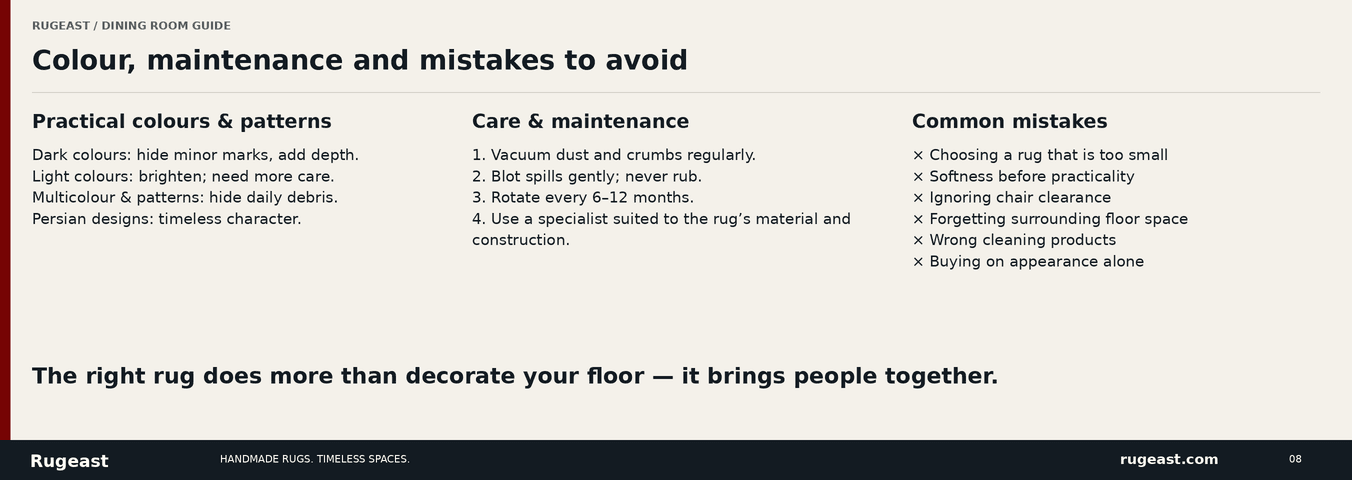
9. Common Mistakes When Choosing a Dining Room Rug
Several common mistakes can make a beautiful rug frustrating to use.
Choosing a rug that is too small. The chairs repeatedly cross its edges, making everyday movement awkward.
Prioritising appearance over stability. A rug that slides or bunches beneath the chairs may not be suitable for the space, regardless of how attractive it looks.
Assuming every flatwoven rug is practical. A kilim can have a low profile and still move on a smooth floor. The individual rug and its setting must be assessed.
Choosing a pile that catches chair legs. Deep or loose pile can make it difficult to pull chairs back and forth.
Ignoring the floor underneath. Parquet, polished stone, ceramic tile and other smooth surfaces can behave differently. Rug stability should be tested on the actual floor whenever possible.
Using unsuitable cleaning products. A product that works on one textile may damage another or affect its colours.
Buying by size alone. Correct dimensions are essential, but construction, maintenance, stability and the intended level of use also matter.
10. Which Handmade Rug Styles Should You Consider?
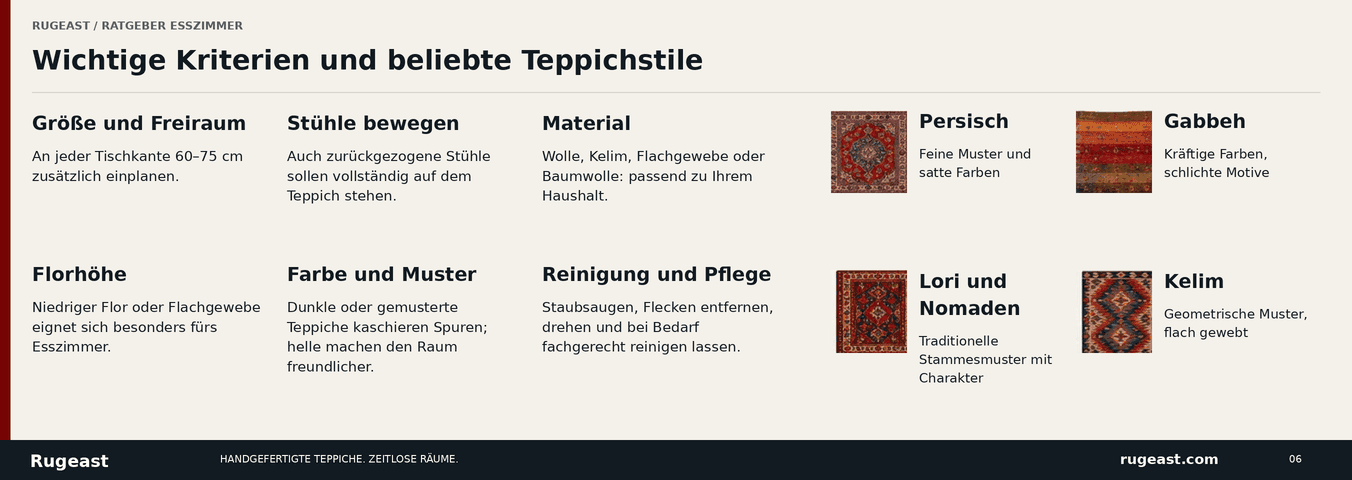
Different rug traditions offer different visual effects. The best choice depends on the room, your preferences and the practical requirements discussed above.
Persian rugs with detailed patterns
Traditional Persian rugs with floral, medallion or all-over designs can work well in formal dining rooms and interiors that benefit from colour and detail.
Consider the overall scale of the design in relation to the table. A dense pattern may provide visual richness, while a more open design can feel quieter.
Geometric and tribal-inspired rugs
Geometric patterns can complement rustic, industrial and contemporary furniture. They may provide a strong visual connection between a dining table and other furnishings without requiring every colour to match.
The exact construction and stability still need to be assessed.
Gabbeh and other expressive designs
Gabbeh rugs are often associated with simpler compositions, bold geometric details and expressive use of colour. Depending on their pile and construction, individual examples may suit relaxed dining spaces.
Do not assume that all Gabbeh rugs have the same pile height or are equally easy to use beneath dining chairs. Check the actual rug.
Traditional designs in modern interiors
A traditional handmade rug can be an effective contrast to modern dining furniture. Rather than treating Persian and Oriental rugs as suitable only for classic rooms, consider how their colours and patterns interact with the architecture and furnishings.
For any style, practical suitability comes first: the rug must fit the table, accommodate the chairs and remain stable on the floor.
11. Buying a Handmade Dining Room Rug Online
Buying online gives you access to a wide range of designs, sizes and weaving traditions. However, photographs alone cannot answer every practical question.
Before placing an order, check the following:
- Exact dimensions: Confirm the rug's actual length and width, rather than relying only on a general size category.
- Construction and materials: Look for clear information about the fibres, pile and weaving or knotting method.
- Pile height: Check whether the surface is likely to allow comfortable chair movement.
- Condition and finish: Review the edges, fringe and overall condition, especially for older or vintage pieces.
- Floor compatibility: Consider whether the rug may require a suitable non-slip underlay.
- Care requirements: Make sure you understand the recommended cleaning method.
- Photographs: Look for full-rug images and close-ups that show colour, texture and detail.
- Delivery and returns: Read the seller's delivery, customs and return terms before ordering.
For European buyers, it is also worth checking where the rug is dispatched from, whether the quoted price includes applicable taxes and delivery charges, and what the return process involves.
At Rugeast, our aim is to help customers choose handmade rugs with a better understanding of their materials, design and everyday use. A rug should be selected not only for its appearance but also for how it will work in the home.
12. Final Recommendation: Is a Handmade Rug Right for Your Dining Room?
A handmade rug can be a beautiful and practical addition to a dining room when it is chosen with care.
For many households, a well-constructed, low-pile handmade wool rug, sized generously enough for the chairs and secured appropriately on the floor, is a strong option to consider.
The most important principles are straightforward:
- Choose dimensions that allow chairs to remain on the rug when pulled out.
- Prefer a pile that allows chairs to move without catching.
- Assess the rug's stability on the actual floor surface.
- Do not assume a kilim is suitable simply because it is flatwoven.
- Match the material and maintenance requirements to the way you use the room.
- Consider the rug's design alongside the table, furniture and overall space.
If you entertain frequently, have young children or need a floor covering that can be washed easily, your priorities may be different. In those cases, a different rug construction—or no rug beneath the dining table—may be the better decision.
The best dining room rug is not simply the one that looks right in a photograph. It is the one that continues to work well when the chairs move, meals are served and everyday life happens around the table.
Explore handmade Persian and Oriental rug designs at Rugeast
Frequently Asked Questions
Can you put a Persian rug under a dining table?
Yes. A Persian rug can work well under a dining table if it is large enough for chair movement and its pile, construction and stability suit the room. Consider cleaning requirements and the condition of the rug before choosing a particularly delicate or valuable piece.
How far should a rug extend beyond a dining table?
A useful starting point is approximately 60–75 cm (24–30 inches) beyond each edge of the table. The correct clearance depends on chair dimensions, how far the chairs are pulled out and the available floor space.
What is the best material for a dining room rug?
A well-constructed, low-pile wool rug is often a strong option because wool can be resilient and comfortable underfoot. However, performance depends on the rug's full construction, finish and care requirements—not fibre alone.
Are kilim rugs suitable under dining tables?
Not always. Some kilims can shift, bunch or wrinkle on smooth floors when chairs are repeatedly moved. Their suitability depends on the individual rug, its weight and flexibility, the floor surface and whether a compatible non-slip underlay can provide adequate stability. A low-pile hand-knotted rug may be a more practical starting point for a frequently used dining room.
Is a low-pile rug better than a high-pile rug for dining rooms?
In many cases, yes. Low-pile rugs generally make chair movement and routine cleaning easier. High-pile rugs may catch chair legs and retain crumbs more readily, making them less convenient beneath a frequently used dining table.
Should a round rug go under a round dining table?
A round rug often creates a balanced appearance under a round table. It still needs enough clearance for the chairs when they are pulled out. The table and chair dimensions should determine the final rug size.
Can a handmade rug be cleaned after food or drink spills?
Often, yes, but the appropriate method depends on the rug's fibres, dyes and construction. Blot spills promptly, avoid aggressive rubbing and untested chemicals, and seek advice from a specialist when the rug is valuable or delicate.
Do I need a rug pad under a dining room rug?
A compatible non-slip underlay may help prevent movement, particularly on smooth flooring. Check that the underlay is suitable for both the rug and the floor finish. If the rug still moves or bunches during normal chair use, reconsider whether it is appropriate for the location.
What size rug do I need for a dining table for six?
Many dining tables for six may work with a rug around 200 × 300 cm, 220 × 310 cm or larger. The best size depends on the table dimensions, chair footprint and available space. Measure the arrangement and test the proposed rug outline before ordering.
Is a handmade rug practical for a family dining room?
It can be, provided you choose a durable construction, an appropriate pile height and a design and material that fit your cleaning routine. If spills are frequent or a fully washable floor covering is essential, a handmade rug may not be the most practical choice for that particular room.