
How to Buy a Handmade Rug Online with Confidence: A Complete Guide to Persian & Oriental Rugs
Whether you are looking for an authentic Persian rug for your living room, a characterful Afghan rug for a relaxed interior or a handwoven kilim with a simpler, more contemporary feel, buying online gives you access to an enormous variety of designs and styles.
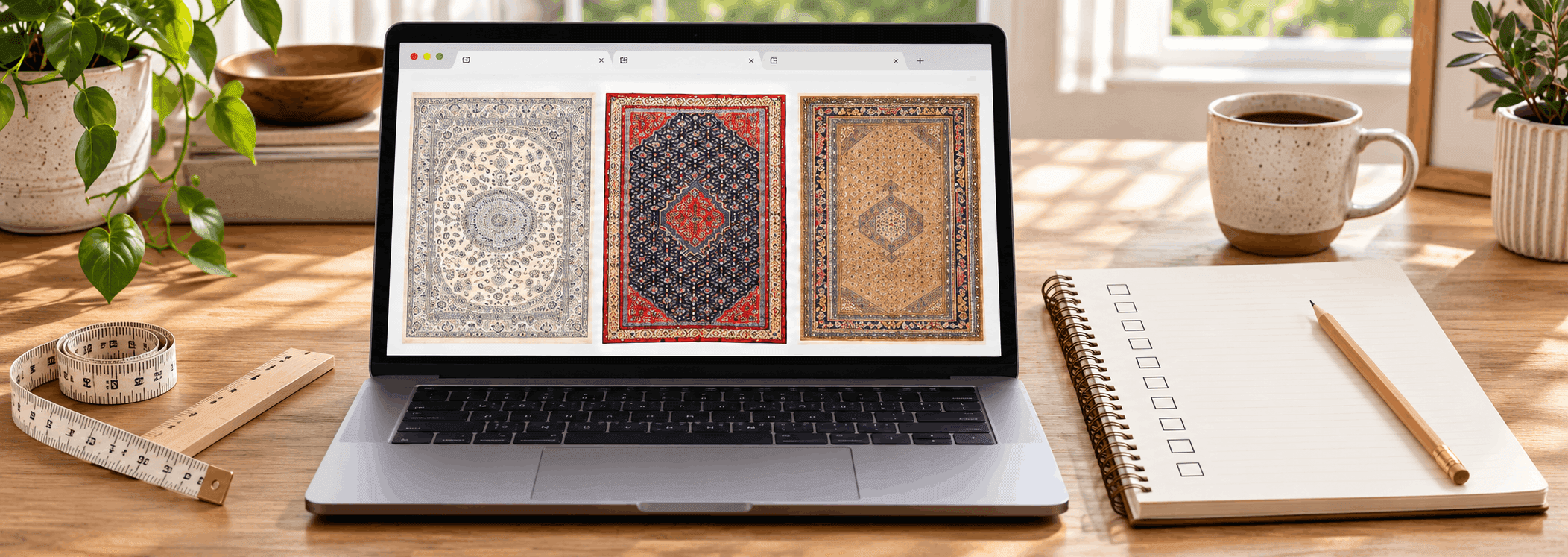
Buying a handmade rug online should be an enjoyable experience—not a guessing game.
Whether you are looking for an authentic Persian rug for your living room, a characterful Afghan rug for a relaxed interior, a traditional Pakistani or Indian rug, or a handwoven kilim with a simpler, more contemporary feel, buying online gives you access to an enormous variety of designs and styles.
But it also raises some very practical questions.
Is the rug really handmade? Is the colour accurate? What is it made from? Is the stated size correct? What condition is it in? Is the price reasonable? And what happens if the rug does not look quite as expected when it arrives?
These are exactly the questions worth asking before you buy.
This guide explains what to look for when shopping for handmade rugs online, with a particular focus on Persian rugs and other Oriental rugs. The aim is not to tell you which rug to buy, but to help you understand the information available and make a more confident choice.
What Should You Check Before Buying a Handmade Rug Online?
If you do not have time to read the entire guide yet, start with these ten points:
- Origin: Is the rug Persian/Iranian, Afghan, Pakistani, Indian, or from another region?
- Construction: Is it genuinely hand-knotted, handwoven, or another type of handmade rug?
- Materials: What are the pile, warp and weft made from?
- Condition: Is it new, vintage, used, restored or repaired?
- Colour: Could lighting or your screen affect how the colours appear?
- Size: Will the dimensions actually work in your room?
- Design: Does the pattern and colour palette suit your interior?
- Price: Are you comparing rugs with genuinely comparable specifications?
- Seller: Does the retailer provide clear product information and contact details?
- Delivery & returns: Do you understand the delivery costs, estimated timeframe and return conditions before ordering?
A good online rug purchase starts with clear information rather than assumptions.
1. Start by Deciding What Kind of Rug You Are Looking For
The term “Oriental rug” covers a remarkably broad world of handmade textiles.
Persian rugs are an important part of that tradition, but they are not the only option. Handmade rugs from Afghanistan, Pakistan and India each have their own regional traditions, designs, materials and weaving practices. Handwoven kilims are another category altogether, with a flatwoven structure rather than a pile.
Understanding these differences is useful because the best rug for your home is not necessarily the one with the most famous name. It is the one whose design, construction, size, condition and character work for your particular space.
Persian & Iranian Rugs
Persian rugs are known for their extraordinary variety.
Depending on their regional and weaving traditions, they can range from highly detailed city rugs to expressive village and tribal designs, from formal floral compositions to geometric patterns and more relaxed contemporary interpretations.
When considering a Persian rug, do not judge it by the name of the region alone. Look at the actual rug: its construction, materials, design, condition, colours and proportions.
Afghan Handmade Rugs
Afghan rugs encompass a wide range of designs and weaving traditions.
Many buyers are drawn to their strong geometric patterns, rich colours and distinctive tribal character, but there is considerable variation between individual rugs.
As with Persian rugs, the country of origin is only one part of the story. The individual rug still needs to be assessed on its own characteristics.
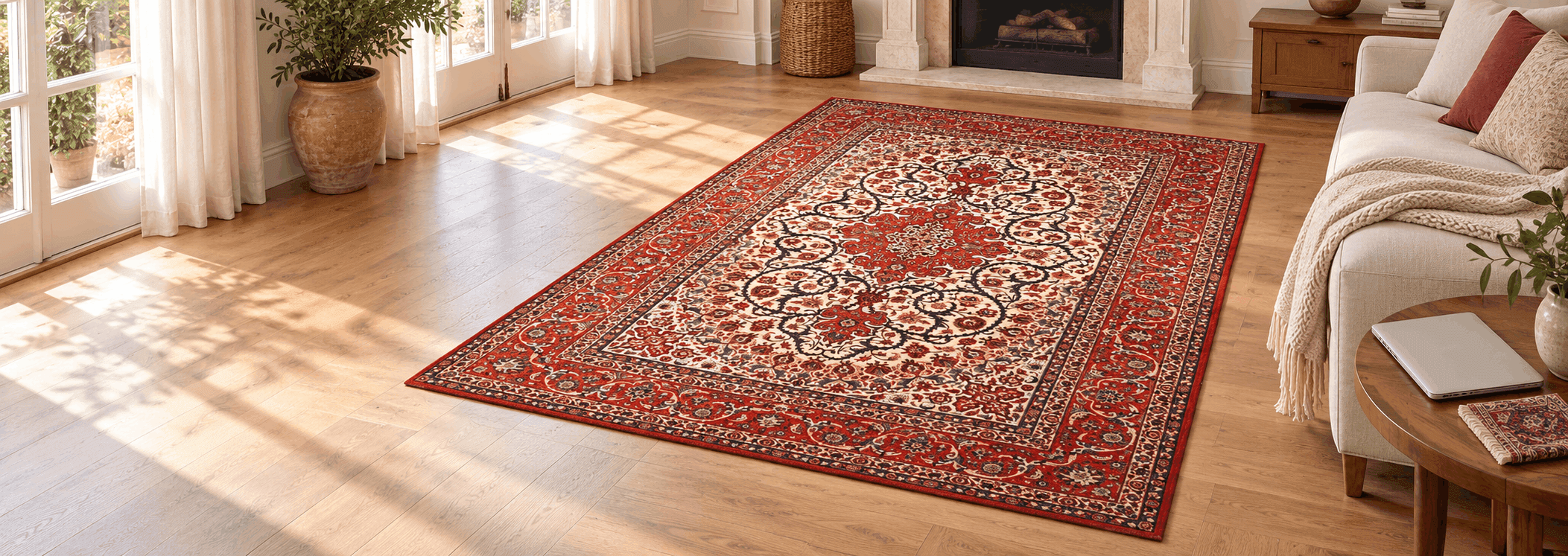
Pakistani Handmade Rugs
Pakistani handmade rugs are available in many different styles, colours and constructions.
Rather than assuming that every Pakistani rug has the same characteristics, check the individual product description for information about materials, construction, dimensions and condition.
Indian Handmade Rugs
India has a long and diverse tradition of Indian handmade rug production, with both traditional and contemporary designs available.
Again, the country name should be treated as a starting point rather than a complete description of the rug.
What About Handmade Kilims?
Kilims are different from pile rugs because they are generally flatwoven rather than knotted with a raised pile.
This gives them a distinctive appearance and feel, and often makes them particularly interesting for contemporary interiors.
If you are considering a kilim, pay particular attention to its weave, thickness, dimensions and intended use.
Does the country of origin tell you everything?
No.
Origin can provide valuable context, but it does not automatically determine quality, durability, value or suitability for your home.
Two rugs from the same country can differ significantly in materials, craftsmanship, condition, design and price.
A useful rule: treat the origin as part of the story—not as a substitute for the actual product information.
2. How Can You Tell If an Online Rug Is Handmade?
One of the most common questions buyers ask is:
“How do I know that this rug is actually handmade?”
When shopping online, you obviously cannot turn the rug over and examine it yourself. That makes the seller's description, photography and supporting information particularly important.
Look for:
- a clear statement about the rug's construction;
- photographs of the front and, where appropriate, the back;
- close-up images of the weave or pile;
- information about materials;
- dimensions and other technical details;
- restoration or condition information where relevant;
- certificates or other documentation, if genuinely available for that particular rug.
A photograph can provide useful clues, but it should not be treated as absolute proof of origin, age or authenticity.
For valuable or particularly important purchases, independent expert assessment may still be appropriate.
3. Understand the Materials: Wool, Silk, Cotton and More
The materials used in a handmade rug influence its appearance, texture, weight, construction and care requirements.
However, terms such as “wool rug” or “silk rug” do not necessarily tell you everything about the construction.
Wool
Wool is one of the most widely used fibres in handmade rugs.
Its characteristics can vary according to the type and quality of wool, preparation, spinning, dyeing and weaving.
If softness, durability or surface texture matters to you, look for specific information about the wool rather than relying solely on the word “wool”.
Silk
Silk can give a rug a distinctive lustre and exceptionally fine appearance.
But if a product is described as a “silk rug”, it is worth checking exactly where silk is used.
Is the pile silk? Are there silk highlights? Is the foundation made from another material?
A good product description should make this reasonably clear.
Cotton and the Foundation
Cotton is commonly used in parts of the foundation of some handmade rugs, including warp or weft structures.
Understanding the materials used in the pile and foundation can give you a better idea of how the rug is constructed.
What About Natural or Vegetable Dyes?
You may come across descriptions such as “natural dyes”, “vegetable dyes” or “plant dyes”.
These terms should ideally be supported by credible information relating to the particular rug.
A colour that looks natural in a photograph does not, by itself, prove how the dye was produced.
Questions worth asking the seller
Before buying, you can ask:
- What fibre is used for the pile?
- What are the warp and weft made from?
- Are different materials used in different parts of the rug?
- Is there documented information about the dyeing process?
4. Check the Condition Carefully
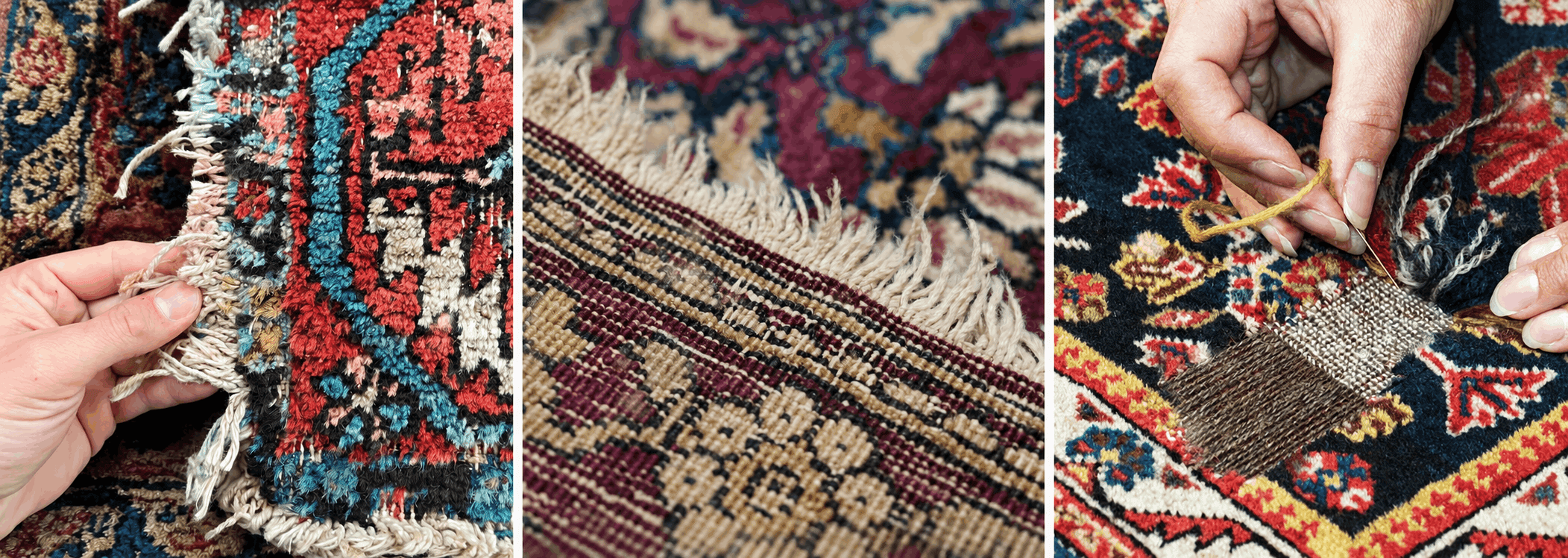
A handmade rug can be new, vintage, antique, previously used, restored or repaired.
None of these descriptions automatically makes a rug right or wrong for you. What matters is understanding the actual condition of the individual piece.
If a rug has been used before, look for information about:
- wear to the pile;
- colour changes;
- stains;
- repairs;
- reweaving;
- damaged or replaced fringes;
- edge repairs;
- areas of thinning;
- previous restoration.
A good condition description should help you understand what you are actually buying rather than simply using broad terms such as “vintage” or “antique”.
5. Learn How to Read Rug Photography
For an online rug buyer, photography is part of the product information.
But photographs are not identical to seeing a rug in person.
Lighting, camera settings, surroundings and your own screen can all influence how colours appear.
Before buying, ask yourself:
- Is the entire rug visible?
- Are there close-up photographs?
- Can you see the borders and fringes?
- Are important areas shown clearly?
- Are there several views?
- Is the rug photographed in a way that gives you a realistic sense of scale?
- Does the retailer mention possible colour differences between the photograph and the physical rug?
If a particular shade is important to your interior, it is perfectly reasonable to ask the seller for additional photographs or video.
Remember: a beautiful photograph helps you appreciate a rug, but it does not independently prove its age, origin, materials or authenticity.
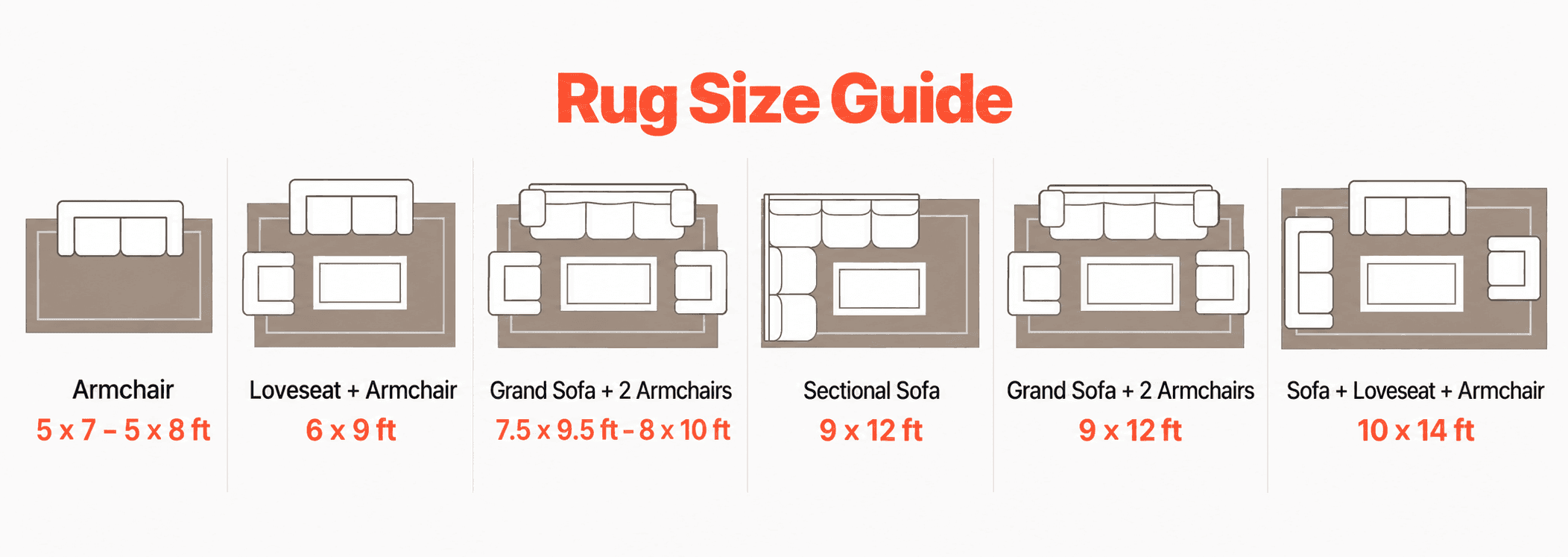
6. Choose the Right Rug Size Before You Fall in Love with the Design
This is one of the simplest—and most frequently overlooked—parts of buying a rug online.
A rug can look perfect on your screen and still be the wrong size for your room.
Before ordering, measure the area where you intend to place it.
Consider:
- the dimensions of the room;
- the position of your sofa and chairs;
- door openings;
- walkways;
- the distance from walls;
- the size of the dining table, if relevant;
- whether furniture will sit partly or completely on the rug.
A simple approach
Measure first. Browse second.
Write down your preferred minimum and maximum dimensions before you start shopping.
This can dramatically reduce the number of rugs you need to consider.
7. Match the Rug's Character to Your Interior
Choosing a handmade rug is not only about technical specifications.
It is also about how the rug feels within your home.
Consider:
- existing furniture;
- wall colours;
- flooring;
- natural and artificial light;
- room proportions;
- the amount of pattern already present;
- whether you want the rug to become a focal point or complement the existing décor.
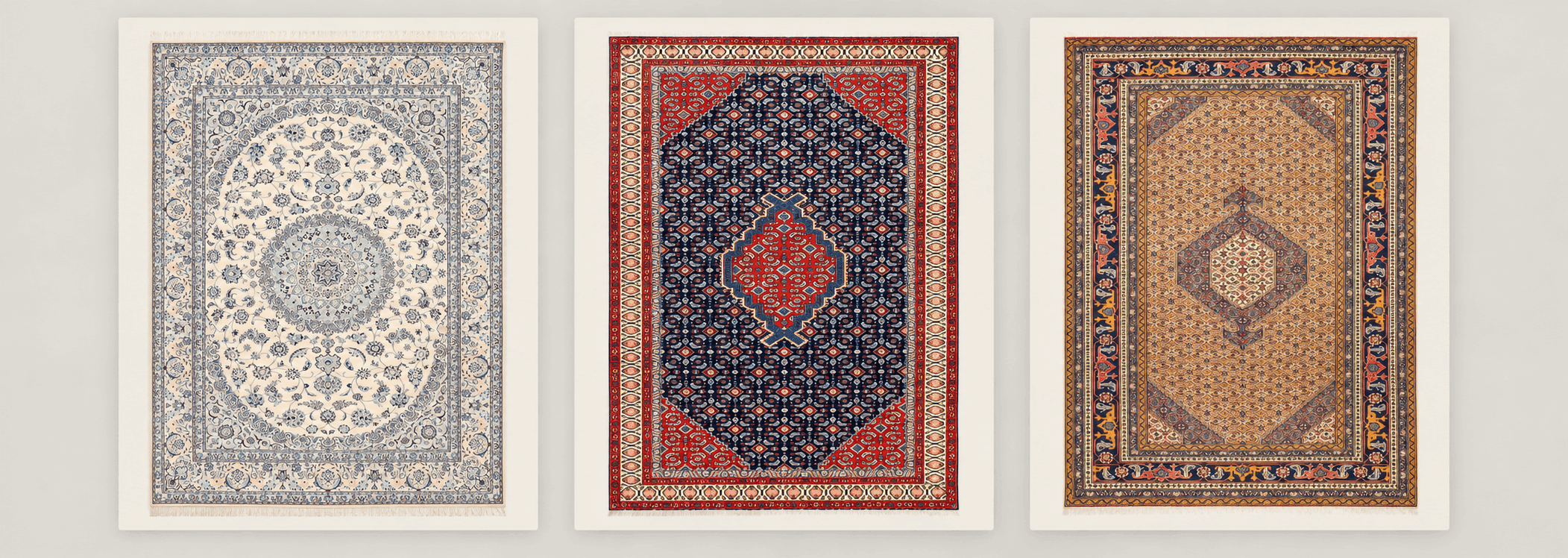
City Rugs
Many traditional Persian city rugs feature carefully organised compositions, floral motifs, medallions or detailed borders.
They can work particularly well when you want the rug to introduce pattern and craftsmanship into a room.
Village & Tribal Rugs
Village and tribal rugs often feature more geometric or expressive compositions, although there is enormous variation within this category.
They can bring a more relaxed and individual character to an interior.
Gabbeh
Gabbeh rugs are often associated with simpler compositions, bold colour fields and relatively uncomplicated motifs.
Their understated character can work particularly well in contemporary interiors.
Vintage Rugs
Vintage rugs can have an individual appearance created by age, use, fading and previous restoration.
Because each piece is different, condition and photography become especially important.
Kilims
The flatwoven structure of a kilim gives it a different visual and tactile character from a pile rug.
For some interiors, that lighter and more graphic appearance can be particularly effective.
The key is not to decorate around a category name. Choose the actual rug that works with your space.
8. How Much Should a Handmade Rug Cost?
There is no single formula that determines the price of a handmade rug.
Factors that can influence price include:
- size;
- materials;
- quality and fineness of construction;
- design;
- condition;
- age;
- rarity;
- craftsmanship;
- provenance where it can be credibly established;
- market conditions.
This is why comparing two rugs purely by dimensions can be misleading.
When comparing prices, compare the rugs—not just the numbers.
Ask:
- Are both rugs handmade?
- Are they made from comparable materials?
- Are they similar in size?
- Are they in similar condition?
- Are they comparable in construction and craftsmanship?
- Are shipping and other costs included?
- Are claims about age, origin or special materials supported by information?
A high price does not automatically prove quality or authenticity. Likewise, a lower price does not automatically mean that a rug is poor quality.
The useful question is whether the price makes sense in relation to the characteristics of that particular rug.
9. How to Assess an Online Rug Seller
When buying a handmade rug online, you are not only buying the rug.
You are also buying through a particular seller and fulfilment process.
Before placing an order, look for:
- clear contact information;
- detailed product descriptions;
- photographs relating to the actual product;
- transparent payment information;
- clear shipping information;
- accessible return conditions;
- a straightforward way to contact the retailer if something goes wrong.
A seller does not need to make extravagant claims to provide a good shopping experience.
In fact, clear and specific information is usually more useful than marketing language.
If an important question remains unanswered, ask before ordering rather than making assumptions.
10. Understand Payment, Delivery and Import Costs
The final cost and delivery experience can depend on where you live.
This is particularly important when buying rugs internationally.
Before completing an order, check:
Payment
- What payment methods are available?
- In which currency will you be charged?
- Is the displayed price the final price?
- Are there any additional fees?
Delivery
- Where is the rug shipped from?
- What delivery timeframe applies to your destination?
- Is tracking available?
- What is the shipping cost?
- Who is responsible for any applicable import duties or taxes?
- What happens if the parcel is delayed or damaged?
Do not assume that delivery times or costs are identical across Europe or internationally.
Always check the current information provided for your specific destination and order.
11. Read the Return Policy Before You Pay
This is one of the most important steps in online shopping—and one that is easy to overlook when you have found a rug you love.
Before ordering, find the retailer's current return policy and check:
- whether the product can be returned;
- how long you have to request a return;
- when the return period starts;
- who pays return shipping;
- what condition the rug must be in;
- whether there are exceptions;
- how refunds are processed.
For customers in the European Union, consumer rights can depend on the nature of the transaction, the seller's location, the buyer's location and the type of product.
Do not rely on a generic statement such as “EU customers have 14 days” without checking the actual circumstances and the seller's current terms.
The retailer's published terms and the applicable law should be checked before purchase.
12. What Should You Do When Your Rug Arrives?
When your rug is delivered, take a moment to inspect it before putting it straight into the room.
Check that:
- the rug matches the product you ordered;
- the dimensions correspond to the listing;
- the overall condition is as described;
- the fringes and edges appear as expected;
- there is no obvious transport damage.
If you notice a problem, document it with photographs and contact the seller through the appropriate channel as soon as possible.
If you think you may need to return the rug, follow the retailer's instructions rather than altering, cleaning or repairing it yourself.
13. Common Mistakes to Avoid When Buying a Handmade Rug Online
Even experienced buyers can overlook details when shopping online.
Here are some of the most common mistakes:
1. Choosing only by the first photograph
The hero image rarely tells the entire story.
2. Ignoring the actual dimensions
A beautiful rug can still be the wrong rug for your room.
3. Assuming every rug from one country is the same
Iran, Afghanistan, Pakistan and India each have diverse rug-making traditions.
4. Confusing a kilim with a pile rug
They are different constructions with different characteristics.
5. Taking claims about age or authenticity at face value
Look for supporting information.
6. Comparing prices without comparing specifications
A 2 × 3 metre rug is not automatically comparable to another 2 × 3 metre rug.
7. Reading the return policy after purchasing
Read it before paying.
8. Assuming delivery is the same everywhere
Destination matters.
9. Being afraid to ask questions
A reputable retailer should be able to explain the important characteristics of the product they are selling.
14. A Simple Decision Process for Choosing Your Rug
If you have several rugs open in different browser tabs, try this simple process.
Step 1 — Define the space
Where will the rug go?
Step 2 — Measure it
Determine the practical size range.
Step 3 — Decide on the character
Traditional? Tribal? Minimal? Colourful? Neutral? Vintage? Flatwoven?
Step 4 — Check the construction
Hand-knotted? Handwoven? Kilim? Other construction?
Step 5 — Check the materials
Wool, silk, cotton or a combination?
Step 6 — Read the condition report
Especially important for vintage and previously used rugs.
Step 7 — Examine all photographs
Do not rely only on the main product image.
Step 8 — Compare the complete cost
Include delivery and any other applicable costs.
Step 9 — Read the return terms
Do this before placing the order.
Step 10 — Ask questions if anything remains unclear
A few minutes of clarification can prevent an expensive misunderstanding.
RUGEAST BUYING GUIDE
Your Handmade Rug Buying Checklist
Before clicking Buy, make sure you can answer these questions:
☐ Do I know what type of rug I am buying?
☐ Is the stated origin clear?
☐ Is the construction clearly described?
☐ Do I know what materials are used?
☐ Have I checked the condition?
☐ Have I looked at detailed photographs?
☐ Does the size work in my room?
☐ Does the design suit my interior?
☐ Have I compared the price with similar rugs?
☐ Do I understand the delivery arrangements?
☐ Do I know the total cost?
☐ Have I read the return conditions?
☐ Have I asked about anything that remains unclear?
If you can confidently answer these questions, you are in a much better position to make an informed purchase.
Why Choose Rugeast for Handmade Persian & Oriental Rugs?
At Rugeast, the main focus is on handmade Persian and Iranian rugs, alongside a carefully selected range of handmade Oriental rugs and kilims from other weaving traditions, including Afghanistan, Pakistan and India.
This means you can explore different styles while keeping the characteristics of each individual rug at the centre of the buying process.
For every rug, the most important information is the information that helps you understand that particular piece—its dimensions, design, materials, construction, condition and other relevant characteristics.
Frequently Asked Questions
Is it safe to buy a Persian rug online?
Online shopping can be a convenient way to access a much wider selection of rugs. The important thing is to check the product information, seller details, payment methods, delivery arrangements and return conditions before purchasing.
How can I tell if a Persian rug is genuinely handmade?
Look at the construction information, photographs of the rug and, where possible, the back of the rug and close-up details. Seller documentation can also be useful. For particularly valuable rugs, independent professional assessment may be appropriate.
Are Persian rugs and Oriental rugs the same thing?
No. “Oriental rug” is a broad term covering handmade rugs from several regions. Persian or Iranian rugs are one important category within this wider world.