
Carpet Fringe Repair & Restoration
Learn how carpet fringe repair protects handmade and machine-made rugs from unraveling. Explore repair methods, cost factors, professional tooling, preparation, common causes of damage, preventive care, specialist selection, and the structural differences that determine suitable treatment options.
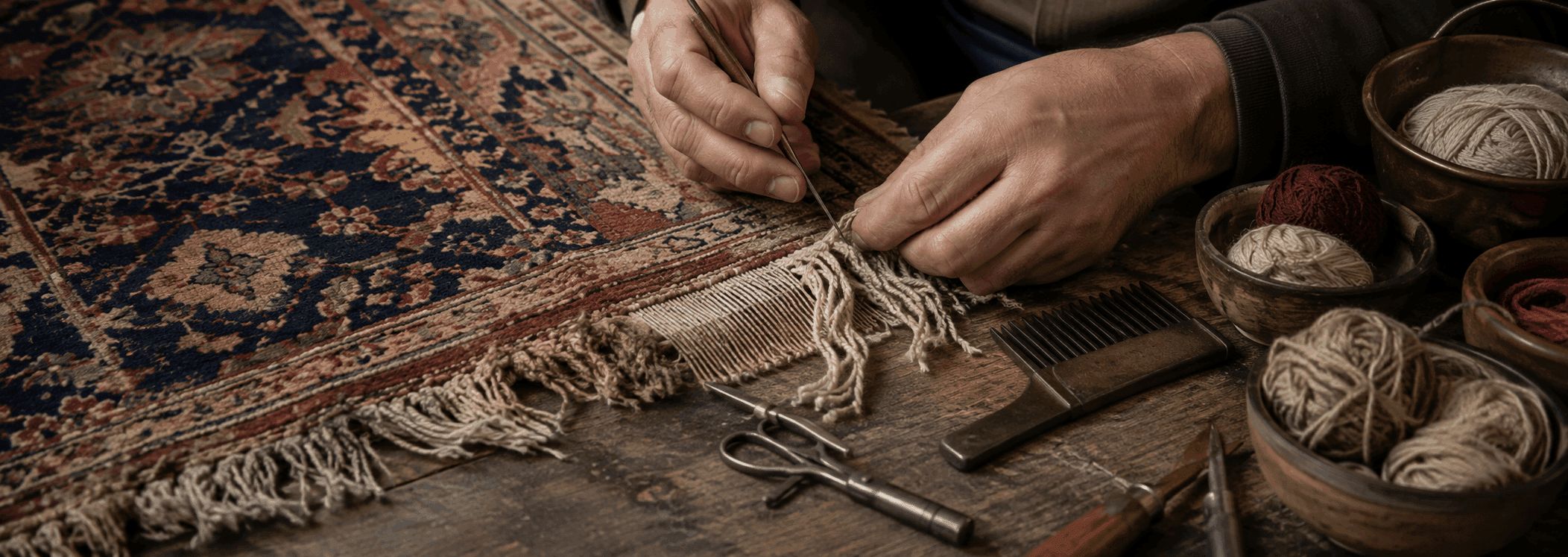
The fringe is an important structural feature of many handmade carpets. It consists of the exposed ends of the warp threads that form the carpet’s foundation. When these threads become worn or damaged, the carpet’s knots may begin to loosen and unravel.
Prompt professional attention can stabilize the affected area, preserve the carpet’s appearance, and prevent more costly damage. Repair techniques differ according to the carpet’s construction, materials, condition, and value.
What Is Carpet Fringe?
Handmade carpets are woven on longitudinal warp threads crossed by horizontal weft threads. The pile knots are tied around the warps, creating the carpet’s design and surface.
When weaving is complete, the remaining warp threads at each end may be secured and left exposed as fringe. The fringe is therefore an extension of the carpet’s foundation rather than a separate decoration.
Machine-made carpets are constructed differently. Their fringes may be sewn or attached after production and are often primarily decorative, although the carpet’s end finish still helps protect it from unraveling.
What Is Carpet Fringe Repair?
Fringe repair involves stabilizing or reconstructing a carpet’s damaged ends. Depending on the condition of the carpet, a specialist may:
- Secure loose or weakened threads
- Tighten or rebuild the end finish
- Replace missing warp extensions
- Reconstruct damaged sections of fringe
- Remove an unsuitable previous repair
- Attach replacement fringe to a machine-made carpet
- Reinforce the foundation before further unraveling occurs
Minor deterioration may require only stabilization. Severe damage may require reconstructing part of the carpet’s foundation before new fringe can be formed.
New fringe should not simply be sewn over structural damage on a handmade carpet. A superficial repair may improve the appearance temporarily without preventing continued unraveling.
Restoration Versus Repair
The terms restoration and repair are sometimes used interchangeably, but they can describe different levels of treatment.
Fringe restoration generally refers to limited work performed when much of the original structure remains intact. The specialist may reinforce weakened knots, secure loose sections, or rebuild small missing areas.
Fringe repair or reconstruction may be necessary when deterioration is extensive. The damaged end may need to be stabilized and partially rewoven before replacement fringe is created.
For an antique or historically important carpet, conservative stabilization may be preferable to extensive reconstruction. The treatment should preserve as much original material as reasonably possible.
Can Carpet Fringe Be Repaired at Home?
Structural fringe repair should generally be performed by a specialist, particularly when the carpet is handmade, antique, silk, finely woven, or commercially valuable.
An inexperienced repair can cause:
- Uneven tension
- Distortion of the carpet’s shape
- Visible or unstable stitching
- Further loss of knots and pile
- Damage from unsuitable yarn or adhesives
- Reduction in the carpet’s value
Ordinary sewing thread, glue, adhesive tape, and household bleaching products should not be used on a valuable carpet.
Some repair companies offer on-site service, but workshop treatment may be safer when the carpet requires washing, color matching, foundation reconstruction, or specialized equipment.
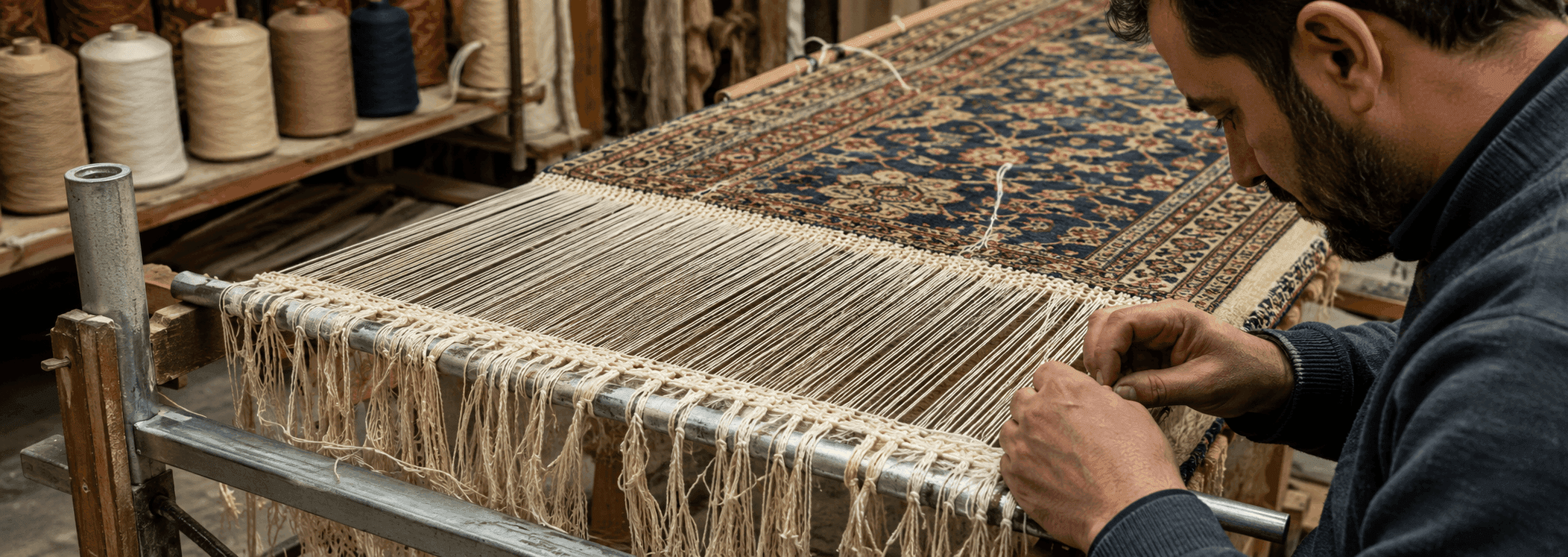
Preparing a Carpet for Fringe Repair
The carpet should be reasonably clean before treatment so that dirt does not interfere with inspection or become trapped in the repaired area.
Depending on its condition, preparation may involve:
- Gentle vacuuming
- Removal of loose debris
- Inspection for insect activity
- Professional washing
- Testing the stability of the dyes
- Documenting damaged areas with photographs
A carpet should not automatically be washed before every repair. Fragile, antique, or color-unstable pieces must first be assessed by a qualified specialist.
Carpet Fringe Repair Costs
The cost cannot usually be determined without examining the carpet. Important factors include:
- Whether the carpet is handmade or machine-made
- The length and depth of the damaged area
- The condition of the foundation
- The carpet’s fiber and construction
- The type of replacement yarn required
- Whether dye matching is necessary
- The fineness of the weave
- The amount of handwork involved
- Previous repairs that must be removed
- Whether cleaning or transportation is required
- Whether the work is completed on-site or in a workshop
Minor stabilization is normally less expensive than complete reconstruction. Ask for a written assessment and itemized estimate before authorizing work on a valuable carpet.
Benefits of Carpet Fringe Repair
Prevents Further Unraveling
Loose or deteriorated ends can allow pile knots and foundation threads to work free. Early repair helps keep the damage from spreading into the carpet’s field.
Reduces Future Repair Costs
Stabilizing a small damaged section is generally less expensive than reconstructing a large area after several rows of knots have been lost.
Improves Appearance
Fringe frames the ends of a carpet. Neat, proportionate fringe can improve its overall appearance, although an antique carpet’s fringe does not need to look completely new.
Extends the Carpet’s Useful Life
Appropriate repairs can make a carpet safer to display or use while preserving its structure for longer.
Helps Preserve Value
Professional treatment may help retain a handmade carpet’s financial, artistic, or sentimental value. Excessive or poorly executed reconstruction, however, can reduce the value of an antique piece.
Repairing Machine-Made Carpet Fringe
The fringe on a machine-made carpet is commonly attached after the main carpet has been manufactured. Repair may involve:
- Trimming damaged decorative fringe
- Securing the carpet’s end
- Machine stitching
- Applying edge binding
- Sewing on ready-made replacement fringe
The replacement should suit the carpet’s color, scale, material, and construction. Sewing decorative fringe over an unsecured edge will not correct underlying unraveling.
Repairing Handmade Carpet Fringe
Repairing a handmade carpet is more complex because its fringe is connected to its structural warp threads. A specialist may need to rebuild damaged warps and wefts, secure the final rows of knots, and reproduce the original end finish.
The repair method should correspond as closely as possible to the carpet’s:
- Weaving structure
- Warp and weft materials
- Knotting technique
- End finish
- Thread thickness
- Color and texture
- Regional construction
Wool, cotton, silk, or another compatible fiber may be used. Silk is not automatically the correct material; the replacement yarn should normally correspond to the carpet’s original foundation.
Common Manual Repair Approaches
Terminology and techniques vary among workshops and weaving traditions. Two approaches sometimes described in carpet-repair guides are the core method and the Botlama method.
Core Method
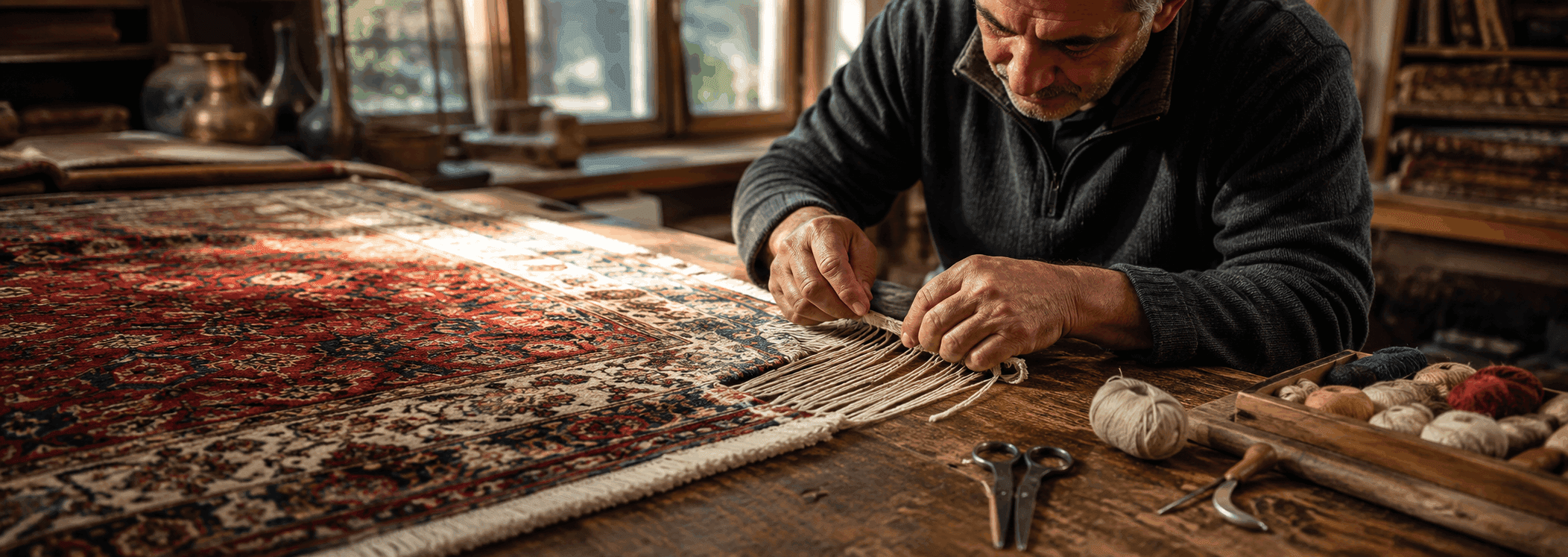
In this approach, a wooden support with evenly spaced nails functions as a temporary frame. Replacement warp threads are stretched between the carpet and the support while being secured through the carpet’s surviving foundation.
A simplified outline is:
- Position the damaged end beside the support.
- Align the replacement threads with the original warps.
- Anchor the threads to the support at even tension.
- Secure them through sound areas of the carpet’s foundation.
- Rebuild the end finish as required.
- Release and trim the threads after stabilization.
Maintaining correct spacing and tension is essential. Errors can distort the carpet or create an unstable repair.
Botlama Method
In the method sometimes transliterated as Botlama, repair yarn is passed through sound rows below the damaged end and worked gradually across the carpet. The process is repeated in the opposite direction to reinforce the area and create a secure foundation.
The precise technique can vary according to the carpet’s construction. It should not be attempted on a valuable carpet without training in weaving and restoration.
Tools Used for Fringe Repair
A professional may use the following tools and materials:
- Warp yarn: Compatible with the carpet’s original foundation and often selected in a suitable diameter and twist.
- Securing or finishing thread: Used to reinforce the carpet’s end and create the appropriate finish.
- Needles: Selected according to the thickness, density, and condition of the carpet.
- Scissors: Used for controlled trimming of yarn.
- Beater or comb: Used when appropriate to position and compact newly woven threads.
- Carpet-weaving knife: Used for precise cutting during knotting and reconstruction.
- Frame or support: Helps maintain alignment and tension during structural work.
The exact equipment depends on the technique and the condition of the carpet.
Why Carpet Fringe Deteriorates
Common causes of fringe damage include:
- Heavy foot traffic
- Vacuuming with a rotating brush
- Furniture placed on the fringe
- Pets chewing or pulling threads
- Moisture and persistent dampness
- Moths or carpet beetle larvae
- Harsh cleaning products
- Improper washing
- Excessive bleaching
- Prolonged sunlight exposure
- Poor storage
- Previous low-quality repairs
- Normal aging and abrasion
Fringe is particularly vulnerable because it is exposed and often receives more mechanical stress than the carpet’s pile.
Preventing Fringe Damage
To protect carpet fringe:
- Avoid vacuuming it with a powered brush.
- Use gentle suction or a soft attachment.
- Do not pull loose threads.
- Keep furniture legs off the fringe.
- Rotate the carpet periodically.
- Address moisture and spills promptly.
- Inspect for moths and carpet beetles.
- Avoid household fringe-whitening chemicals.
- Do not comb delicate fringe aggressively.
- Arrange professional assessment when knots begin to loosen.
If the fringe becomes tangled, straighten it gently by hand without pulling on individual threads.
Choosing a Fringe-Repair Specialist
Before entrusting a handmade or antique carpet to a repairer:
- Request a condition assessment.
- Ask whether the proposed work is structural or cosmetic.
- Confirm which materials and techniques will be used.
- Request photographs of comparable repairs.
- Obtain a written estimate.
- Ask how much original material will be removed.
- Discuss how the treatment could affect the carpet’s value.
- Photograph the carpet before it leaves your possession.
- Confirm insurance and responsibility for damage.
- Seek an independent opinion for a rare or valuable carpet.
Conclusion
Fringe damage should be addressed before it spreads into the body of the carpet. On a handmade carpet, the fringe is part of the structural foundation, so effective repair requires more than attaching new decorative threads.
Minor damage may need only stabilization, while severe deterioration can require foundation reconstruction and a new end finish. Because the correct treatment depends on the carpet’s construction, materials, condition, and value, structural fringe work is best entrusted to an experienced carpet restorer.
FAQs
1. Why is fringe repair important for handmade carpets?
The fringe extends from the carpet’s structural warp threads. Damage can loosen knots and allow unraveling to spread into the carpet’s field.
2. How much does carpet fringe repair cost?
Costs depend on the damaged area, foundation condition, materials, weave fineness, dye matching, previous repairs, cleaning needs, and required handwork.
3. Can carpet fringe be repaired at home?
Structural repairs should generally be performed by an experienced specialist, especially for handmade, antique, silk, finely woven, or valuable carpets.