
How to Identify a Genuine Handmade Rug from a Fake One?
Authentic hand-knotted rugs can be identified through visible knots, woven foundation, and structural construction. Fringe, materials, design variations and abrash offer supporting clues, but no single test is decisive. For valuable rugs, request documentation and an independent expert assessment.
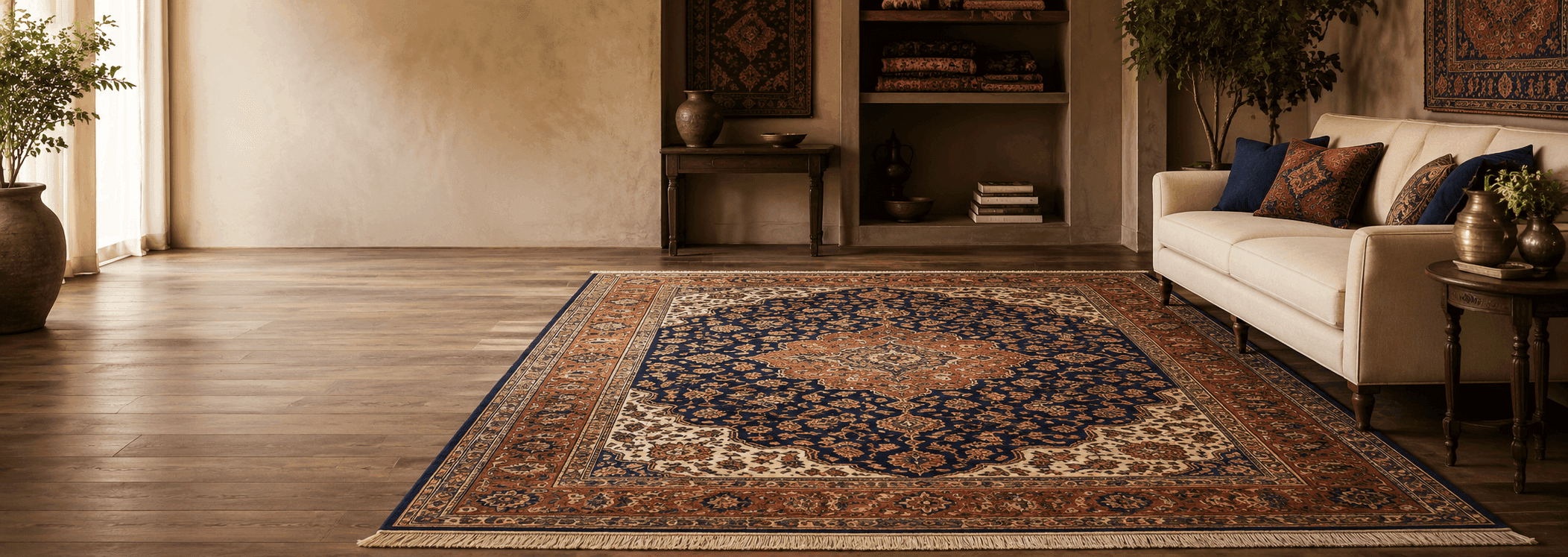
Hand-knotted rugs are valued for their craftsmanship, distinctive construction, and artistic character. However, machine-woven and hand-tufted rugs can imitate their appearance, making visual identification difficult.
No single test proves authenticity. A reliable assessment considers the rug’s structure, materials, workmanship, documentation, and the seller’s claims together.
1. Examine the Back
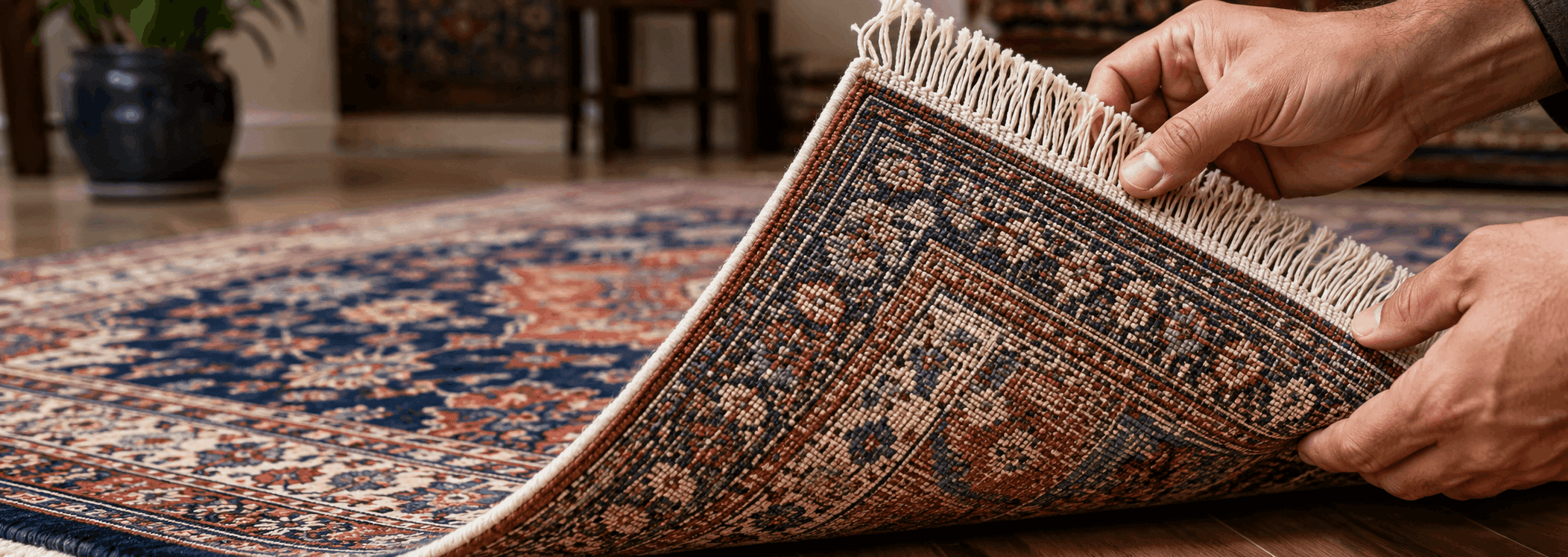
The reverse is one of the most useful areas to inspect. On a hand-knotted rug:
- The design is usually visible on the back.
- Individual knots can normally be distinguished.
- The foundation may show minor variations in spacing and tension.
- There is generally no fabric or latex backing concealing the construction.
Machine-made rugs often have extremely regular structures, while hand-tufted rugs commonly have a fabric backing attached with adhesive.
Irregularity alone does not prove that a rug is handmade. Skilled hand-knotting can be remarkably consistent, and modern manufacturing can imitate small imperfections.
2. Check the Fringe
In many hand-knotted rugs, the fringe consists of the warp threads that form the rug’s foundation. It is therefore part of the structure rather than a decorative addition.
On many machine-made rugs, fringe is sewn onto the finished edge. However, fringe may have been shortened, replaced, or repaired on an older handmade rug, so this feature is not conclusive by itself.
3. Inspect the Sides and Ends
The sides of a hand-knotted rug are usually finished by wrapping or overcasting the outer warp threads. The ends may include fringe, a flat-woven section, or another traditional finish.
Examine these areas for:
- Machine stitching
- Applied binding
- Glue or latex
- Detached backing fabric
- Repairs or reconstructed edges
Repairs do not necessarily make a rug inauthentic, but they should be disclosed because they may affect condition and value.
4. Study the Construction
In a hand-knotted pile rug, yarn is tied around the warp threads in successive rows. Weft threads are inserted between the rows to stabilize the structure. This traditional method differs from tufting, in which yarn is pushed through a prepared foundation and commonly secured with adhesive.
The Smithsonian describes traditional pile carpets as having pile tied by hand to the warps, with weft threads inserted after each row of knots.
A magnifying glass can make the knot and foundation structure easier to examine.
5. Evaluate the Design Carefully
Minor variations in outlines, spacing, symmetry, or repeated motifs may reflect manual production. These variations can contribute to a rug’s individual character.
Nevertheless:
- Perfect symmetry does not prove machine production.
- Imperfection does not prove hand-knotting.
- Handmade rugs may follow detailed cartoons.
- Machine-made rugs can reproduce intentionally irregular designs.
Design should therefore be evaluated alongside the underlying structure.

6. Assess the Materials
Hand-knotted rugs may be made from wool, silk, cotton, goat hair, camel hair, synthetic yarn, or mixtures of these materials. Natural fibers are common, but they are not a requirement for handmade construction.
Similarly, machine-made rugs are not always synthetic; some are produced from wool or other natural fibers.
Touch and appearance can provide clues, but they cannot reliably establish fiber content. Avoid destructive burn tests. For valuable rugs, consult a textile specialist or use professional fiber analysis.
In the United States, most covered textile and wool products must carry information identifying their fiber content, country of origin, and the responsible manufacturer or business.
7. Do Not Assume the Dyes Are Natural
Handmade rugs may contain natural dyes, synthetic dyes, or both. Synthetic dyes have been used in rug-producing regions since the nineteenth century, so their presence does not automatically indicate machine production.
Subtle color variation—often called abrash—may arise from different dye batches, variations in wool, or changes during the weaving process. It can support an assessment of handmade production, but it does not prove that the dyes are natural or that the rug is old.
Accurate dye identification may require specialist analysis.
8. Treat Knot Count as a Quality Detail, Not Proof
Knot density can help describe a rug’s construction, but it does not determine authenticity or quality by itself.
A finely knotted rug is not necessarily artistically superior, and many excellent village or nomadic rugs have relatively coarse structures. Important considerations also include:
- Quality of the wool or silk
- Strength of the foundation
- Consistency of construction
- Design and color
- Condition
- Intended weaving tradition
Hand-tied knots may be highly regular, while a poorly manufactured imitation may appear uneven. Knot irregularity is therefore not a dependable authenticity test.
9. Consider Weight and Thickness Cautiously
Handmade rugs are not always heavier or thicker than machine-made rugs. Weight depends on size, pile height, fiber, foundation, knot density, backing, and finishing.
Some fine hand-knotted rugs are exceptionally thin and light. Conversely, a machine-made or hand-tufted rug with a heavy latex backing can be unusually thick and heavy.
Weight and thickness should never be used as stand-alone tests.
10. Avoid Scratch and Water Tests
The suggested “scratch test” has no reliable basis for distinguishing handmade rugs from machine-made products. The sound produced depends on fiber, pile, density, condition, and the surface beneath the rug.
Do not pour water onto a rug as an authenticity test. Absorption varies according to fiber type, treatments, pile construction, and contamination. Water can also cause:
- Dye bleeding
- Shrinkage
- Watermarks
- Foundation distortion
- Mold or mildew
- Damage to the floor underneath
A water-repellent rug is not necessarily machine-made, and a water-absorbent rug is not necessarily handmade.
11. Review Labels and Documentation
A tag or certificate can provide useful information, but it is only as trustworthy as its issuer. A generic “certificate of authenticity” does not independently prove a rug’s origin, age, materials, or construction.
For an important purchase, request a written invoice stating:
- Dimensions
- Construction method
- Fiber content
- Stated country or region of origin
- Approximate age, if claimed
- Condition
- Known repairs or alterations
- Dye information, if supported
- Seller’s return policy
Claims about age, tribal attribution, workshop, or provenance should be supported by evidence.
12. Compare the Price With the Evidence
A very low price may justify additional caution, but price alone proves nothing. Handmade rugs vary enormously in value according to their origin, size, materials, condition, age, design, and market demand.
An expensive rug is not automatically authentic, just as an affordable rug is not necessarily machine-made. Compare similar examples and obtain an independent assessment when the financial commitment is substantial.
Warning Signs
Exercise caution when:
- The backing conceals the rug’s construction.
- The fringe is decorative but advertised as structural.
- Glue or latex is visible.
- The seller guarantees appreciation in value.
- An “antique” rug has no credible provenance.
- Natural-dye claims are based only on color variation.
- Repairs or artificial aging are not disclosed.
- The seller discourages independent inspection.
- The invoice does not record verbal claims.
- The return policy is unclear or unavailable.
Conclusion
The most useful indicators of a hand-knotted rug are its visible knot structure, woven foundation, and method of construction. Fringe, design variations, materials, and color changes can provide supporting evidence, but none is decisive alone.
Weight, price, sound, and water absorption are not reliable authenticity tests. For an antique, valuable, or uncertain rug, the safest approach is to request detailed written documentation and obtain an independent assessment from a qualified rug specialist.
FAQs
1. What is the strongest sign of a hand-knotted rug?
Visible individual knots tied to a woven foundation are the most dependable structural evidence.
2. Does an irregular design prove a rug is handmade?
No. Handmade rugs can be highly consistent, while manufacturers may intentionally reproduce minor irregularities.
3. Are fringe and natural fibers proof of authenticity?
No. Fringe may be attached or repaired, and both handmade and machine-made rugs can contain natural or synthetic fibers.