
loom preparation of handmade carpets
Learn how handwoven carpet straightening uses controlled tension to reduce waviness, skewing, bulges, and uneven edges. Explore main causes, workshop methods, measurement, washing considerations, treatment limits, and why fragile, antique, or structurally damaged rugs require an expert assessment.
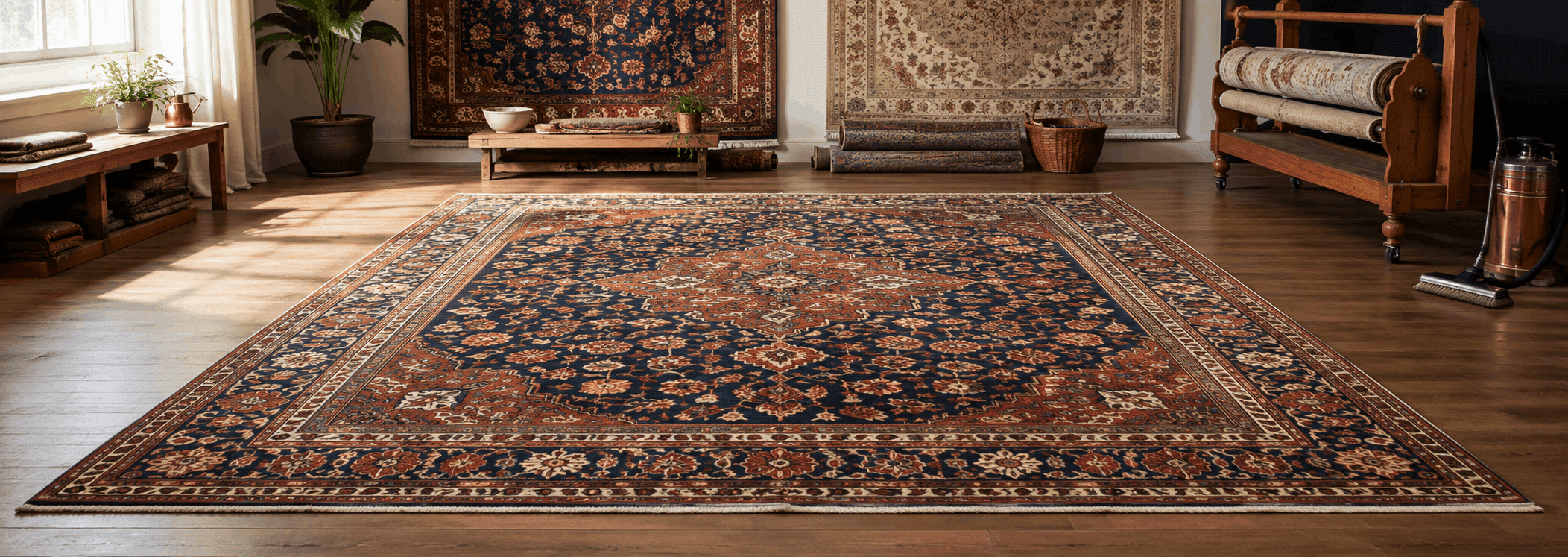
Handwoven Carpet Straightening: Methods, Uses, and Limitations
Handwoven carpets can sometimes develop uneven edges, bulges, depressions, or other distortions. A specialist may correct minor irregularities through a controlled straightening and tensioning process commonly called carpet stretching or blocking. In Persian carpet restoration, this procedure may be known as dar-keshi.
This treatment is distinct from preparing the warps on a weaving loom. Warp preparation takes place before weaving begins, whereas carpet straightening is performed after the carpet has been woven—often following washing or restoration.
What Is Handwoven Carpet Straightening?
Carpet straightening is a workshop procedure used to improve the shape and alignment of a handmade carpet. The carpet is measured, secured to a frame or specialized apparatus, and carefully tensioned until its edges and foundation become more even.
A distorted carpet may display:
- Wavy or curved edges
- Unequal length or width
- A skewed rectangular shape
- Localized bulges or depressions
- Uneven tension across its surface
- Corners that do not lie flat
The treatment must be gradual and carefully controlled. Excessive force can break foundation threads, loosen knots, damage fringes, or permanently distort the carpet.
Why Do Handwoven Carpets Become Distorted?
Irregularities may originate during weaving or develop later through use, washing, storage, or environmental exposure.
Common causes include:
- A defective or poorly aligned loom
- Uneven warp tension
- Inaccurate warp preparation
- Inconsistent beating of the weft
- Variation in the weaver’s knotting tension
- Low-quality or unstable materials
- Improper washing or drying
- Persistent moisture
- Uneven wear or heavy furniture
- Incorrect folding, transportation, or storage
- Previous repairs performed under unsuitable tension
Because handmade carpets are constructed row by row, even a small tension difference can gradually affect their final dimensions.
What Can Carpet Straightening Correct?
Straightening is most suitable for mild or moderate dimensional irregularities. It may improve a carpet that has slightly curved edges, localized waviness, or limited skewing.
It cannot reliably correct every deformation. A severely distorted carpet may return partly to its earlier shape after treatment, particularly when the problem results from:
- Fundamentally uneven weaving
- Severely damaged warps or wefts
- Weak or deteriorated fibers
- Extensive previous repairs
- Repeated exposure to moisture
- Structural differences between sections of the carpet
A specialist should assess whether straightening alone is sufficient or whether structural restoration is also required.
Straightening Versus Carpet Restoration
Carpet straightening and restoration are related but different procedures.
Straightening primarily changes the carpet’s alignment through controlled tension. Restoration addresses physical damage to its structure or surface, such as:
- Broken warps and wefts
- Missing pile
- Tears or holes
- Damaged edges
- Deteriorated fringes
- Moth damage
- Previous defective repairs
Some carpets require both treatments. Structural weaknesses must ordinarily be stabilized before substantial tension is applied.
Is Straightening Offered by Carpet-Cleaning Companies?
Some specialist carpet-cleaning workshops provide straightening in addition to washing, fringe repair, edge restoration, reweaving, and treatments for color migration.
Not every cleaning company is qualified to perform structural work on handmade carpets. Before authorizing treatment, ask whether the company employs an experienced carpet restorer and whether it has handled carpets of comparable material and construction.
A valuable, antique, silk, or unusually fragile carpet should be assessed by a specialist in handmade textiles.
Handwoven Carpet Straightening Methods
Workshop terminology varies, but straightening systems generally secure the carpet and apply gradual tension in selected directions. Three methods commonly described in the trade are hinged-frame, press-frame, and hook-frame straightening.
Hinged-Frame Straightening
This traditional workshop method uses wooden boards or frames. The carpet is secured at carefully selected points, and movable sections of the frame gradually apply tension.
A hinged apparatus generally contains a fixed section and a movable section connected by metal hinges. Adjusting the movable section helps the restorer correct limited distortion.
Nails must never be placed indiscriminately through a carpet. Their position, spacing, and pressure must be selected according to the carpet’s structure and condition.
Press-Frame Straightening
A press-frame system is usually made primarily of metal and may be supported by adjustable stands. Instead of securing the carpet directly to wooden planks with nails, the apparatus uses clamps or comparable holding mechanisms.
Some systems hold the carpet vertically, allowing the operator to adjust the working height. This can improve access and reduce physical strain during treatment.
Hook-Frame Straightening
In this method, the carpet is measured at several points to identify the direction and extent of the distortion. Hooks, rods, cords, or grouped warp ends may then be used to distribute tension.
Where fringe or warp repair is necessary, the surviving warps may be divided into small bundles. These bundles can be looped or tied around a metal rod so that force is distributed across the carpet’s end rather than concentrated on isolated threads.
One traditional approach uses a metal rod sometimes transliterated as sikho. The exact arrangement of the warp bundles depends on the carpet’s construction and the repair technique.
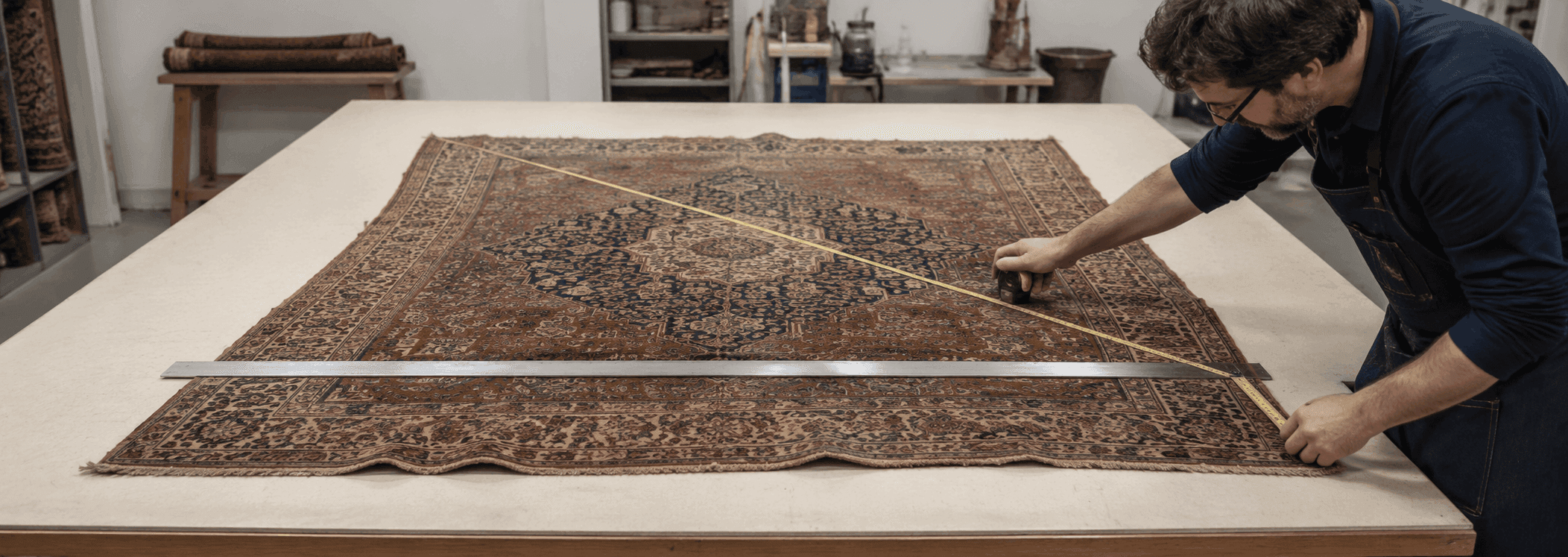
Measuring the Carpet Before Treatment
Accurate measurement is essential. A specialist may compare:
- The length at the center and both sides
- The width at several points
- The two diagonals
- The alignment of borders
- The position of corners
- Areas containing bulges or depressions
- The condition of the edges and fringes
Unequal diagonals may indicate skewing, while differences in width or length can reveal where corrective tension is needed.
What Happens During Treatment?
Although the procedure varies, it commonly involves:
- Inspecting the carpet’s foundation, pile, edges, and fringes.
- Testing the stability of its fibers and dyes.
- Recording its dimensions and distortion.
- Completing any necessary structural repairs.
- Positioning the carpet on an appropriate frame.
- Securing it without concentrating pressure on fragile areas.
- Applying controlled tension gradually.
- Allowing the carpet to dry or rest in the corrected position.
- Rechecking its dimensions before release.
- Inspecting it for new stress or structural damage.
The goal is a safe improvement, not necessarily perfect geometric uniformity. Some handmade irregularities are inherent features of the carpet and should not be forcibly eliminated.
Does Washing Affect the Process?
Straightening is often performed after professional washing because moisture makes some fibers more responsive to reshaping. Nevertheless, uncontrolled stretching of a wet carpet can cause serious damage.
Before washing, the specialist should evaluate:
- Dye stability
- Fiber condition
- Previous repairs
- Foundation strength
- Areas of uneven tension
- The possibility of shrinkage or color bleeding
A fragile or color-unstable carpet may require a modified treatment or may be unsuitable for washing and stretching altogether.
Do Machine-Made Carpets Require This Treatment?
Traditional frame straightening is primarily associated with handwoven carpets because their structures can contain variations in warp tension and weaving.
Machine-made carpets may also curl, buckle, or become distorted, but their problems usually have different causes, including backing failure, heat, moisture, installation errors, or manufacturing defects. Treatment may involve flattening, backing repair, reinstallation, or replacement rather than traditional handwoven-carpet straightening.
Can Tapestries Be Straightened?
A handwoven tapestry can develop rippling, bulges, or uneven tension due to weak warps, inconsistent weaving, unsuitable hanging, or environmental changes. Because tapestries are displayed vertically rather than used as floor coverings, distortion from foot traffic is uncommon.
Treatment should be conservative. A textile conservator may use controlled humidification, blocking, mounting, or structural support rather than the forceful tensioning methods used for heavier floor carpets.
The expression “tapestry loom preparation” may also be used incorrectly to mean setting up the warp before weaving. These are separate procedures:
- Warp preparation: Establishes the foundation before weaving.
- Blocking or straightening: Addresses distortion after weaving.
Common Defects in Handwoven Carpets
Transportation and Storage Damage
Improper folding, stacking, or storage can cause creases, tears, abrasion, mold, insect damage, and permanent deformation.
Foundation and Tension Defects
Uneven or damaged warp threads can make the carpet skewed, wavy, or irregular in width.
Weaving Defects
Errors during weaving may produce inconsistent knot density, uneven borders, missing areas, or structural weakness.
Color Bleeding
Unstable dyes may migrate during washing or exposure to moisture. Straightening cannot correct this problem; specialized color treatment may be required.
Fringe Damage
Because fringe threads extend from the carpet’s foundation, their deterioration can lead to unraveling and loss of pile at the ends.
Edge Damage
Worn or broken side finishes can weaken the carpet and alter its shape. These areas may need reinforcement before straightening.
Choosing a Qualified Specialist
Before authorizing the work:
- Request a written condition assessment.
- Ask whether the distortion is structural or temporary.
- Confirm which straightening method will be used.
- Ask whether washing is necessary.
- Discuss the possibility of the distortion returning.
- Confirm that weak edges and fringes will be stabilized first.
- Request photographs of comparable work.
- Obtain an itemized estimate.
- Photograph and measure the carpet before treatment.
- Seek a textile conservator’s opinion for an antique or museum-quality piece.
Be cautious of anyone who guarantees perfect results without first examining the carpet. Severe or structurally embedded distortion may be impossible to eliminate safely.
Conclusion
Handwoven-carpet straightening is a specialized process that uses controlled tension to reduce waviness, skewing, bulges, and other dimensional irregularities. It is most effective when the deformation is limited and the carpet’s foundation remains sound.
The procedure is not the same as warp preparation or comprehensive carpet restoration. Because excessive or uneven tension can cause permanent damage, the carpet should be inspected and treated by a professional familiar with its fibers, construction, age, and condition.
FAQs
1. What is handwoven carpet straightening?
It is a specialist procedure that uses gradual, controlled tension to improve a handmade carpet’s shape, alignment, edges, and foundation.
2. Can straightening correct every carpet deformation?
No. Severe distortion caused by uneven weaving, damaged foundations, weak fibers, moisture, or extensive repairs may not be safely or permanently corrected.
3. Is carpet straightening usually performed after washing?
It often follows professional washing because damp fibers may respond better to reshaping. However, fragile or color-unstable carpets require careful assessment first.