
The carpet weaving and its mysterious history
Kilim weaving is a flatweaving craft with uncertain origins across Central Asia, Iran, the Caucasus and Anatolia. Archaeology confirms early textile production but not one inventor or an unbroken 8,000-year tradition. Its geometric motifs reflect technique, regional culture and changing symbolism.
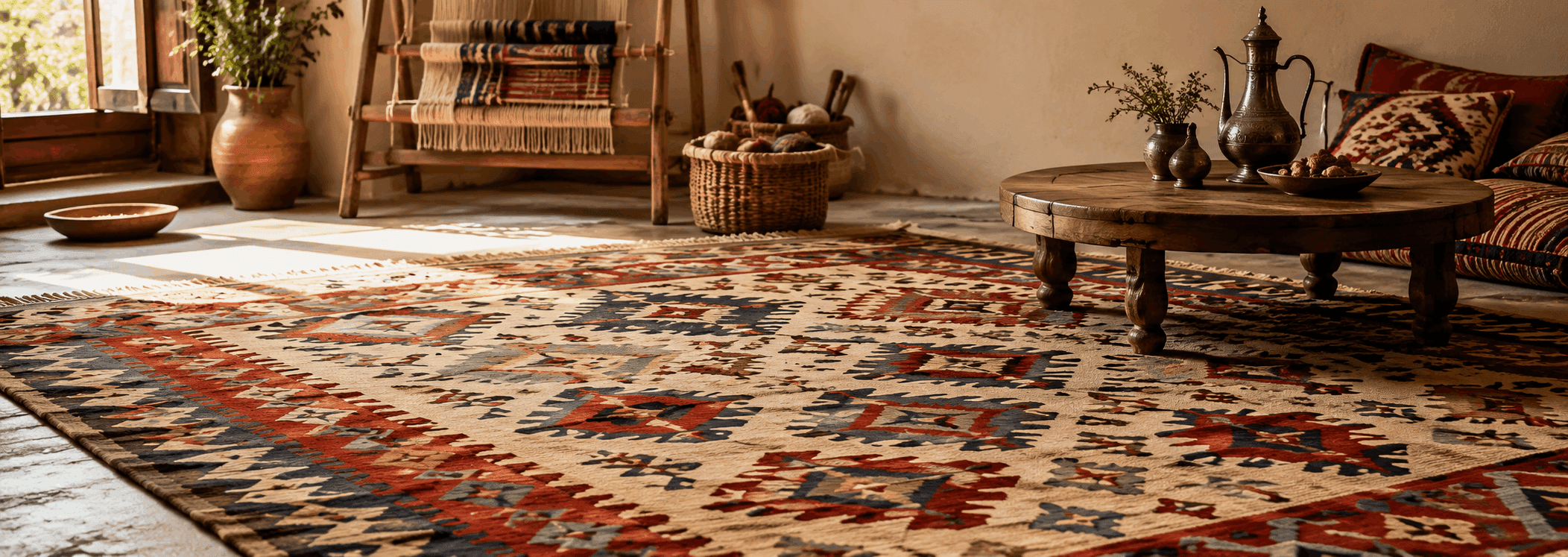
Kilim weaving is among the oldest forms of textile production. Unlike pile carpets, kilims are flatwoven: the design is created by interlacing warp and weft threads rather than tying knots to form a raised surface.
The precise origin of kilim weaving remains unknown. Because textiles deteriorate easily, the archaeological record is incomplete, and no surviving evidence conclusively identifies one ethnic group or region as its inventor.
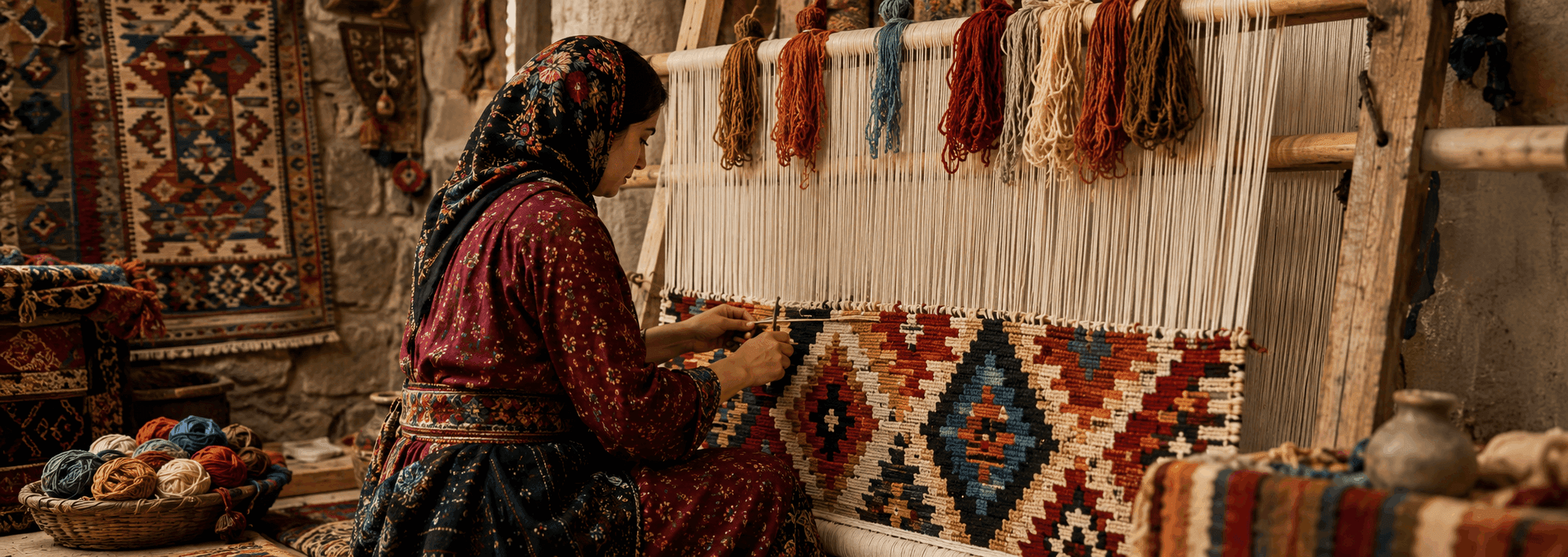
Possible Origins in Central Asia and Anatolia
Central Asia is often associated with the early development of rugs because its pastoral communities raised sheep and had ready access to wool. These communities produced practical textiles for flooring, bedding, storage, shelter, and animal equipment. Similar weaving traditions, however, also developed across Anatolia, Iran, the Caucasus, and neighboring regions.
Textiles and weaving implements discovered at archaeological sites demonstrate that weaving was practiced thousands of years ago. They do not necessarily prove that recognizable kilims or knotted carpets were being produced at the same time.
The Neolithic settlement of Çatalhöyük in central Anatolia, occupied from approximately 7100 to 6000 BCE, has attracted particular attention. Its wall paintings and geometric compositions were once interpreted as evidence of an ancient kilim tradition. Some researchers compared these designs with motifs found on much later Anatolian flatweaves. This interpretation remains disputed, however, because visual similarity alone cannot establish an uninterrupted weaving tradition spanning eight millennia.
Consequently, claims that kilim weaving at Çatalhöyük has been conclusively documented should be treated cautiously.
Early Evidence of Pile-Carpet Weaving
The oldest substantially preserved knotted-pile carpet is the Pazyryk carpet, discovered in a frozen burial mound in the Altai Mountains of Siberia. It dates from approximately the fifth or fourth century BCE. Its sophisticated construction indicates that pile-carpet weaving was already highly developed, although its exact place of manufacture remains debated. Guinness World Records
Other textile fragments have been recovered across Central Asia, Mongolia, Siberia, and Anatolia. Later Anatolian examples provide clearer evidence of an established carpet-weaving tradition. A knotted fragment in the Metropolitan Museum of Art, for example, dates from the thirteenth or early fourteenth century and belongs to a group of early carpets discovered in central Anatolian mosques. Metropolitan Museum of Art
These discoveries demonstrate that both flatweaving and pile weaving had long histories across a broad geographical area. They do not support assigning the invention of carpet weaving definitively to a single people or location.

Spiritual and Religious Meanings in Kilim Motifs
Kilim designs frequently include geometric representations of people, animals, plants, celestial bodies, and everyday objects. Some motifs have been interpreted as symbols of fertility, protection, abundance, marriage, motherhood, or defense against misfortune.
Their angular appearance is partly determined by the structure of the loom: diagonal and curved forms are more difficult to create with interlaced warp and weft threads than straight, stepped lines. Symmetry and repetition may therefore reflect both aesthetic preferences and technical requirements.
Some designs may have carried spiritual, social, or personal meanings for their weavers. Nevertheless, the meaning of an ancient motif cannot always be established from its appearance alone. Symbols may change meaning across communities and generations, while modern explanations may not accurately represent their earliest significance.
Conclusion
Kilim weaving developed within the pastoral and settled cultures of a wide region extending from Central Asia and Iran to the Caucasus and Anatolia. Its beginnings cannot yet be assigned conclusively to one civilization.
Archaeological discoveries confirm the great antiquity of textile production, but claims of an uninterrupted eight-thousand-year kilim tradition remain unproven. The surviving evidence instead presents flatweaving as a gradually evolving craft shaped by available materials, practical needs, regional traditions, and the symbolic imagination of generations of weavers.
FAQs
1. Where did kilim weaving originate?
Its exact origin is unknown, but it developed across Central Asia, Iran, Anatolia, the Caucasus and neighboring regions.
2. Does Çatalhöyük prove an 8,000-year kilim tradition?
No. Its geometric artwork resembles later kilim motifs, but visual similarity cannot prove an uninterrupted weaving tradition.
3. What do traditional kilim motifs represent?
They may symbolize fertility, protection, abundance, marriage or motherhood, although meanings vary across cultures and generations.