
The Most Popular Persian Rug Types: From Gabbeh to Tabriz and Heriz
Persian rugs are among the most recognizable and highly regarded handmade rugs in the world. Known for their intricate designs, rich colors, natural materials, and traditional craftsmanship, Persian rugs are much more than floor coverings.
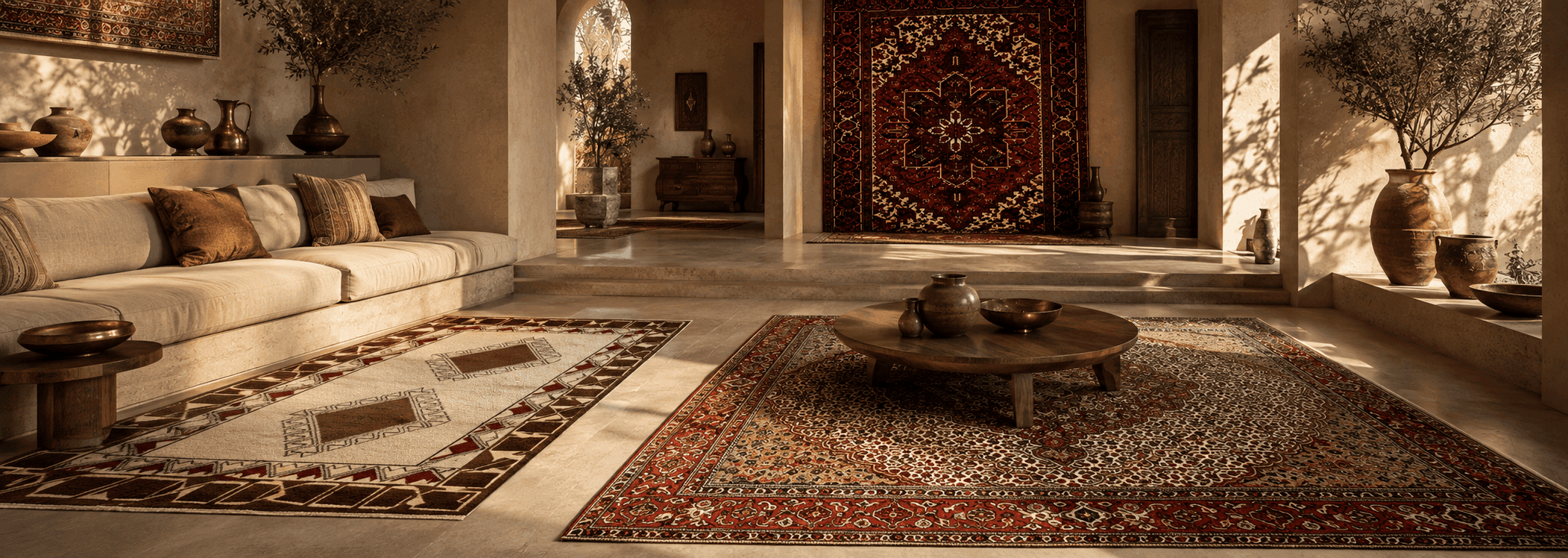
Persian rugs are among the most recognizable and highly regarded handmade rugs in the world. Known for their intricate designs, rich colors, natural materials, and traditional craftsmanship, Persian rugs are much more than floor coverings. Each rug can tell a story about the region, culture, and weaving traditions from which it comes.
However, not all Persian rugs look or feel the same. Different cities, villages, and nomadic communities throughout Iran have developed their own distinctive styles, patterns, colors, and weaving techniques.
Some of the most popular types of Persian rugs include Gabbeh, Tabriz, Heriz, Kashan, Isfahan, Kerman, Bakhtiari, Qom, and Nain.
In this guide, we explore the most popular Persian rug types, what makes each one unique, and how to choose the right Persian rug for your home.
What Makes Persian Rugs Special?
Traditional Persian rugs are made in different regions of present-day Iran and have a history that goes back centuries.
Many Persian rugs are hand-knotted, meaning that each individual knot is tied by hand. This traditional process requires considerable time, patience, and skill.
The region where a rug is made can have a major influence on its appearance. Different areas have developed their own traditional patterns, colors, materials, and weaving techniques.
This is why a Gabbeh rug can look completely different from a finely detailed Tabriz rug, even though both belong to the rich tradition of Persian rug making.
Wool is one of the most common materials used in Persian rugs because of its durability and natural softness. Fine Persian rugs may also incorporate cotton or silk, depending on their construction and design.
1. Gabbeh Rugs – Simple, Warm, and Modern
Gabbeh rugs are among the most popular Persian rugs for contemporary interiors.
The term Gabbeh is generally associated with simple, rustic rugs traditionally produced by Persian tribal and nomadic communities.
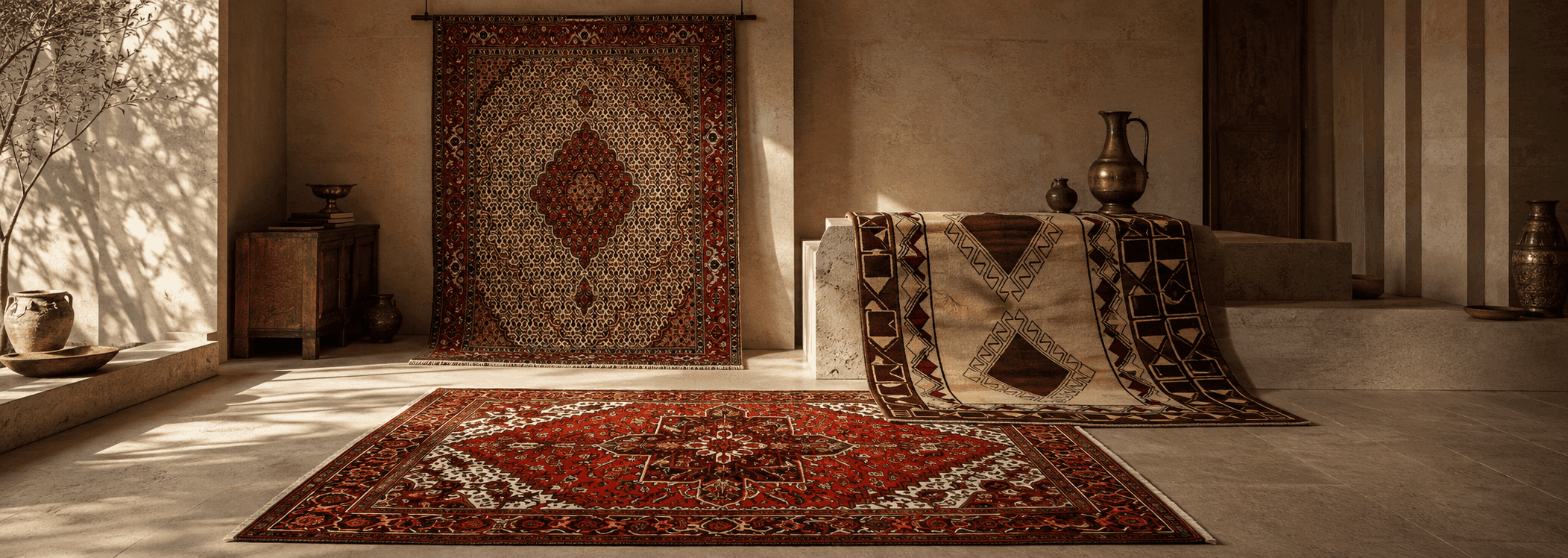
Gabbeh rugs are often characterized by relatively simple geometric designs, bold shapes, minimal decoration, and a soft, thick wool pile.
Their colors can range from natural beige and cream to red, brown, blue, and other warm earth tones.
Unlike highly detailed Persian city rugs, Gabbeh designs are intentionally understated.
This simplicity is one of the reasons they work so well in modern homes.
A Gabbeh rug can complement minimalist, Scandinavian, rustic, or contemporary interiors while adding warmth and a handcrafted feel.
Why Are Gabbeh Rugs So Popular?
Their simple designs make them easy to combine with different types of furniture.
They can work beautifully with modern sofas and minimalist furniture while also complementing traditional wooden pieces.
Their thick wool pile also gives them a comfortable and cozy texture.
If you are looking for a modern Persian rug with traditional roots, a Gabbeh can be an excellent choice.
2. Tabriz Rugs – Elegant, Detailed, and Refined
Tabriz rugs are among the most famous Persian rugs and are particularly well known for their detailed craftsmanship.
They originate from the city of Tabriz in northwestern Iran, a historic center of Persian rug production.
Many Tabriz rugs feature a central medallion surrounded by intricate floral motifs, delicate leaves, vines, and decorative borders.
Other designs may feature all-over floral patterns or highly detailed pictorial compositions.
Common colors include deep red, navy blue, cream, beige, and other sophisticated shades.
Many Tabriz rugs also have a relatively high knot density, allowing weavers to create extremely detailed patterns.
What Kind of Interior Works Best With a Tabriz Rug?
Tabriz rugs are particularly well suited to classic and elegant interiors.
They can add a sophisticated atmosphere to a living room, dining room, library, or home office.
If you are looking for a classic Persian rug with intricate details and an elegant appearance, a Tabriz rug is worth considering.
3. Heriz Rugs – Bold Patterns and Strong Character
Heriz rugs originate from the Heriz region in northwestern Iran.
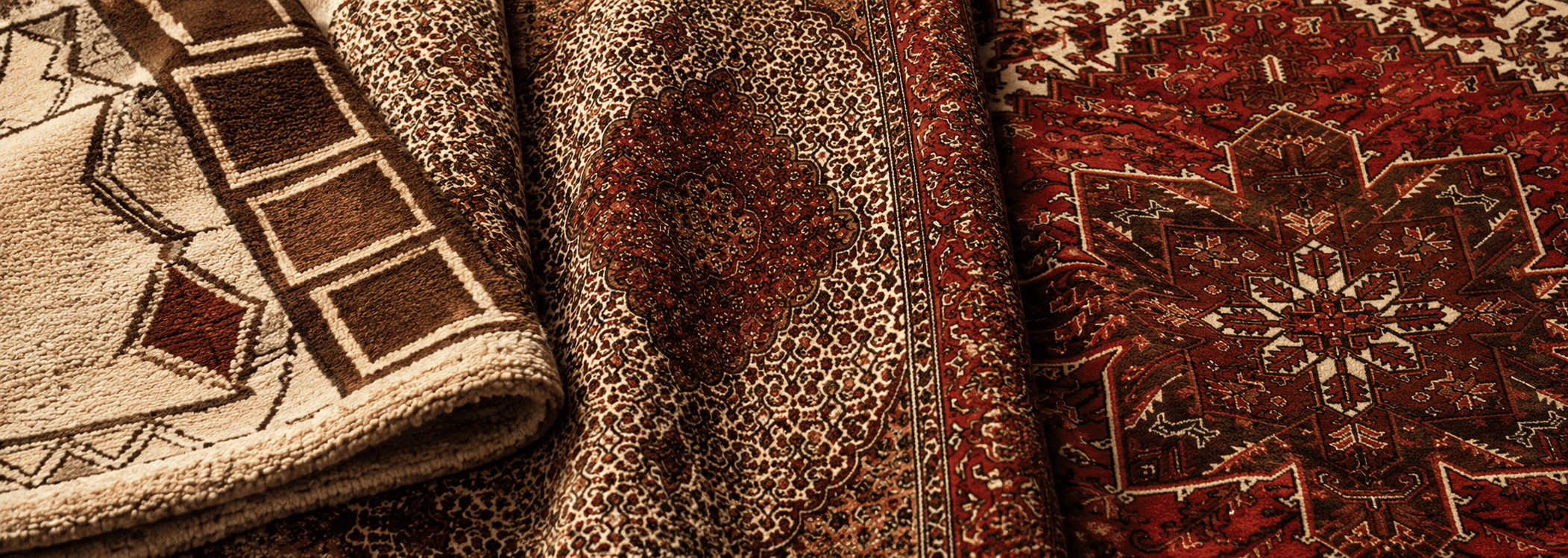
They are famous for their bold geometric patterns and distinctive central medallions.
A traditional Heriz rug often features a large, strong central medallion surrounded by angular floral and geometric motifs.
Compared with some finely detailed Persian city rugs, Heriz designs tend to have a stronger and more graphic appearance.
Red, dark blue, beige, and earthy tones are commonly found in Heriz rugs.
They are also well known for their sturdy construction and use of durable wool.
Why Are Heriz Rugs So Popular?
Heriz rugs have a strong visual personality.
Their bold patterns can turn a rug into the focal point of a room rather than simply serving as a background element.
They work particularly well with traditional, rustic, transitional, and even modern interiors.
If you want a Persian rug with bold geometric patterns and a distinctive character, Heriz is an excellent style to explore.
4. Kashan Rugs – Classic Floral Elegance
Kashan rugs originate from the city of Kashan in central Iran.
They are one of the classic styles of Persian rugs and are often recognized for their elegant floral designs.
Many Kashan rugs feature a central medallion surrounded by flowers, leaves, vines, and decorative borders.
Red, dark blue, cream, and beige are among the colors frequently found in traditional Kashan designs.
Their detailed patterns often create a refined and traditional appearance.
Where Do Kashan Rugs Work Best?
Kashan rugs are ideal for classic living rooms, dining rooms, libraries, and other elegant spaces.
They can also complement antique furniture, traditional woodwork, and classic interior design.
If you want a traditional Persian rug with timeless floral elegance, Kashan is one of the most popular choices.
5. Isfahan Rugs – Fine Details and Sophisticated Designs
Isfahan rugs are considered some of the finest Persian rugs.
They originate from Isfahan, a historic city that has long been an important center of Persian art, architecture, and craftsmanship.
Isfahan rugs are often known for intricate floral designs, elegant central medallions, detailed borders, and highly refined compositions.
Many feature sophisticated combinations of navy blue, red, cream, beige, and other subtle colors.
Their relatively high knot density allows weavers to create exceptionally fine details.
What Makes Isfahan Rugs Special?
Isfahan rugs combine visual elegance with highly skilled craftsmanship.
A finely made Isfahan rug can work as both a beautiful decorative piece and a long-term investment in traditional craftsmanship.
For anyone searching for an elegant, finely detailed Persian rug, Isfahan is one of the most important styles to consider.
6. Kerman Rugs – Floral Patterns and Timeless Designs
Kerman rugs originate from the city of Kerman in southeastern Iran.
They are often recognized for floral patterns, graceful lines, and sophisticated color combinations.
Traditional Kerman designs can be highly detailed and create a balanced, harmonious appearance.
Some feature central medallions, while others use repeating floral patterns across the entire surface.
Because of their versatility, Kerman rugs can work with many different interior styles.
They can complement traditional homes as well as elegant contemporary spaces.
7. Bakhtiari Rugs – Bold Tribal Character
Bakhtiari rugs come from areas associated with the Bakhtiari people in western and southwestern Iran.
They are an important part of Persian tribal and village rug traditions.
Bakhtiari rugs are often recognized for geometric designs, strong colors, and motifs inspired by nature and traditional life.
Garden-inspired patterns, geometric medallions, flowers, and repeated motifs are common features.
Bakhtiari rugs often have a lively and distinctive appearance.
Their strong designs make them ideal for interiors where the rug is intended to become a visual focal point.
For people who appreciate tribal Persian rugs with character and history, Bakhtiari rugs are particularly appealing.
8. Qom Rugs – Fine and Luxurious
Qom rugs, also known as Qum rugs, originate from the city of Qom in Iran.
They are especially known for their fine knotting and intricate designs.
High-quality Qom rugs may incorporate silk, either throughout the rug or as an important part of the design.
Silk allows weavers to create exceptionally fine details and gives the surface a distinctive appearance and subtle sheen.
Qom rugs are often elegant and sophisticated, making them particularly suitable for interiors where a luxurious atmosphere is desired.
9. Nain Rugs – Light Colors and Elegant Patterns
Nain rugs originate from the city of Nain in central Iran.
They are particularly recognizable for their light color palettes and elegant floral designs.
Cream, beige, light blue, and dark blue are common colors in Nain rugs.
Many designs feature a central medallion surrounded by intricate borders and delicate floral motifs.
Their lighter appearance makes them particularly suitable for bright and contemporary interiors.
A Nain rug can work beautifully with minimalist furniture, neutral colors, and modern interior design.
How Do You Choose the Right Persian Rug?
Choosing the right Persian rug involves more than simply finding a pattern you like.
First, consider the atmosphere you want to create in your room.
If you prefer a simple and relaxed aesthetic, a Gabbeh rug may be an excellent choice.
For a traditional and sophisticated interior, styles such as Tabriz, Kashan, or Isfahan can work beautifully.
If you prefer bold geometric designs and a stronger visual presence, consider a Heriz or Bakhtiari rug.
For particularly fine and luxurious designs, Qom and Isfahan rugs are worth exploring.
Size is equally important.
A rug should be proportional to the room and furniture. In a living room, a larger rug can help visually connect the seating area. In a dining room, the rug should generally be large enough for the chairs to remain on the rug even when they are pulled away from the table.
Why Does the Origin of a Persian Rug Matter?
The origin of a Persian rug is one of its most important characteristics.
A rug's region of origin can provide valuable information about its traditional patterns, colors, materials, and weaving techniques.
Two rugs may look similar at first glance but come from completely different regions and traditions.
The origin is therefore more than just a geographical detail. It is part of the rug's identity and history.
When buying a traditional hand-knotted Persian rug, learning about its origin can help you understand its character and craftsmanship.
Hand-Knotted or Hand-Tufted?
If you are looking for a traditional Persian rug, it is also important to understand the difference between hand-knotted and hand-tufted rugs.
A hand-knotted rug is made by tying individual knots by hand. This traditional process is time-consuming and requires considerable skill.
A hand-tufted rug is made by pushing yarn through a foundation using a tufting tool. The process is faster and usually more affordable.
Both types can be attractive and well made, but they should not be considered the same construction.
If traditional Persian craftsmanship is important to you, a hand-knotted rug is generally the more appropriate choice.
Persian Rugs at RugEast
At RugEast, we celebrate the beauty and craftsmanship of traditional handmade Persian rugs.
Our collection includes Persian rugs with different regional styles, patterns, colors, and characteristics.
From distinctive Gabbeh rugs to finely detailed traditional Persian designs, the world of Persian rugs offers an incredible variety of styles to explore.
When choosing a rug, we recommend looking beyond color and pattern. The rug's origin, construction, materials, size, condition, and craftsmanship are all important factors.
The right Persian rug should not only complement your home but also reflect your personal taste.
Final Thoughts
The world of Persian rugs is incredibly diverse.
Gabbeh, Tabriz, Heriz, Kashan, Isfahan, Kerman, Bakhtiari, Qom, and Nain are among the best-known Persian rug types, each showcasing a different side of Persian weaving traditions.
Every region has its own patterns, colors, materials, and techniques.
If you prefer a simple and cozy aesthetic, a Gabbeh rug can be an excellent choice. For classic elegance, Tabriz, Kashan, and Isfahan rugs offer sophisticated designs. If bold geometric patterns are more your style, Heriz and Bakhtiari rugs can bring strong character to your space.
Ultimately, there is no single Persian rug that is the best for everyone.
The right choice is the rug that fits your home, your personal style, and your practical needs.
A hand-knotted Persian rug is more than a decorative piece. It brings together craftsmanship, history, culture, and artistry—and with proper care, it can become part of your home for generations.
Frequently Asked Questions About Persian Rugs
1) What are the most popular types of Persian rugs?
Some of the most popular Persian rug types include Gabbeh, Tabriz, Heriz, Kashan, Isfahan, Kerman, Bakhtiari, Qom, and Nain. Each style has its own patterns, colors, construction methods, and regional characteristics.
2) What is a Gabbeh rug?
A Gabbeh is a traditional Persian rug often associated with tribal and nomadic weaving traditions. Gabbeh rugs typically feature simple geometric designs, natural colors, and a soft, relatively thick wool pile. They are particularly popular in modern interiors.
3) What is a Tabriz rug?
A Tabriz rug originates from Tabriz in northwestern Iran. Tabriz rugs are known for intricate designs, floral motifs, central medallions, detailed borders, and skilled craftsmanship.
4) What makes a Heriz rug special?
Heriz rugs are known for bold geometric patterns and distinctive central medallions. They often feature strong red, blue, beige, and earthy tones and are appreciated for their durable construction.
5) Are Gabbeh rugs modern?
Gabbeh rugs have traditional roots, but their simple designs and natural colors make them particularly suitable for modern and minimalist interiors.
6) Which Persian rugs are the finest?
Tabriz, Isfahan, and Qom rugs are among the Persian rug styles known for fine knotting and intricate designs. High-quality Qom rugs may also incorporate silk.
7) Which Persian rug is best for a modern home?
Gabbeh and Nain rugs are often excellent choices for modern homes. Their simpler designs or lighter color palettes can complement contemporary furniture and neutral interiors.