
How Experts Identify a Persian Rug Without Seeing Its Label
For experienced rug experts, the absence of a label is not necessarily a problem. A Persian rug can often reveal its origin through its construction, knotting technique, materials, colors, design, and weaving style.
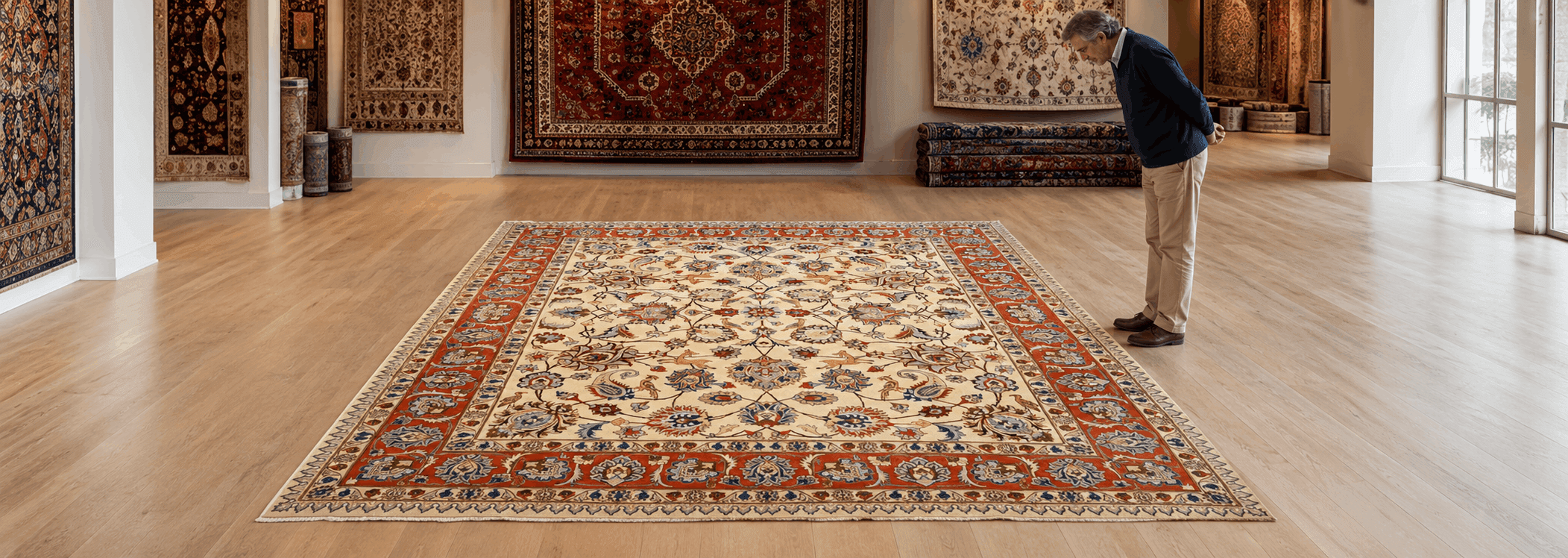
When buying a Persian rug, many people look for a label or a tag to confirm where the rug was made.
But what happens when there is no label?
For experienced rug experts, the absence of a label is not necessarily a problem. A Persian rug can often reveal its origin through its construction, knotting technique, materials, colors, design, and weaving style.
In fact, experienced dealers and collectors often examine the rug itself before relying on a label.
This is because labels can sometimes be removed, replaced, damaged, or simply never attached to a handmade rug in the first place.
So how can an expert identify a Persian rug without seeing its label?
Let's look at the clues professionals use.
Why Labels Are Not Always Reliable
A label can be useful, but it should not be the only evidence used to identify a rug.
Many traditional handmade Persian rugs were never produced with modern commercial labels. Older rugs, village rugs, tribal rugs, and rugs made for local use may have no label at all.
Even newer rugs can lose their original tags over time.
This is why professional identification focuses on the physical characteristics of the rug.
A label might say "Persian rug," but the rug itself can provide much more detailed information.
1. The Knotting Technique
One of the first things an expert examines is how the rug was constructed.
Persian rugs are traditionally hand-knotted, and the type and structure of the knots can provide valuable clues about their origin.
The Persian knot, also known as the asymmetrical or Senneh knot, is traditionally associated with Persian rug weaving.
Unlike the symmetrical Turkish or Ghiordes knot, the Persian knot is asymmetrical and can allow weavers to create very detailed designs.
However, knot type alone is not enough to identify a rug as Persian.
Different weaving regions can use similar techniques, and individual weavers may work differently.
Experts therefore examine the knot structure together with other characteristics.
2. Looking at the Back of the Rug
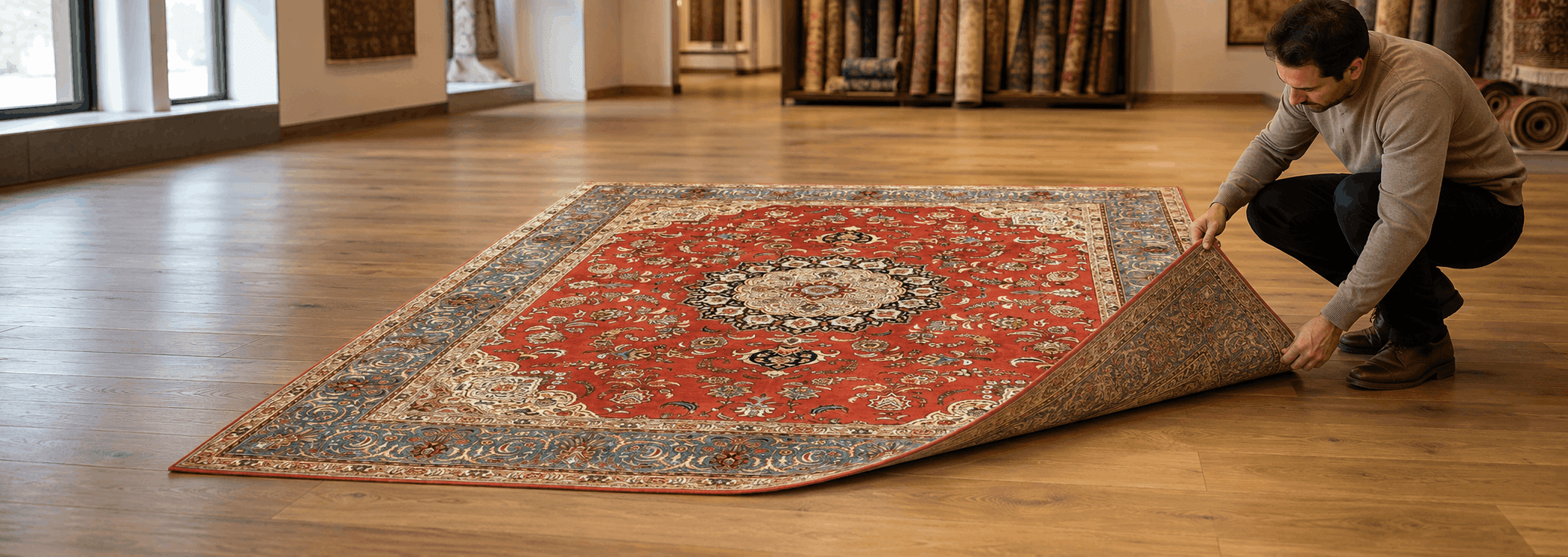
The back of a hand-knotted rug can tell an expert a surprising amount.
When a rug is turned over, you can often see the individual knots and the foundation threads.
Experts look at:
- Knot structure
- Knot density
- Foundation material
- Warp direction
- Weft structure
- Knot alignment
- Overall weaving consistency
The back can also reveal whether the rug is genuinely hand-knotted.
A machine-made rug tends to have a much more mechanically uniform structure.
A hand-knotted rug, on the other hand, may show small variations created by the human weaving process.
These variations are not necessarily flaws. They are often part of what makes a handmade rug unique.
3. The Materials Used
Materials are another important clue.
Traditional Persian rugs are commonly made with wool, cotton, silk, or combinations of these materials.
The type and quality of wool can provide information about a rug's region and intended use.
For example, some tribal and village rugs use relatively robust wool, while finer workshop rugs may feature carefully prepared wool with a softer feel and more precise finishing.
Silk Persian rugs can often be recognized by their extremely fine structure and smooth, luminous appearance.
Experts may also examine whether the foundation is made from cotton, wool, or silk.
The combination of pile and foundation materials can help narrow down the rug's origin.
4. The Color Palette
Color is one of the most recognizable characteristics of a Persian rug.
Traditional Persian rugs often feature rich reds, deep blues, warm browns, ivory, gold, and green.
But color alone cannot prove where a rug was made.
Instead, experts look at the relationship between colors.
Different regions developed their own preferred color combinations and dyeing traditions.
A village rug may have a more earthy and informal palette, while a sophisticated city workshop rug may use a broader range of carefully balanced colors.
Experts also examine how the colors have aged.
Natural dyes can develop subtle variations and patina over time, while some synthetic dyes may produce a more uniform appearance.
However, modern synthetic dyes can also be highly sophisticated, so color should always be considered together with other evidence.
5. The Design and Motifs
The design of a rug can provide some of the strongest clues about its origin.
Persian rug traditions developed across many different regions, and each developed recognizable patterns and motifs.
For example, Tabriz rugs are often associated with detailed floral compositions, medallions, and highly refined drawing.
Isfahan rugs are known for sophisticated floral designs and elegant compositions.
Kashan rugs frequently feature elaborate floral patterns and central medallions.
Heriz rugs are commonly recognized for bold geometric medallions and strong angular floral motifs.
Gabbeh rugs, traditionally associated with tribal weaving in southwestern Iran, often feature simpler geometric designs, large motifs, and a more expressive appearance.
These characteristics are not absolute rules.
A rug can be influenced by multiple regional traditions, and modern producers may intentionally reproduce famous Persian styles.
Nevertheless, design remains an important part of professional identification.
6. The Rug's Construction
Two rugs may look similar from the front but have completely different construction.
Experts therefore examine how the rug was actually made.
They may look at:
- The type of knot
- Knot density
- Pile height
- Warp and weft
- Selvedges
- Ends
- Edge finishing
- Overall structure
These details can help distinguish between rugs from different regions.
Construction is particularly useful because it is much harder to imitate consistently than a decorative pattern.
A manufacturer can reproduce a famous Persian design, but reproducing the exact traditional construction of a particular weaving region is more complicated.
7. The Shape and Proportions
The shape of a rug can also provide clues.
Traditional village and tribal rugs are not always perfectly rectangular.
Slight irregularities can occur because they were woven by hand, sometimes on relatively simple looms.
City workshop rugs are often more carefully planned and can have more precise proportions.
The shape alone is never enough to identify a rug, but it can support other evidence.
8. The Selvedges and Edges
Experts pay close attention to the sides of a rug.
The selvedges are the finished edges running along the length of the carpet.
Their construction can vary between regions and weaving traditions.
Some rugs have simple hand-finished edges, while others have more elaborate structures.
The way the edges have been repaired or finished can also provide clues about the rug's history.
Because the sides are structurally connected to the weaving process, they can sometimes reveal information that is not obvious from the front.
9. The Ends and Fringe
The ends of a Persian rug can also reveal how it was constructed.
Experts examine whether the fringe is part of the original foundation or was added later.
They also look at how the warp threads are secured and finished.
This can help distinguish original construction from later repairs.
However, fringe should not be used by itself to determine whether a rug is Persian.
Fringe styles can be altered during restoration, and similar techniques may appear in different weaving traditions.
10. The Type of Weaving Region
One of the most important distinctions experts make is between city, village, and tribal rugs.
City rugs are often produced in organized workshops and may feature highly detailed, symmetrical designs.
Village rugs are usually more informal and can show greater variation in design and construction.
Tribal rugs may feature bold geometric designs, strong colors, and distinctive local motifs.
Understanding these categories helps experts narrow down a rug's likely origin.
11. Signs of Age and Wear
Age is another important part of identification.
Experts examine how the pile has worn, how the colors have changed, and whether the foundation has aged naturally.
They may also look for:
- Surface wear
- Oxidized pile
- Abrash
- Repairs
- Rewoven areas
- Patina
- Changes in foundation color
These signs can help determine whether a rug is genuinely old or simply designed to look antique.
However, determining an exact age from appearance alone can be difficult.
Professional authentication may require additional research and scientific analysis.
12. Abrash as a Clue
Abrash refers to a visible change in color within an area of a rug.
It can occur when different batches of wool were dyed at different times.
Because traditional dyeing was done manually, matching exactly the same color from one dye bath to another could be difficult.
Abrash is common in many traditional handmade rugs and can provide clues about how the rug was produced.
But it is not proof of Persian origin.
Modern rugs can also develop or reproduce color variations.
13. Natural vs Synthetic Dyes
Experts may also investigate the dyes used in the rug.
Traditional Persian carpets often used natural dyes derived from plants and other natural sources.
Madder was widely used for red, indigo for blue, and walnut materials for brown and earthy shades.
The presence of natural dyes can provide useful historical information, particularly when examining older rugs.
However, natural dye does not automatically mean a rug is antique.
Modern handmade rugs can also be dyed using traditional natural-dye techniques.
Similarly, synthetic dyes do not automatically mean that a rug is low quality.
Modern synthetic dyes can offer excellent colorfastness.
14. The Overall "Personality" of the Rug
Experienced rug experts often develop an intuitive understanding of different weaving traditions.
They recognize combinations of characteristics rather than relying on a single feature.
A particular rug might have:
- A certain type of wool
- A specific knot structure
- A recognizable color palette
- A particular border design
- Distinctive finishing
- Regional motifs
When these clues appear together, they can create a strong indication of where the rug originated.
This is why identifying a Persian rug is often more like putting together a puzzle than checking a single label.
Can You Identify a Persian Rug at Home?
You can certainly look for clues yourself.
Start by turning the rug over and examining its construction.
Then look closely at the colors, design, edges, fringe, materials, and overall condition.
Take clear photographs of:
- The entire rug
- A close-up of the front
- A close-up of the back
- The edges
- The fringe
- Any labels or signatures
- Areas showing wear or repairs
These photographs can be useful when asking a professional for an initial opinion.
However, photographs cannot always replace an in-person examination.
What About Persian Rug Signatures?
Some Persian rugs contain signatures associated with a particular workshop or weaver.
A signature can be useful, but it should not automatically be accepted as proof of authenticity.
Experts examine the signature together with the rug's construction, design, materials, and provenance.
A rug can have a signature and still require authentication.
Why Professional Identification Matters
Identifying a Persian rug correctly can be important when the rug is antique, rare, or potentially valuable.
An expert can help determine:
- Whether the rug is hand-knotted
- Its likely region of origin
- Approximate age
- Materials
- Construction
- Style
- Condition
- Possible rarity
For particularly valuable rugs, professional appraisal and authentication can provide much stronger evidence than online guesses.
Persian Rugs at RugEast
At RugEast, we believe that understanding a Persian rug starts with looking beyond the surface.
The beauty of a handmade rug comes from the combination of its design, materials, colors, and weaving tradition.
Whether you are interested in a Gabbeh, Tabriz, Heriz, Kashan, or another Persian style, learning how experts identify rugs can help you understand what makes each piece different.
A Persian rug does not need a label to tell its story.
Sometimes, the knots, colors, wool, edges, and patterns tell you everything you need to know.
Final Thoughts
Identifying a Persian rug without a label is a combination of knowledge, observation, and experience.
Experts examine the knotting technique, back structure, materials, colors, motifs, edges, fringe, construction, age, and signs of wear.
No single feature can usually provide a definitive answer.
Instead, professionals combine multiple clues to build a picture of the rug's origin and history.
That is what makes Persian rugs so fascinating.
Their identity is often woven directly into the rug itself.
Frequently Asked Questions
1) How can you tell if a rug is Persian without a label?
Experts examine its knotting technique, construction, materials, colors, motifs, edges, fringe, and overall weaving style. Several characteristics together can help determine whether a rug is Persian and identify its likely region.
2) Can you identify a Persian rug by the knot?
The knot can provide an important clue, particularly when combined with other construction details. However, knot type alone cannot prove that a rug is Persian.
3) What is a Persian knot?
A Persian knot, also known as an asymmetrical or Senneh knot, is a type of knot traditionally used in Persian rug weaving. It differs from the symmetrical Turkish or Ghiordes knot.