
Why Do Persian Rugs Sometimes Have Different Knot Sizes?
When looking closely at the back of a Persian rug, you may notice something surprising: the knots do not always appear perfectly uniform. Some may look smaller and tighter, while others seem slightly larger or more widely spaced.
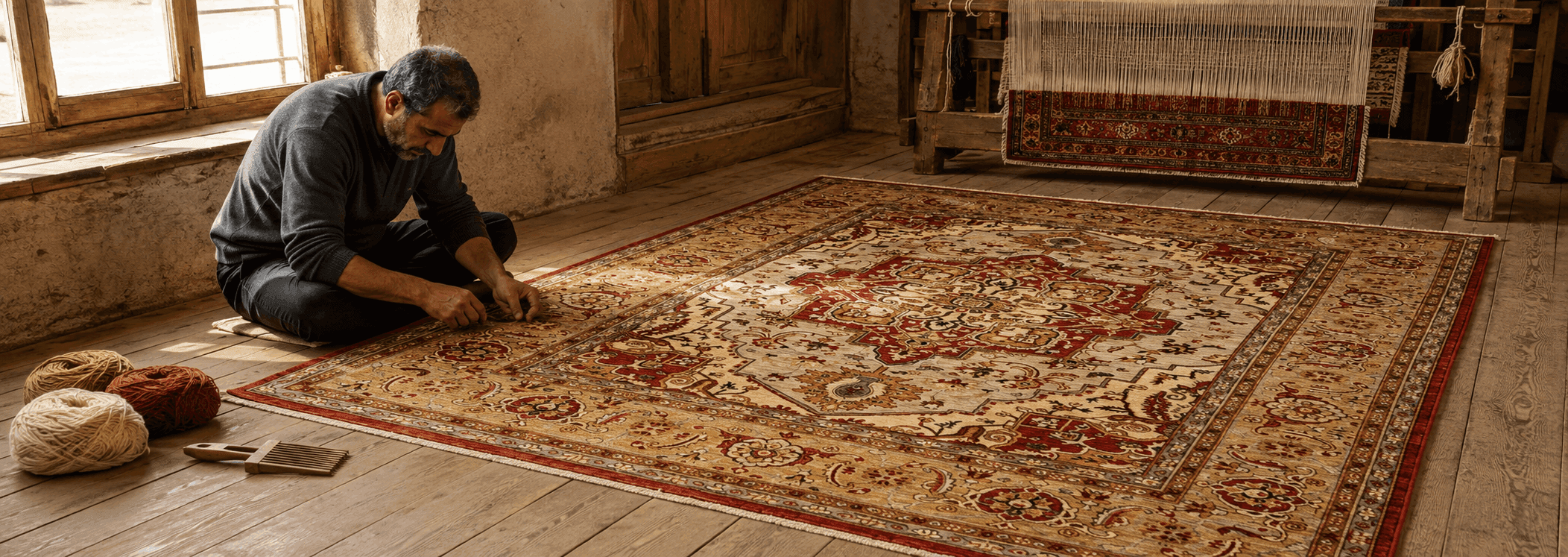
When looking closely at the back of a Persian rug, you may notice something surprising: the knots do not always appear perfectly uniform. Some may look smaller and tighter, while others seem slightly larger or more widely spaced.
At first, this might look like a flaw. In reality, different knot sizes are common in handmade Persian rugs and can tell us a great deal about how a rug was made, who made it, and where it came from.
Understanding knot variation is an important part of appreciating the craftsmanship behind Persian rugs.
What Is a Knot in a Persian Rug?
Persian rugs are traditionally made by tying individual knots around the warp threads. These knots form the foundation of the rug's pile and ultimately create its patterns and designs.
Depending on the region and weaving tradition, different knotting techniques may be used. The most common include the Persian or asymmetrical knot and the Turkish or symmetrical knot.
The size of each knot depends on several factors, including the thickness of the yarn, the spacing of the warp threads, the type of loom, and the individual weaver's technique.
Because handmade rugs are created knot by knot rather than by machine, small variations are completely natural.
Why Are Knot Sizes Sometimes Different?
1. The Weaver's Hand Is Not a Machine
One of the simplest explanations is human craftsmanship.
A weaver may tie hundreds or even thousands of knots during a single working session. The tension of the yarn, the pressure applied to each knot, and the spacing between threads can naturally change.
This means that even a highly skilled weaver may produce knots that are not identical in size.
Rather than indicating poor workmanship, minor variations can be evidence of a genuinely handmade rug.
2. Different Parts of the Rug May Require Different Knotting
Persian rug designs can be extremely detailed. A central medallion, floral border, animal figure, or geometric motif may require a different level of precision than a large area of background color.
In particularly detailed sections, the weaver may work with finer yarn or tighter knotting to create sharper shapes.
Larger, simpler areas may use slightly different spacing.
This can create visible differences in knot size across the rug.
3. The Yarn Thickness Can Change
The material used for the pile also influences knot size.
Wool yarn, for example, can vary naturally in thickness. Handmade yarn is not always perfectly consistent from one section to another.
Silk rugs generally allow for extremely fine knotting because silk fibers can be spun very finely. Wool rugs, particularly village and tribal rugs, may have thicker yarn and more substantial knots.
The important point is that knot size should always be considered together with the rug's material and weaving tradition.
4. Changes During the Weaving Process
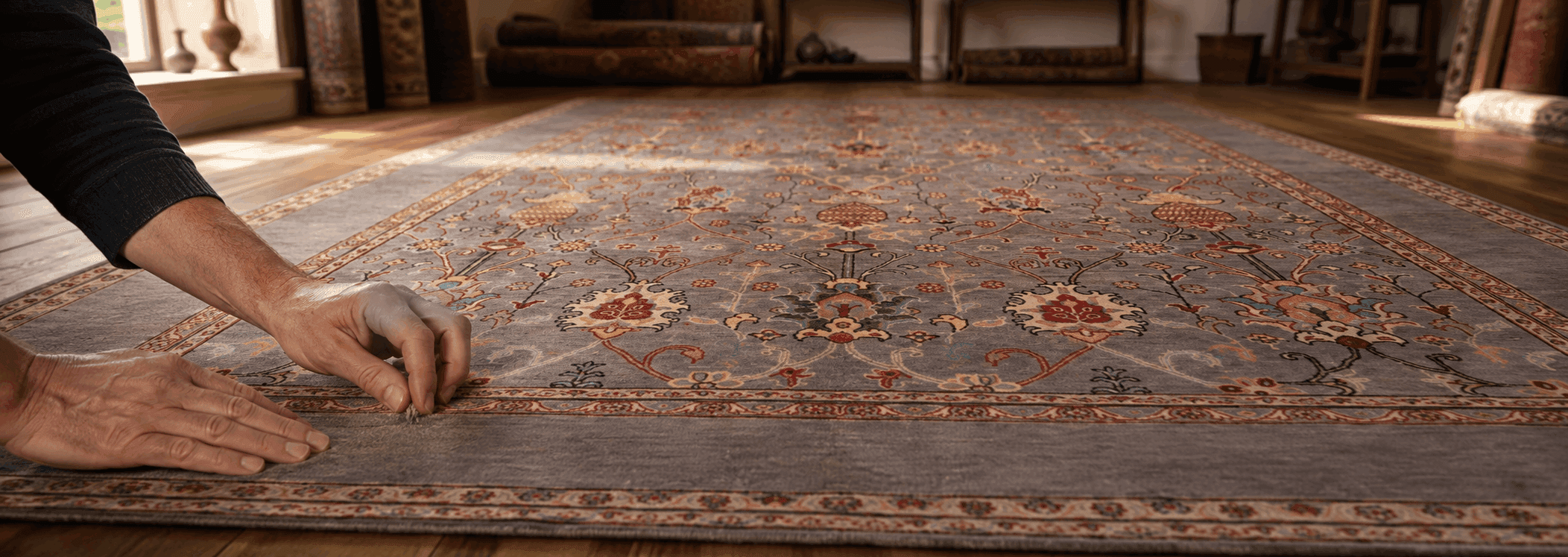
Some Persian rugs take months or even years to complete. During that time, a weaver's technique can change.
The rug may also be worked on by more than one person, particularly in a workshop or family weaving environment.
Different weavers can naturally have slightly different knotting styles. As a result, one part of the rug may appear finer or more compact than another.
This does not necessarily reduce the rug's quality.
Does Uneven Knotting Mean a Persian Rug Is Low Quality?
Not necessarily.
A common misconception is that every knot in a valuable Persian rug must be exactly the same size. In reality, handmade rugs are judged by much more than uniformity.
Experts consider the overall construction, materials, design, dye quality, condition, craftsmanship, age, origin, and consistency of the rug as a whole.
A rug with small variations in knot size can still be beautifully made and highly valuable.
However, significant irregularities combined with weak construction, loose edges, poor materials, or other problems may indicate lower-quality workmanship.
The key is to look at the entire rug rather than judging it from knot size alone.
Can Knot Size Help Identify Where a Persian Rug Was Made?
Yes, but only as one clue.
Different weaving regions developed their own traditions, and these traditions can influence knot density, knot type, yarn thickness, and overall construction.
For example, some city rugs are known for relatively fine and detailed weaving, while many tribal and village rugs have a more relaxed structure and thicker wool.
However, there is no universal rule such as "small knots always mean a better rug" or "large knots mean a village rug."
Experienced rug dealers and collectors usually examine several characteristics together, including the back, knot structure, colors, motifs, borders, materials, and finishing details.
Knot Size vs. Knot Density
Knot size and knot density are related, but they are not exactly the same thing.
Knot density refers to how many knots are packed into a specific area of the rug. A rug with very fine knotting can contain a large number of knots per square inch, allowing the weaver to create highly detailed patterns.
But a high knot count does not automatically mean a rug is better.
A coarser rug can have its own artistic value, especially when its design, wool quality, natural dyes, age, or tribal character makes it desirable.
The right question is not simply "How many knots does this rug have?" but rather "Does the knotting suit the rug's design, materials, and weaving tradition?"
Are Different Knot Sizes a Sign of an Antique Persian Rug?
Not by themselves.
Older handmade rugs can certainly show variations in knot structure, particularly after years of wear, stretching, repairs, and restoration. But knot variation alone cannot prove that a rug is antique.
Age should be evaluated using multiple characteristics, such as the condition of the wool, foundation, dyes, pile, ends, edges, design characteristics, and signs of natural wear.
In other words, different knot sizes can support the story of a handmade rug, but they are not an age certificate.
How to Examine Knot Sizes Yourself
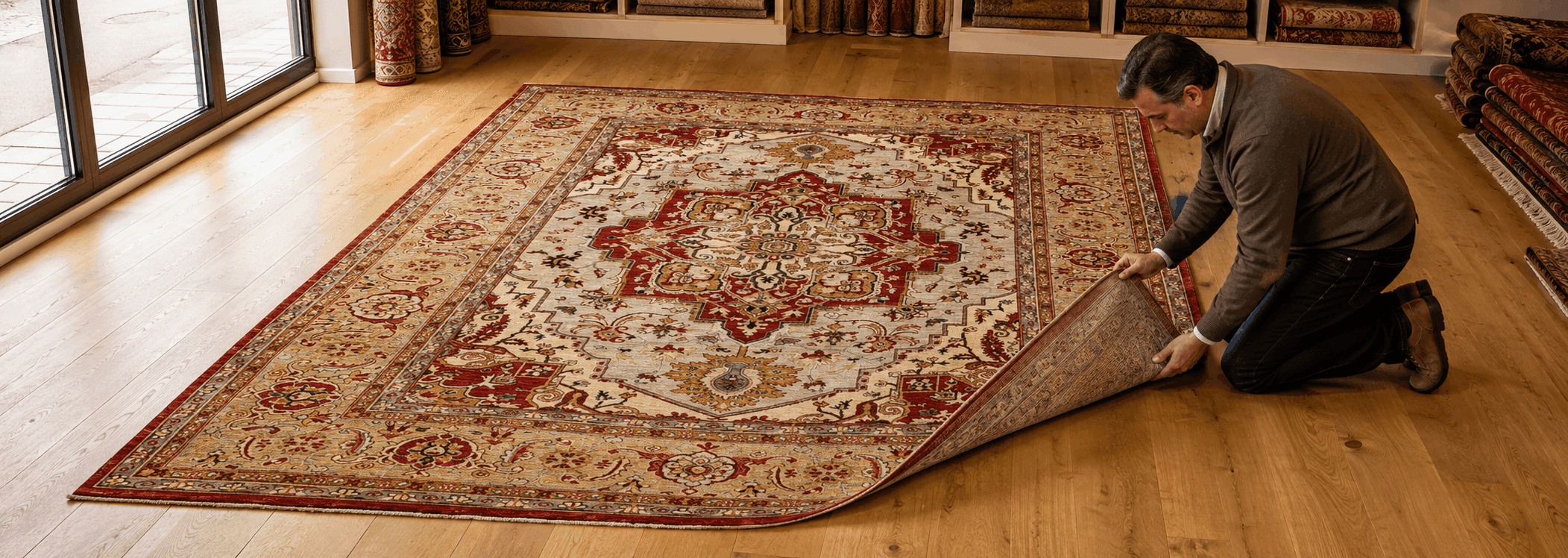
If you want to inspect a Persian rug, turn it over and look carefully at the back.
Instead of searching for perfect uniformity, look for the overall structure.
Ask yourself:
- Are the knots securely formed?
- Is the weave reasonably consistent?
- Can you see the individual warp and weft threads?
- Does the knotting correspond with the rug's design?
- Are there obvious repairs or areas with dramatically different construction?
- Does the rug appear handmade rather than mechanically produced?
A magnifying glass can be useful when examining a fine rug.
However, identifying a Persian rug from knot structure alone can be difficult. A professional may need to examine the rug's materials, dyes, construction, design, and condition together.
The Beauty of Handmade Imperfection
One of the most fascinating things about Persian rugs is that they are handmade objects.
Small differences in knot size, yarn thickness, color, and tension are part of that process. They show that a person—not a machine—created the rug one knot at a time.
Instead of seeing every irregularity as a defect, it can be more useful to see it as part of the rug's individual character.
At RugEast, we believe that understanding these details makes it easier to appreciate the craftsmanship behind every handmade Persian rug.
Conclusion
Different knot sizes in Persian rugs are usually the result of the human weaving process, variations in yarn, changes in technique, and differences between sections of a design.
They do not automatically indicate poor quality, nor do they prove that a rug is antique.
The real value of knot structure comes from understanding it alongside the rug's materials, design, origin, craftsmanship, age, and overall condition.
That combination of details is what makes every handmade Persian rug unique.
FAQ
1) Are different knot sizes normal in Persian rugs?
Yes. Minor variations are common in handmade Persian rugs and can result from differences in yarn, tension, technique, and weaving conditions.
2) Do smaller knots mean a better Persian rug?
Not necessarily. Fine knotting can allow for greater detail, but quality also depends on materials, craftsmanship, design, dyes, condition, and origin.
3) Can knot size tell me how old a Persian rug is?
Knot size alone cannot determine age. It should be considered together with other characteristics such as materials, dyes, wear, construction, and design.