
From Fleece to Persian Rug: How Iranian Wool Is Washed, Spun, Dyed and Prepared
Discover the hidden journey behind every woolen Persian rug—from shearing and sorting the fleece to spinning, dyeing, and weaving. Learn how each stage of wool preparation shapes the rug’s texture, durability, colour, and character.
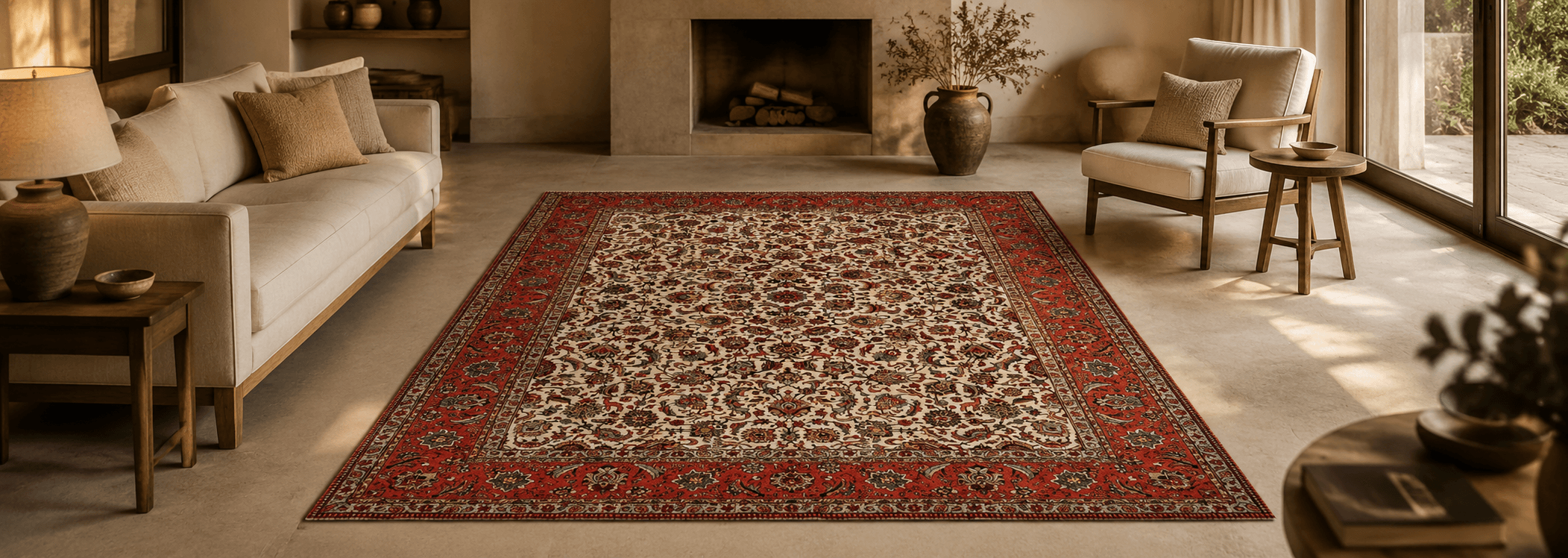
The Hidden Journey Behind Every Woolen Persian Carpet
When you look at a handmade Persian rug, it is easy to focus on what is visible.
The colours.
The patterns.
The knots.
The craftsmanship.
But long before the first knot is tied, another story has already begun.
It starts with a sheep.
The fleece must be collected, sorted, cleaned, prepared, spun and sometimes dyed before it becomes the yarn that a weaver can use.
This transformation is one of the least visible—and most important—parts of traditional Persian carpet production.
A beautiful rug is therefore not simply the result of weaving.
It is the result of a chain of material decisions.
Sheep → Fleece → Sorting → Washing → Drying → Opening/Carding → Spinning → Dyeing → Yarn → Weaving → Persian Rug
Every stage can influence the final appearance, durability, texture and character of the carpet.
RUGEAST
The Carpet Begins Before the Loom
A common misconception is that the making of a Persian rug starts when the weaver begins knotting. In reality, the story begins much earlier.
The quality of the final carpet is partly determined before the wool ever reaches the loom.
This is why understanding wool preparation is essential for anyone who wants to understand handmade Persian rugs.
1. Shearing: The First Step in the Wool Journey
The process begins with the removal of the sheep's fleece.
Traditionally, shearing was carried out according to the seasonal conditions and the needs of the animals.
The timing matters.
Wool must be collected in a condition suitable for further processing, while the animal itself must be protected from unnecessary stress or exposure to unsuitable weather.
Historically, shearing was an important seasonal activity in pastoral communities.
The fleece was not simply viewed as an industrial raw material.
It was part of a larger agricultural and household economy.
2. One Fleece Does Not Mean One Quality
A sheep's fleece is not perfectly uniform.
Different parts of the animal can produce fibres with different characteristics.
The fibre may vary in:
- length,
- fineness,
- strength,
- colour,
- crimp,
- cleanliness,
- and amount of vegetable matter.
This is why traditional wool preparation begins with sorting.
Experienced wool workers understand that the quality of the final yarn depends partly on how carefully the raw fleece is selected.
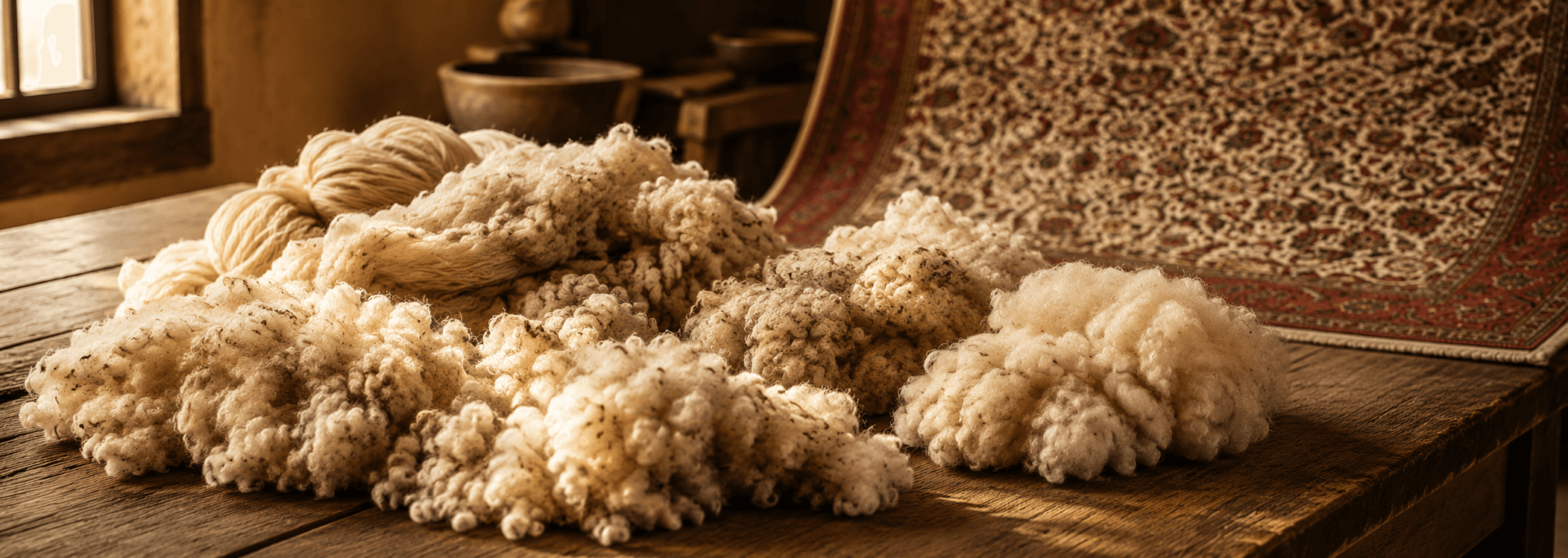
3. Sorting the Wool
Sorting is a crucial but often overlooked stage.
The fleece may contain:
- different grades of fibre,
- dirt,
- vegetable matter,
- coarse fibres,
- shorter fibres,
- and other impurities.
Traditional workers separate materials according to their intended use.
The finest fibres may be directed toward particular types of yarn, while stronger or coarser fibres may be appropriate for other applications.
This is one reason why simply knowing that a rug is made from "wool" tells us very little.
The quality and preparation of the wool matter enormously.
4. Washing: More Than Simply Cleaning
After sorting, wool needs to be washed.
Raw fleece contains naturally occurring substances, including lanolin, along with dirt and environmental material.
Washing helps remove unwanted substances and prepares the fibres for further processing.
But washing must be handled carefully.
Excessive agitation, unsuitable temperatures or harsh treatment can affect the fibre.
Traditional wool processing therefore requires knowledge and experience.
The objective is not simply:
"Make the wool clean."
The objective is:
"Clean the wool without damaging the characteristics that make it useful."
RUGEAST
Why Is Lanolin Important?
Lanolin is a natural waxy substance found in sheep's wool. It helps protect the sheep's skin and fleece.
During wool processing, much of the lanolin is removed. However, the way wool is washed and prepared can influence the feel and behaviour of the resulting fibre.
This is another example of why traditional material preparation is more complex than it first appears.
5. Drying the Wool
After washing, the wool needs to dry properly.
Traditionally, this could involve spreading the wool out and allowing air and sunlight to assist the drying process.
The goal is to prevent excessive moisture from remaining in the fibre.
Proper drying is important because poorly dried material can create problems during storage and subsequent processing.
In traditional production, even a simple stage such as drying requires attention.
6. Opening and Carding the Wool
Once clean and dry, wool fibres need to be opened and organised.
Traditional methods may involve tools designed to separate and loosen the fibres.
The objective is to create a more workable mass of fibres that can eventually be transformed into yarn.
Modern textile production often uses mechanised carding systems.
Traditional carpet production, however, may rely on simpler tools and considerable manual skill.
The difference is not merely technological.
The method of fibre preparation can influence the structure and character of the yarn.
7. Spinning: Turning Fibre Into Yarn
This is one of the most fascinating stages.
Loose wool fibres cannot simply be used directly for most types of carpet weaving.
They must first become yarn.
Spinning involves drawing and twisting the fibres together.
The amount and direction of twist can influence:
- strength,
- thickness,
- elasticity,
- surface texture,
- and the way the yarn behaves during weaving.
Traditional handspinning can also introduce subtle variations in yarn thickness.
For a handmade rug, these variations may contribute to its individual character.
RUGEAST
Handspun Yarn Is Not Necessarily "Perfectly Uniform"
Industrial yarn production often aims for extreme consistency. Traditional handspinning may produce slight variations.
These variations can affect the way light interacts with the pile and can contribute to the visual liveliness of a handmade rug.
Uniformity and quality are not always the same thing.
8. Why Yarn Twist Matters
The twist of a yarn is more important than many buyers realise.
A yarn with different levels of twist can behave differently in the finished carpet.
It can influence:
- firmness,
- flexibility,
- surface texture,
- durability,
- and the appearance of the pile.
This is particularly important when comparing different regional traditions.
The same raw material can produce very different results depending on how it is spun.
9. Handspun vs. Machine-Spun Yarn
This distinction deserves careful attention.
Handspun yarn
May exhibit:
- natural variation,
- changing thickness,
- individual character,
- traditional tactile qualities.
Machine-spun yarn
Generally offers:
- greater uniformity,
- predictable thickness,
- consistent production,
- industrial repeatability.
Neither is automatically superior.
The question is whether the yarn is appropriate for the rug's:
- construction,
- design,
- purpose,
- and weaving tradition.
10. Dyeing: Giving Wool Its Colour
Once the yarn is prepared, it may be dyed.
Colour is one of the defining characteristics of Persian rugs.
Traditional Iranian carpet culture developed an extraordinary knowledge of natural and synthetic colour sources.
Historically, natural dyes derived from plants, insects and minerals played a major role.
Examples include:
- madder for red tones,
- indigo for blue,
- weld and other plants for yellow,
- walnut-related materials for brown tones.
The exact palette depended on regional traditions, available materials and the dyer's knowledge.
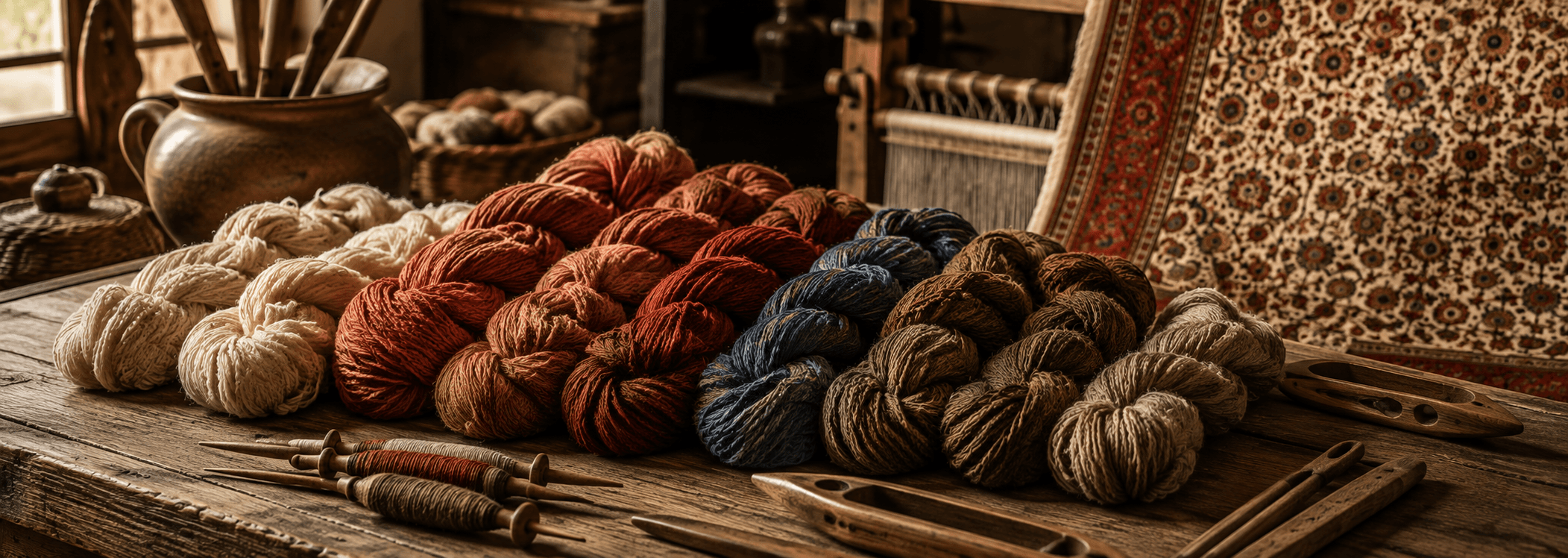
11. Natural Dyes and the Character of Persian Rugs
Natural dyes are often discussed as if they automatically guarantee superior quality.
That is too simplistic.
The quality of a dyed yarn depends on many variables, including:
- the dye source,
- preparation,
- concentration,
- water,
- temperature,
- mordant,
- timing,
- and the skill of the dyer.
The same dye material can produce different results under different conditions.
This is one reason traditional Persian colours can be so complex.
A single red, for example, may contain subtle variations rather than appearing as a perfectly uniform industrial colour.
12. The Beauty of Colour Variation
One of the most admired characteristics of many older Persian rugs is abrash.
Abrash refers to visible variation or changes in colour across an area of a rug.
It can occur when:
- the dyer runs out of one batch of dyed yarn,
- a new dye bath is prepared,
- the same dye source produces a slightly different result,
- or the yarn absorbs colour differently.
Abrash is not necessarily a defect.
In antique and tribal rugs, it can become part of the rug's visual personality.
RUGEAST
When an "Imperfection" Becomes Beauty
Modern industrial production often tries to eliminate variation. Handmade rugs can turn variation into character.
A subtle change in colour can tell us something about the dyeing process, the history of the rug, the materials available to the weaver, and the human nature of its production.
13. Preparing the Yarn for the Loom
After spinning and, where appropriate, dyeing, the yarn must be prepared for weaving.
The exact process varies according to the type of carpet and weaving tradition.
Different yarns may be used for:
- warp,
- weft,
- pile.
Their characteristics need to suit their specific function.
The warp forms the structural foundation.
The weft helps secure and organise the construction.
The pile creates the visible surface of many knotted carpets.
Understanding this distinction helps explain why a Persian rug cannot be evaluated simply by asking:
"What kind of wool is it?"
The more useful question is:
"Where and how is the wool being used within the structure of the rug?"
14. Wool Is Part of a Larger System
At this point, an important principle becomes clear.
The quality of a Persian rug does not depend on wool alone.
It emerges from the interaction between:
- Fibre
- Yarn
- Dye
- Warp
- Weft
- Knotting
- Finishing
- Use and Care
This is why two rugs made from wool of apparently similar quality can have completely different characteristics.
15. Why Traditional Preparation Still Matters Today
Industrial textile technology can produce highly consistent yarns at enormous scale.
Yet traditional wool preparation remains relevant.
Why?
Because handmade Persian rugs are not simply industrial products.
They are cultural objects whose value can lie in:
- material individuality,
- craftsmanship,
- regional identity,
- historical continuity,
- and human involvement.
Traditional processing helps preserve some of these characteristics.
RUGEAST
The Difference Is in the Chain
A high-quality Persian rug is not created by one "magic" material. It is the result of many good decisions made consecutively.
Good fleece → careful sorting → appropriate washing → proper preparation → skilled spinning → suitable dyeing → precise weaving
A weakness at one stage can affect everything that follows.
16. Can You Tell How Wool Was Processed by Looking at the Finished Rug?
Sometimes.
An experienced specialist may identify clues in:
- yarn structure,
- pile texture,
- lustre,
- irregularity,
- colour behaviour,
- handle,
- and overall construction.
However, these observations are interpretive rather than absolute.
A serious evaluation should consider multiple characteristics rather than relying on a single visual clue.
17. What Buyers Should Look For
When buying a handmade Persian rug, ask questions beyond the design.
Material
What fibre is used?
Yarn
Is the yarn handspun or machine spun?
Dye
Are the colours natural, synthetic, or a combination?
Construction
How are warp, weft and pile constructed?
Origin
Does the material correspond to the claimed region?
Condition
Has the rug been washed, repaired, overdyed or restored?
These questions provide much more useful information than simply asking whether a rug is "100% wool."
RUGEAST
Persian Rug Buyer's Checklist
Before purchasing an important handmade Persian rug, check:
☐ Wool quality
☐ Yarn structure
☐ Handspun or machine-spun yarn
☐ Natural or synthetic dyes
☐ Warp and weft materials
☐ Knot structure
☐ Pile condition
☐ Repairs and restoration
☐ Provenance
☐ Overall condition
18. Why "100% Wool" Is Not Enough
A label saying 100% wool may sound reassuring.
But it tells us surprisingly little.
Two rugs can both be made from 100% wool and still differ enormously in:
- fibre quality,
- yarn quality,
- spinning,
- dyeing,
- construction,
- craftsmanship,
- durability,
- historical significance.
For serious buyers, the material should always be considered within the context of the entire rug.
FAQ
1) How is wool prepared for a Persian rug?
Wool for a traditional Persian rug typically goes through several stages: shearing, sorting, washing, drying, opening or carding, spinning, and often dyeing. The resulting yarn is then prepared for use in the warp, weft or pile according to the rug's construction.
The exact process varies by region, workshop, weaving tradition and period.
2) Is handspun wool better for Persian rugs?
Not automatically.
Handspun wool can provide natural variation and a distinctive tactile character, while machine-spun yarn generally offers greater consistency.
The better choice depends on the rug's construction, design, intended use and regional tradition.
2) Are natural dyes always better than synthetic dyes?
No.
Natural dyes can produce remarkable depth and variation, but dye quality depends on the dye source and the skill of the dyer.
High-quality synthetic dyes can also be stable and technically excellent.
The important issue is understanding which dyes were used, how they were applied and whether they are appropriate for the rug.
3) How is wool prepared for Persian rugs?
It is generally sorted, washed, dried, opened or carded, spun into yarn and, when required, dyed before being used in weaving.
4) Is Persian rug wool always handspun?
No. Traditional rugs may use handspun wool, but machine-spun yarn is also found in many modern and commercial carpets.
5) What is handspun wool?
Handspun wool is yarn created by manually drawing and twisting wool fibres into a continuous thread.
CONCLUSION
The story of a Persian rug does not begin at the loom.
It begins with the fleece.
From the moment wool is collected, every stage of preparation can influence the final carpet.
- Shearing.
- Sorting.
- Washing.
- Drying.
- Fibre preparation.
- Spinning.
- Dyeing.
- Weaving.
Together, these processes transform an ordinary natural fibre into one of the most enduring forms of textile art in the world.
This is why understanding Persian rug wool requires more than knowing whether a carpet is made from wool.
We need to understand where the wool came from, how it was prepared, how it was spun, how it was dyed and how it became part of the structure of the finished rug.
That knowledge allows us to look at a Persian rug differently.
We stop seeing only a pattern.
We begin to see a material history.
RUGEAST
From Sheep to Art
A Persian rug may lie quietly on the floor. But hidden inside it is a remarkable chain of human and natural processes:
Animal → Landscape → Fibre → Craft → Colour → Yarn → Knot → Rug
That is the deeper story of Persian carpet wool.