
Isfahan Rug History: From Royal Workshops to Modern Homes
Today, Isfahan rugs are admired for their refined designs, detailed floral patterns, elegant colors, fine wool, and sophisticated craftsmanship. But the story behind these rugs goes much further than modern homes and contemporary interiors.
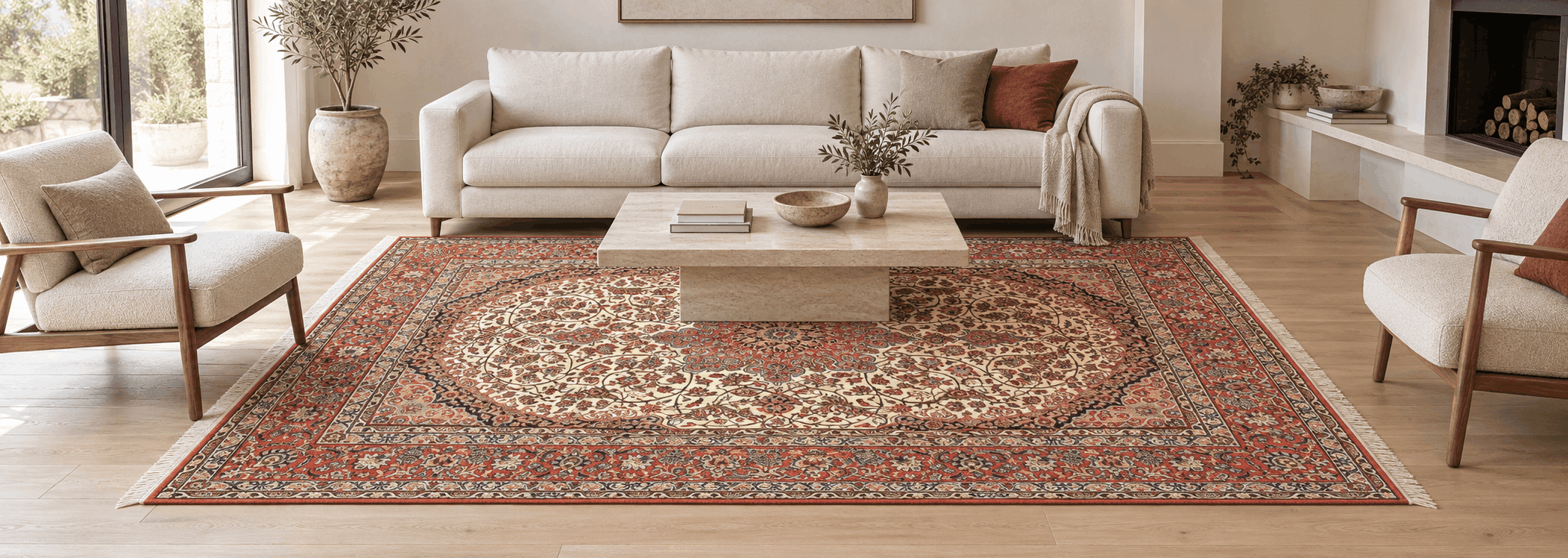
Few Persian rugs have a history as closely connected to art, architecture, and royal patronage as the Isfahan rug.
Today, Isfahan rugs are admired for their refined designs, detailed floral patterns, elegant colors, fine wool, and sophisticated craftsmanship. But the story behind these rugs goes much further than modern homes and contemporary interiors.
The history of Isfahan rug weaving is closely connected to the rise of Isfahan as a major artistic center during the Safavid period, particularly after Shah Abbas I moved the capital to the city in 1598. During this period, royal patronage helped transform Persian carpet weaving into one of the country's most important artistic traditions.
From royal workshops to modern carpet studios, Isfahan has experienced periods of extraordinary creativity, decline, and revival.
Isfahan Before the Great Safavid Revival
Carpet weaving existed in Iran long before Isfahan became famous for its rugs.
However, surviving evidence does not allow historians to establish a continuous line of Isfahan carpet production from ancient times to the present. Persian carpet production existed in many regions simultaneously, including cities, villages, and rural communities.
The major turning point came during the Safavid dynasty.
The Safavids ruled Iran from 1501 and placed enormous importance on the arts. Carpets became increasingly connected with royal culture, architecture, diplomacy, and international trade.
Before Isfahan became the capital, the Safavid court was based in Tabriz and later Qazvin. When Shah Abbas I moved the capital to Isfahan in 1598, the city became the center of a remarkable artistic and architectural transformation.
The Safavid Golden Age
The reign of Shah Abbas I is often considered one of the most important periods in the history of Persian art.
Under his patronage, Isfahan developed into a major center for architecture, textiles, painting, metalwork, ceramics, and carpet production.
Royal workshops were established in Isfahan, and carpet production became closely connected with the artistic world of the Safavid court. Historical sources place royal carpet workshops in the area between Chehel Sotoun and the royal square, showing how closely carpet production was connected to the heart of the capital.
These workshops produced luxury carpets for royal palaces, religious buildings, diplomatic gifts, and international trade.
Carpets made under royal patronage were not simply practical floor coverings. They were highly sophisticated works of art.
Influence of Royal Artists
The Safavid court brought together painters, designers, calligraphers, architects, textile specialists, and other craftsmen.
Their influence can be seen in Persian carpet designs.
Floral compositions, elegant arabesques, central medallions, complex borders, and balanced layouts became increasingly sophisticated.
Carpet designers were influenced by other forms of Safavid art, particularly manuscript illumination, architecture, tilework, and decorative arts.
This connection between different artistic disciplines helped create the refined visual language associated with classical Persian carpets.
Isfahan Rugs and Architecture
One of the most interesting aspects of Isfahan rugs is their relationship with the city's architecture.
Safavid Isfahan became famous for monumental buildings, gardens, mosques, palaces, and decorative tilework.
The colors and forms found in these surroundings influenced the visual culture of the city.
Traditional Isfahan rugs often feature elegant floral designs, intricate borders, medallions, and carefully balanced compositions.
Blue, ivory, red, beige, and other sophisticated tones are frequently used to create a refined appearance.
This connection between architecture and carpet design remains part of Isfahan's artistic identity.
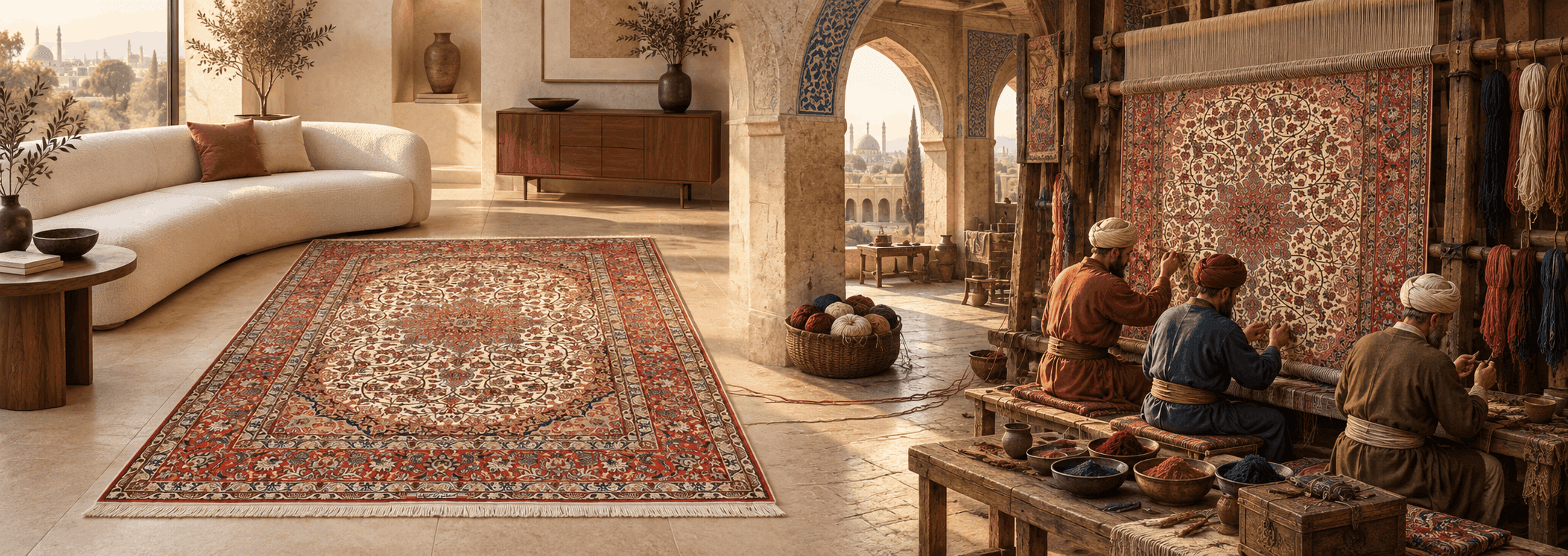
From Royal Workshops to Commercial Production
The royal workshops were not isolated from the commercial world.
Historical evidence shows that carpets produced under royal patronage could also enter international markets. Persian carpets were exported to Europe and India, while wealthy individuals and members of the nobility also commissioned carpets.
This helped establish Persian carpets as luxury products far beyond Iran.
However, it is important to remember that the term "Isfahan rug" does not always prove that a specific historical carpet was physically woven in Isfahan.
Historical rug attribution can be complicated. Scholars have often emphasized that geographical names used for Persian carpets may describe a style or tradition rather than provide absolute proof of the exact place where a particular rug was made.
The Decline After the Safavid Period
The Safavid dynasty eventually collapsed, and the political and economic conditions that had supported royal carpet production changed dramatically.
The Afghan invasion of 1722 had a major impact on Isfahan.
The city's crafts and industries suffered from war, political instability, economic disruption, and population changes.
The connection between modern Isfahan rugs and the Safavid period therefore should not be viewed as one completely uninterrupted tradition.
Historical research shows that skills and production were disrupted several times after the Safavid era.
For a long period, Isfahan was no longer producing carpets on the same scale associated with its royal past.
The Revival of Isfahan Rug Weaving
The modern history of Isfahan rugs is largely a story of revival.
By the early 20th century, carpet production began to develop again in Isfahan.
Around the 1920s, the city had become an important center of carpet weaving. Local craftsmen adapted older traditions to changing commercial markets and developed a recognizable Isfahan style.
This revival did not simply copy Safavid carpets.
Instead, modern weavers combined historical Persian design traditions with contemporary market demands.
The result was a new generation of highly refined city rugs.
The Rise of Fine Isfahan Rugs
Modern Isfahan rugs became particularly respected for their technical precision.
Fine wool, detailed drawing, sophisticated floral patterns, balanced medallions, and carefully coordinated colors became characteristic features.
Some high-quality examples also incorporate silk, either in the foundation or as highlights within the design.
The level of knotting can be extremely fine in exceptional pieces, allowing weavers to reproduce intricate details.
However, knot count should never be the only measure of quality.
Materials, craftsmanship, design, condition, age, and overall construction are equally important.
Isfahan Rugs in Modern Homes
Today, Isfahan rugs have moved far beyond royal palaces and traditional Persian interiors.
Their elegant designs make them suitable for modern homes, where they can work with both classic and contemporary furniture.
A finely detailed Isfahan rug can become the focal point of a living room, dining room, bedroom, or study.
Because many Isfahan designs use balanced floral patterns and sophisticated color combinations, they can complement rather than overwhelm a modern interior.
This versatility is one reason why Isfahan rugs remain popular internationally.
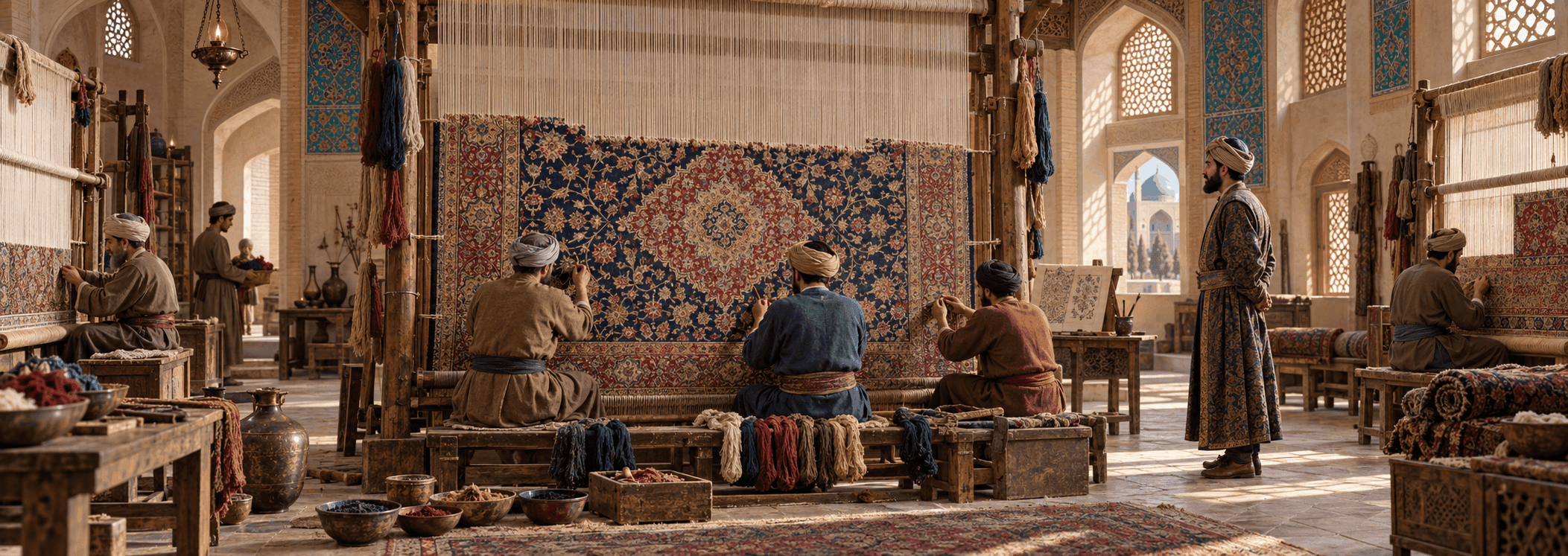
Why Isfahan Rugs Still Matter
The appeal of an Isfahan rug is not only its appearance.
Every handmade rug represents a combination of material, technique, design, and regional tradition.
Isfahan rugs are especially interesting because their history connects several important chapters of Persian culture: Safavid royal art, urban craftsmanship, international trade, architectural design, and modern revival.
The result is a rug tradition that has evolved while retaining strong connections to Persian artistic heritage.
Isfahan Rugs at RugEast
At RugEast, we believe that understanding the history behind a Persian rug makes its design even more meaningful.
An Isfahan rug is more than a beautiful pattern on the floor.
Its design reflects centuries of Persian artistic traditions, while its construction represents the skill of generations of craftsmen.
Whether you are furnishing a traditional interior or adding a Persian accent to a modern home, an Isfahan rug can bring together history, craftsmanship, and timeless design.
Final Thoughts
The history of Isfahan rugs is a story of royal patronage, artistic innovation, disruption, and revival.
Their greatest historical association began during the Safavid period, when Isfahan became the capital and a major center of Persian art.
Royal workshops helped elevate carpet weaving into a sophisticated art form, while the city's architecture and artistic culture influenced carpet design.
After periods of decline, Isfahan's carpet industry experienced a major revival in the early 20th century.
Today, Isfahan rugs continue that legacy in homes around the world.
They may no longer be made exclusively for royal palaces, but their connection to Persian art and craftsmanship remains deeply woven into every piece.
Frequently Asked Questions
1) When did Isfahan become famous for Persian rugs?
Isfahan became particularly important as a carpet and artistic center during the Safavid period, especially after Shah Abbas I moved the capital there in 1598. Its modern commercial rug industry was revived much later, particularly during the early 20th century.
2) What are Isfahan rugs known for?
Isfahan rugs are known for refined floral designs, detailed patterns, sophisticated color combinations, fine craftsmanship, and high-quality materials. Many traditional and modern examples also show strong influence from Persian architectural and decorative arts.
3) Are Isfahan rugs suitable for modern homes?
Yes. Their balanced designs and elegant color palettes can work very well in both traditional and contemporary interiors. A carefully selected Isfahan rug can add Persian craftsmanship and historical character without making a room feel overly traditional.