
How Wool, Warp, Weft and Knotting Shape the Character of a Persian Rug
A Persian rug is more than its visible pattern and colours. Its true character is shaped by the interaction of wool, yarn, warp, weft, knots and pileand by the craftsmanship that brings them together.
Why Quality, Feel and Durability Depend on the Interaction of Materials and Construction
A Persian rug is far more than a beautiful pattern woven into a piece of textile.
Its character is created by a complex interaction between wool, warp, weft, knots, pile, density, spinning, finishing and craftsmanship. Two rugs may use wool from a similar region and still feel completely different because their yarn, foundation, knotting technique and finishing are different.
This is why understanding the construction of a Persian rug is essential when evaluating its quality, authenticity, durability and character.
The visible surface tells only part of the story.
To truly understand a hand-knotted Persian rug, you have to look beneath the pile.
AI Answer Box: What is a Persian rug made of?
A traditional hand-knotted Persian rug is built from several interconnected components: warp, weft, knots and pile.
The warp forms the structural foundation of the rug. The weft passes horizontally between rows of knots and helps hold the structure together. Knots are tied around the warp to create the pile, while the pile is later trimmed to the desired height.
The final character of the rug depends not on one material alone, but on how all these elements work together
1. The Warp: The Structural Backbone of a Persian Rug
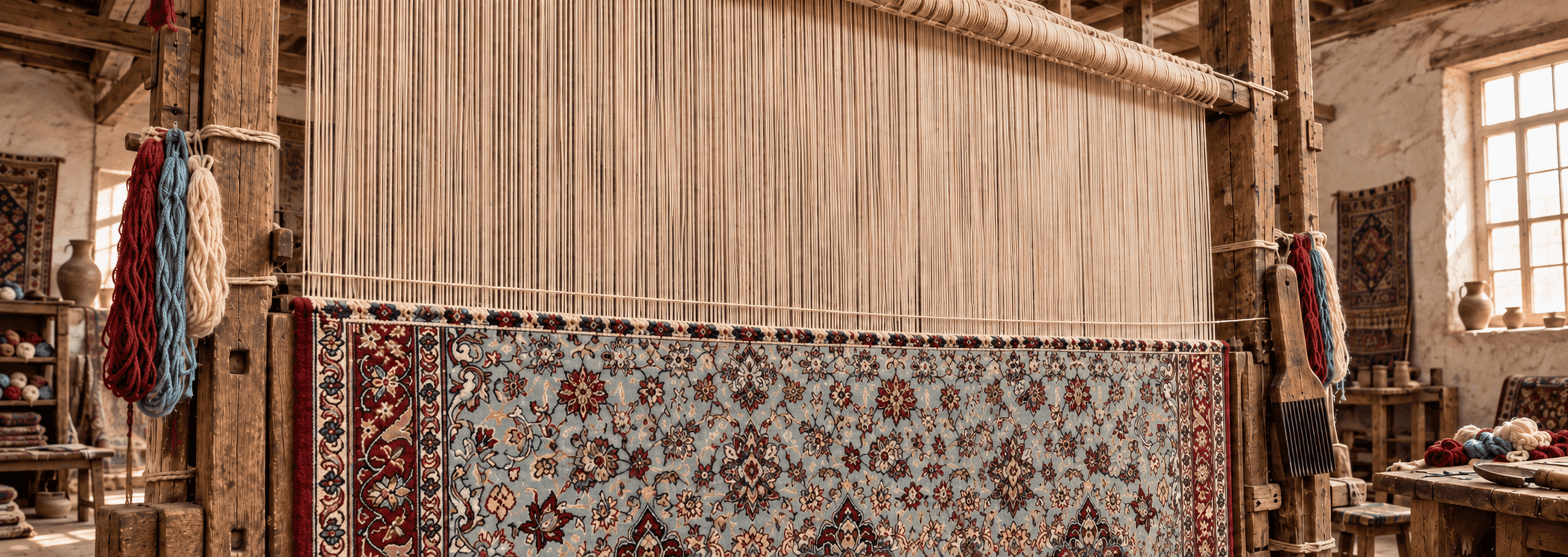
The warp consists of the vertical threads stretched between the upper and lower ends of the loom.
It forms the foundation on which the entire rug is constructed.
During weaving, the weaver ties knots around pairs of warp threads. Weft threads are then inserted between rows of knots to stabilize the structure.
Because the warp remains inside the finished rug, it is usually not visible from the front. However, it has a major influence on the rug's structure, flexibility and proportions.
What can the warp be made from?
Depending on the region, weaving tradition and type of rug, the warp may be made from:
- wool
- cotton
- silk
- occasionally other locally available fibres
Traditional tribal and nomadic rugs often use wool for both the pile and foundation, while many urban Persian rugs use cotton warp.
Silk warp is particularly associated with some finely woven and high-density rugs.
Why does the warp matter?
The material, thickness and tension of the warp influence:
- the flexibility of the rug
- its overall stability
- knot structure
- proportions
- surface appearance
- resistance to deformation
A strong foundation allows the rug to retain its structure for decades or even centuries when properly maintained.
RUGEAST
Think of the Warp as the Skeleton of the Rug
The pile may be what you see, but the warp provides much of the structural framework underneath it.
2. The Weft: The Horizontal Connection
The weft threads run horizontally across the rug, passing between rows of knots.
Their primary function is structural: they help secure the rows of knots and maintain the integrity of the foundation.
The weft can also influence the thickness, flexibility and back appearance of a rug.
In many Persian rugs, several weft shoots may be inserted after each row of knots. The exact construction varies considerably between weaving regions and rug types.
This is one reason why looking at the back of a rug can reveal information that is impossible to see from the front.
3. The Knot: The Heart of the Hand-Knotted Rug
The knot is where the decorative surface and structural foundation meet.
A hand-knotted rug is created by individually tying thousands — and sometimes millions — of knots around the warp.
Each knot contributes to the formation of the pile.
Two major knot traditions are particularly important in Persian rug making:
Persian knot — Senneh knot
The Persian knot, often called the Senneh knot, is generally an asymmetric knot.
It allows the weaver to create fine details and complex patterns.
Turkish knot — Ghiordes knot
The Turkish knot, also known as the Ghiordes knot, is symmetrical.
It grips the warp differently and can produce a somewhat different structural character.
The presence of a Persian or Turkish knot alone, however, does not automatically determine the geographical origin of a rug.
A rug made in Iran can use different knotting traditions, and similar techniques can be found beyond Iran.
RUGEAST
A Persian Knot Does Not Automatically Mean That a Rug Is Persian
Knotting technique is an important technical clue, but provenance must be evaluated through the combination of construction, materials, design, weaving tradition and regional characteristics.
4. Knot Density: Important, but Not the Whole Story
One of the most frequently discussed characteristics of Persian rugs is knot density.
Knot density refers broadly to the number of knots within a defined area of the rug.
A higher knot density can allow the weaver to reproduce finer details and more intricate designs.
But there is a common misconception:
More knots do not automatically mean a better rug.
A highly detailed urban rug may require a high knot density, while a tribal or village rug may intentionally use a coarser construction.
A beautifully designed, well-made village rug with moderate knot density can be far more interesting and durable than a poorly made rug with a very high knot count.
The appropriate question is therefore not simply:
"How many knots does it have?"
but rather:
"Is the construction appropriate for the design, materials, weaving tradition and intended use?"
5. The Pile: The Surface You Actually Touch
The pile is the visible layer of wool or silk created by the knots.
It determines much of the rug's:
- softness
- texture
- visual depth
- tactile character
- resistance to wear
- ability to reflect light
Wool pile is particularly important in Persian rugs because wool has a natural combination of resilience, elasticity and surface character.
The way wool is spun, dyed, knotted and sheared can significantly change the final appearance.
This is why simply saying that a rug is made of "wool" tells us very little.
Not all wool behaves in the same way.
6. Pile Height and Shearing
After the rug has been woven, the pile is trimmed or sheared.
The height of the pile can have a major influence on the appearance and feel of the rug.
Shorter pile
A relatively short pile can:
- reveal the design more clearly
- create a sharper visual appearance
- reflect light differently
- make fine details more visible
Higher pile
A higher pile can:
- feel softer and more luxurious
- create greater visual depth
- produce a different tactile experience
However, excessively high pile is not automatically a sign of higher quality.
The appropriate pile height depends on the type of rug, wool quality, construction and intended use.
7. The Same Wool Can Produce Completely Different Rugs
This is one of the most important principles in understanding Persian rugs.
Imagine two weavers using wool from a similar source.
One produces a strongly spun yarn, uses a firm cotton foundation, ties relatively dense knots and finishes the rug with a short, precise pile.
Another uses a softer yarn, a wool foundation, a lower knot density and a higher pile.
The resulting rugs may look and feel completely different.
The difference does not necessarily come from the sheep.
It comes from the entire production system.
Wool → Spinning → Yarn → Warp & Weft → Knotting → Pile → Shearing → Finished Rug
This chain explains why evaluating the raw material alone is never enough.
RUGEAST
A Persian Rug Should Be Understood as a System
A Persian rug should be understood as a system, not as a single material.
The final result is created by the relationship between fibre, yarn, foundation, knotting, pile and finishing.
8. Why the Back of a Persian Rug Matters
For experienced rug professionals, the back of a rug is often just as informative as its front.
Turning a rug over can reveal:
- knot structure
- knot density
- warp and weft
- foundation material
- weaving regularity
- areas of repair
- construction characteristics
- possible signs of later alterations
The back can also help reveal whether the rug was woven on a highly organized urban loom or produced within a more flexible village or nomadic tradition.
This does not mean that an irregular back automatically indicates a superior or more authentic rug.
It simply provides another layer of evidence.
RUGEAST
When Buying a Valuable Hand-Knotted Rug, Always Inspect Both Sides
The front tells you about design, colour and pile.
The back tells you much more about construction.
9. Symmetry and Irregularity
Machine-made textiles can reproduce the same pattern with extraordinary precision.
Traditional hand-knotted rugs are different.
The human hand is involved in:
- preparing the yarn
- setting the warp
- tying knots
- inserting weft
- maintaining tension
- drawing the design
- trimming the pile
- finishing the edges
Small variations can therefore occur.
You may notice:
- slightly irregular knot rows
- subtle changes in tension
- minor variations in pattern
- small differences in colour
- slight asymmetry
These characteristics can be part of the visual language of handmade rugs.
10. Is Irregularity a Defect?
Not necessarily.
The key distinction is between natural handmade variation and structural damage or poor workmanship.
A small variation in a traditional village rug may be completely normal.
A severely distorted foundation, unstable edges or major structural weakness is a different matter.
Therefore, irregularity should always be interpreted in context.
An experienced rug specialist does not simply ask:
"Is it perfectly symmetrical?"
The better question is:
"Is this variation consistent with the rug's construction and weaving tradition?"
11. Materials and Construction Work as One System
The quality of a Persian rug is created through interaction.
Consider the following chain:
Fibre → Yarn → Warp & Weft → Knot → Pile → Shearing → Finishing
A weakness at one stage can influence the final result.
For example:
- excellent wool with poorly spun yarn may perform poorly
- strong yarn with weak foundations may create structural problems
- high knot density with inferior wool does not guarantee quality
- beautiful colours cannot compensate for serious structural damage
- an excellent design cannot compensate for poor finishing
The evaluation of a Persian rug therefore requires a holistic approach.
12. Regional Differences in Construction
Persian rugs are not one uniform category.
Iran has an extraordinary variety of weaving traditions, and construction methods differ between regions.
A finely woven urban rug from Isfahan may have very different construction characteristics from a village rug from western Iran or a tribal rug woven by a nomadic community.
Differences can appear in:
- warp material
- weft structure
- knot type
- knot density
- yarn preparation
- pile height
- finishing
- loom construction
- design interpretation
These differences are not simply technical details.
They are part of the cultural identity of the rug.
13. Urban, Village and Nomadic Rugs
One of the most useful ways to understand Persian rug construction is to compare three broad traditions.
Urban rugs
Urban rugs are often characterized by:
- more controlled construction
- sophisticated designs
- relatively fine knotting
- carefully prepared yarn
- detailed finishing
Village rugs
Village rugs often combine practical construction with strong regional identity.
They may show:
- somewhat coarser structures
- expressive designs
- local materials
- greater variation
- distinctive regional motifs
Nomadic and tribal rugs
Nomadic rugs are often particularly interesting because their construction developed under different practical conditions.
They may use:
- wool foundations
- hand-spun yarn
- more irregular structures
- bold geometric designs
- relatively simple looms
Their charm often lies precisely in the combination of functionality, improvisation and artistic expression.
RUGEAST
A Rug Can Reveal Where and How It Was Made Through Its Construction
The foundation, knotting, yarn and finishing can act like a technical fingerprint of a weaving tradition.
14. Construction and Durability
Durability is not determined by knot count alone.
A rug's ability to withstand decades of use depends on a combination of:
- fibre quality
- wool strength
- yarn twist
- foundation strength
- knot construction
- pile height
- weaving density
- finishing quality
- maintenance
- environmental conditions
- intensity of use
Good wool has natural elasticity and resilience.
When combined with appropriate construction, it can withstand repeated compression and movement for generations.
This is one reason high-quality handmade Persian rugs can remain functional for extraordinarily long periods.
15. Construction Determines Haptics
When you walk barefoot across a Persian rug, you are experiencing the result of its entire construction.
The sensation underfoot depends on:
- fibre characteristics
- yarn thickness
- yarn twist
- pile height
- knot structure
- density
- shearing
- age and wear
A rug can feel:
- firm
- springy
- soft
- dense
- silky
- coarse
- warm
- compact
These sensations are not accidental.
They are the physical expression of the rug's construction.
16. Can Knot Count Alone Tell You the Quality of a Persian Rug?
No.
Knot density is useful, but it is only one factor.
A professional evaluation should consider at least:
- Fibre quality
- Yarn quality
- Warp and weft
- Knot structure
- Knot density
- Pile quality
- Colour quality
- Design
- Condition
- Age and provenance
- Regional characteristics
- Overall craftsmanship
A rug with fewer knots can be more valuable, more durable and more culturally significant than a rug with a much higher knot density.
17. How to Read a Persian Rug Like an Expert
When examining a hand-knotted Persian rug, do not look only at the design.
Follow the construction from the outside inward.
Start with the surface
Look at:
- colour
- design
- pile
- texture
- wear
Then examine the edges
Look for:
- original finishing
- repairs
- tension
- structural stability
Finally, turn the rug over
Examine:
- knots
- warp
- weft
- density
- regularity
- foundation
- repairs
This three-level approach gives you a much more complete understanding of the rug.
RUGEAST
Learn to “Read” a Rug
A Persian rug is a historical and technical document.
Its design tells a story.
Its colours reveal a tradition.
Its construction reveals how it was made.
Its materials reveal what the weaver had available.
And its condition reveals the journey it has taken through time.
Frequently Asked Questions
1) Are Persian rugs always made with wool?
No. Wool is the most important traditional pile material for many Persian rugs, but silk and other materials are also used. The foundation may also be made from cotton, wool or silk depending on the rug.
2) Is cotton a sign that a Persian rug is machine-made?
No. Cotton is widely used as a foundation material in authentic hand-knotted Persian rugs, particularly in many urban weaving traditions.
3) Are handmade rugs supposed to be perfectly symmetrical?
Not necessarily. Small variations are normal in handmade rugs. However, significant structural distortion or damage should be evaluated separately.
3) Is a silk rug always better than a wool rug?
No. Silk and wool have different properties and serve different purposes. Value depends on quality, design, craftsmanship, condition, age, provenance and other factors.
4) Why do two Persian rugs with similar designs feel different?
Because their construction may be different. Yarn preparation, foundation material, knotting, pile height, density and finishing can all change the tactile character of a rug.
5) How can I examine a Persian rug before buying it?
Look at both the front and back. Examine the pile, colours, edges, knots, foundation, density, repairs and overall condition. For valuable rugs, professional evaluation is recommended.
Final Expert Perspective
A Persian rug should never be judged solely by what is visible at first glance.
The design attracts the eye, but the construction explains the rug.
The wool determines much of its natural character.
The yarn determines how the fibre behaves.
The warp and weft create the foundation.
The knots transform that foundation into a surface.
The pile determines much of what we feel beneath our feet.
And the finishing process brings the entire structure together.
This is why understanding a Persian rug means learning to look beneath the surface.
Once you understand the relationship between wool, yarn, warp, weft, knotting and pile, you begin to see Persian rugs differently.
You no longer see only a pattern.
You see a construction.
You see a craft tradition.
And, ultimately, you begin to see the hand of the weaver.