
The Difference Between Vegetable-Dyed and Chemical-Dyed Persian Rugs
Color is one of the first things we notice when we look at a Persian rug. A deep red field, a rich blue border, warm earth tones, or subtle shades of green can completely change the character of a rug. But behind every color is a story about how the wool was prepared and dyed.
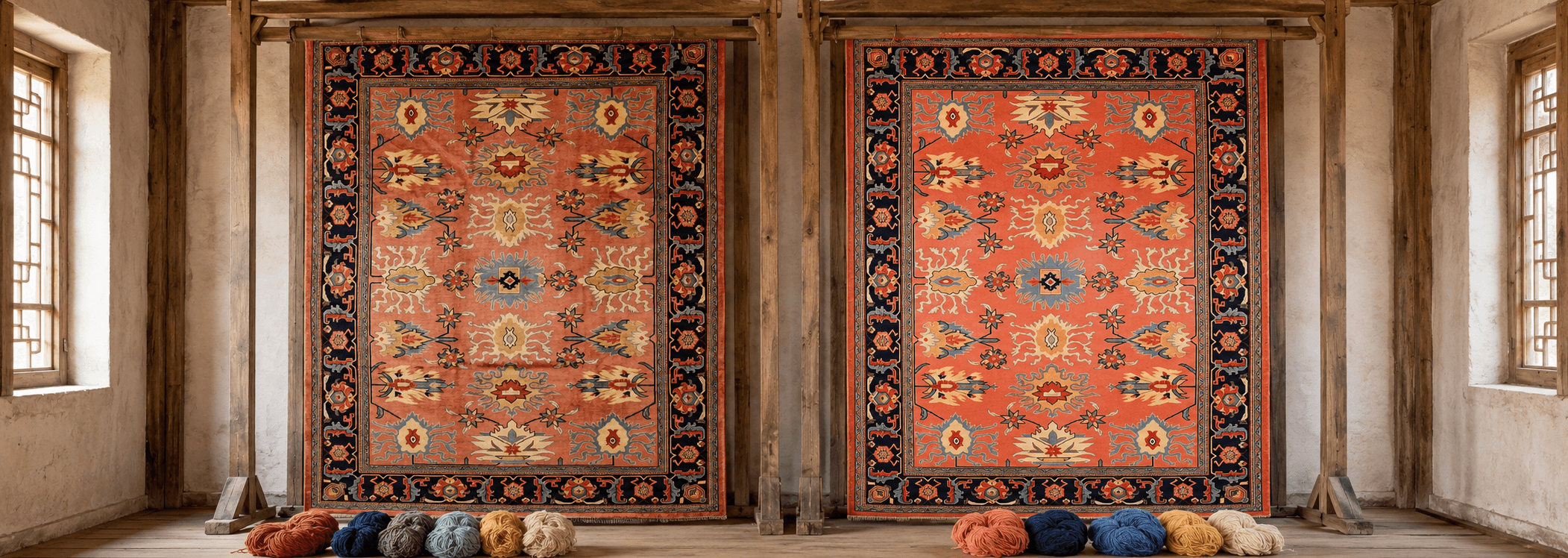
Color is one of the first things we notice when we look at a Persian rug.
A deep red field, a rich blue border, warm earth tones, or subtle shades of green can completely change the character of a rug. But behind every color is a story about how the wool was prepared and dyed.
Traditionally, Persian rug weavers relied on natural dyes made from plants, roots, insects, and other natural materials. Over time, synthetic and chemical dyes became increasingly common because they offered greater consistency, a wider range of colors, and a faster dyeing process.
Today, both natural and synthetic dyes can be found in Persian rugs.
Understanding the difference between vegetable-dyed and chemical-dyed Persian rugs can help you appreciate the craftsmanship behind a rug, understand how its colors may age, and make a more informed decision when buying a handmade Persian rug.
What Are Vegetable Dyes?
Vegetable dyes are natural colorants traditionally obtained from plants and other naturally occurring materials.
For centuries, Persian dyers developed sophisticated methods for extracting color from locally available resources. The wool was cleaned, treated with a mordant, and then immersed in a dye bath to create the desired shade.
Some of the best-known traditional dye sources include:
- Madder root for red and reddish tones
- Indigo for blue
- Walnut husks for brown and darker earthy colors
- Pomegranate rind and other plants for yellow tones
- Weld and other plants for yellow
- Cochineal and other insect dyes for rich crimson and red shades
Madder has historically been one of the most important sources of red in Persian carpets. The final color can vary depending on the plant, mordant, water, dyeing method, and other conditions.
Indigo has also played an important role in Persian carpet production and can create a wide range of blue shades. Traditional indigo dyeing involves fermentation and oxidation, creating a distinctive dyeing process unlike many other natural colorants.
What Are Chemical or Synthetic Dyes?
Chemical dyes, often called synthetic dyes, are manufactured using chemical processes rather than being extracted directly from plants or insects.
Synthetic dyes began transforming the textile industry during the nineteenth century. William Henry Perkin's discovery of the first synthetic dye in 1856 marked an important turning point.
Synthetic dyes became popular because they were faster and more economical to produce. They also allowed dyers to achieve highly consistent colors and create shades that were difficult to reproduce using traditional natural materials.
For carpet production, this was a major advantage.
Instead of relying on the availability and quality of natural dye materials, a dyer could reproduce a specific color much more consistently.
However, not all synthetic dyes are the same.
Early synthetic dyes, particularly some early aniline dyes, could be unstable and prone to fading or bleeding. Modern high-quality synthetic dyes can be considerably more stable and colorfast.
Vegetable-Dyed vs Chemical-Dyed Persian Rugs
The most important difference is the source of the color.
Vegetable and other natural dyes come from natural materials, while synthetic dyes are manufactured chemically.
But the difference goes beyond the source of the dye.
Natural dyes often create subtle variations and depth within a color. A red field may contain slightly different shades of red rather than appearing completely uniform.
This variation can give an older Persian rug a soft, organic appearance.
Synthetic dyes, especially when applied consistently, can produce very even and uniform colors.
That does not automatically make them inferior.
A well-made Persian rug using modern synthetic dyes can still be beautiful, durable, and highly decorative.
The important question is what type of rug you are looking for and what qualities matter most to you.
The Beauty of Naturally Dyed Persian Rugs
One of the most appealing characteristics of naturally dyed rugs is the way their colors interact.
Natural dyes often create colors with subtle variation rather than a completely flat appearance.
As a rug ages, the colors can develop a soft patina that contributes to its character.
This is particularly important in antique and vintage Persian rugs.
A naturally dyed rug may appear slightly different under different lighting conditions, and individual areas of the wool can show gentle variations in tone.
For collectors and enthusiasts, this depth and variation are part of the charm of a handmade rug.
What Is Abrash?
One of the terms you may encounter when researching naturally dyed Persian rugs is abrash.
Abrash refers to a visible variation in color within an area of a rug.
For example, a large red field may gradually change from one shade of red to another in horizontal or vertical bands.
This can happen when a weaver runs out of one batch of dyed wool and continues with another batch made at a slightly different time.
Because traditional dye batches were prepared manually, achieving exactly the same shade every time was difficult.
Abrash is therefore often associated with traditional handmade rugs and can be appreciated as part of their character rather than treated as a defect.
However, abrash alone should not be used as proof that a rug was dyed exclusively with natural dyes.
It is one clue among many.
How Do Natural Dyes Age?
The way a rug ages depends on many factors, including the quality of the dye, the wool, exposure to sunlight, cleaning methods, humidity, and general use.
High-quality natural dyes can age beautifully.
Rather than simply disappearing, some colors gradually soften and develop a more nuanced appearance.
This is one reason antique Persian rugs can have such distinctive palettes.
The colors may no longer look exactly as they did when the rug was new, but the changes can contribute to the rug's character.
At the same time, it is important to remember that natural does not automatically mean completely fade-proof.
Some natural dyes can be sensitive to excessive sunlight, moisture, heat, or inappropriate cleaning.
Can Natural Dyes Bleed?
Yes.
Natural dyes can bleed under certain conditions, particularly when a rug is exposed to excessive moisture, heat, or inappropriate cleaning products.
This is especially important when cleaning antique or valuable Persian rugs.
A dark red or blue area can potentially transfer color into a lighter part of the rug if the dye is not sufficiently fixed or if the rug is cleaned incorrectly.
For this reason, valuable Persian rugs should be handled carefully and professionally when wet cleaning is required.
Are Chemical Dyes Always Bad?
No.
This is an important misconception.
The phrase "chemical dye" can sometimes create the impression that synthetic dyes are automatically low quality.
That is not accurate.
Modern synthetic dyes can be designed to provide excellent colorfastness and durability. In fact, synthetic dyes have become highly sophisticated and are widely used throughout the textile industry.
The problem is particularly associated with some older, poor-quality synthetic dyes rather than with every synthetic dye ever produced.
Therefore, the presence of synthetic dye does not automatically mean that a Persian rug is unattractive or poorly made.
Why Were Synthetic Dyes Introduced?
The introduction of synthetic dyes changed Persian carpet production significantly.
Traditional natural dyeing could be time-consuming.
The availability of synthetic colors made it possible to produce specific shades more quickly and consistently.
Synthetic dyes also expanded the range of available colors.
This was particularly useful for commercial production, where consistency between different batches of wool was important.
Historical research on Persian carpets shows that synthetic dyes began appearing in Iran in the late nineteenth and early twentieth centuries, while natural dyes continued to be used for many years alongside newer chemical alternatives.
How Can You Tell If a Persian Rug Uses Natural Dyes?
Determining whether a finished Persian rug contains natural or synthetic dyes is not always possible just by looking at it.
There are several visual clues that experienced rug experts may consider.
Look at the Color Variation
Natural dyes can create subtle differences within a single color.
Look closely at a large field of red, blue, or another color.
Does the color have depth and gentle variation, or is it completely uniform?
Subtle variation may suggest traditional dyeing, although it is not definitive proof.
Look at the Abrash
Visible changes in tone across a color field may indicate different batches of dyed wool.
Abrash is particularly common in traditional handmade rugs.
Again, however, it should be treated as evidence rather than absolute proof.
Examine the Rug's Age and History
The age and provenance of a rug can provide useful context.
If you are examining an antique Persian rug, the type of dye used can be an important part of determining its history and authenticity.
However, natural dye alone cannot prove that a rug is antique.
Modern rugs can also be produced using traditional natural dyes.
Professional Dye Analysis
For valuable antique rugs, scientific analysis can provide much stronger evidence.
Researchers can analyze dye molecules and identify specific natural or synthetic colorants.
Scientific studies of Iranian carpets have demonstrated that historical and twentieth-century rugs can contain both natural dyes such as madder and synthetic dye compounds.
Which Is Better: Vegetable Dye or Chemical Dye?
There is no universal answer.
If your priority is traditional craftsmanship, historical character, and a naturally varied color palette, a naturally dyed Persian rug may be especially appealing.
If your priority is consistent color, durability, a specific modern shade, and easier production, a high-quality synthetic dye can be an excellent choice.
For antique and collectible rugs, natural dyes are often highly valued because they are associated with traditional dyeing practices and can contribute to a rug's visual character.
For contemporary handmade rugs, however, the quality of the entire rug matters far more than simply whether the dye is natural or synthetic.
Construction, wool quality, knotting, design, origin, finishing, and overall craftsmanship all matter.
Do Natural Dyes Make a Persian Rug More Valuable?
They can, but not automatically.
The type of dye is only one factor in determining the value of a Persian rug.
Other factors include:
- Age
- Origin
- Rarity
- Condition
- Knotting quality
- Materials
- Design
- Provenance
- Craftsmanship
- Historical significance
A naturally dyed rug with poor construction and damage is not necessarily more valuable than a well-made rug using high-quality synthetic dyes.
For antique rugs, however, authentic traditional dyes can be an important part of the rug's historical and artistic value.
Why Color Matters When Buying a Persian Rug
Color is not simply a decorative choice.
It affects how a rug looks today and how it may develop over time.
A naturally dyed Persian rug can have subtle variations that make the surface appear more alive.
A synthetic-dyed rug may offer a cleaner and more consistent appearance.
Neither is automatically the right choice.
The best option depends on your personal taste, the age and style of the rug, and how you intend to use it.
Persian Rugs at RugEast
At RugEast, we appreciate the craftsmanship and cultural history behind handmade Persian rugs.
Every rug has its own combination of design, materials, weaving technique, color, and regional character.
Understanding how those colors are created can make choosing a Persian rug much more meaningful.
Whether you prefer the organic depth of traditional natural dyes or the consistency of modern colors, the most important thing is to understand what you are buying.
A Persian rug is not simply a combination of colors and patterns.
Every color is part of the rug's story.
Final Thoughts
The difference between vegetable-dyed and chemical-dyed Persian rugs goes far beyond whether a color comes from a plant or a laboratory.
Natural dyes have played a central role in Persian carpet history for centuries. Madder, indigo, walnut, pomegranate, and other natural sources helped create the distinctive palettes associated with traditional Persian weaving.
Synthetic dyes later transformed the industry by making colors faster, more consistent, and easier to reproduce.
Today, both natural and synthetic dyes have a place in Persian rug making.
For antique and collectible rugs, natural dyes can add historical significance, visual depth, and character. For modern handmade rugs, high-quality synthetic dyes can also provide attractive and durable results.
Rather than asking which type of dye is automatically "better," it is more useful to understand how the dye was made, how well it was applied, how it has aged, and how it contributes to the overall quality of the rug.
That understanding allows you to appreciate a Persian rug not only for its beautiful design, but also for the fascinating process hidden behind every color.
FAQ
1) What is the difference between vegetable-dyed and chemical-dyed Persian rugs?
Vegetable-dyed rugs use natural color sources such as plants, roots, and sometimes insects, while chemical-dyed rugs use manufactured synthetic dyes. Natural dyes often create more subtle color variation, while synthetic dyes can provide highly consistent shades.
2) What natural dyes are used in Persian rugs?
Common natural dye sources include madder root for red, indigo for blue, walnut husks for brown, and various plants and natural materials for yellow and other shades.
3) What is madder dye?
Madder is a natural dye obtained from the roots of the Rubia plant. It has historically been one of the most important sources of red in Persian carpet weaving.
4) What is indigo used for in Persian rugs?
Indigo is primarily used to create blue shades, ranging from lighter blues to deep navy tones. It has a long history in Persian textile and carpet dyeing.
5) What is abrash in a Persian rug?
Abrash is a subtle variation in color within a rug, often caused by differences between batches of dyed wool. It is commonly seen in traditional handmade rugs and can contribute to their character.