
Transylvanian Carpets
Transylvanian carpets are Ottoman Anatolian rugs from the 16th to 18th centuries, preserved mainly in Lutheran churches. Known for niche, columned, geometric and floral designs, they reveal the trade, prestige and cultural exchange that widely connected Anatolia, Transylvania and Christian Europe.
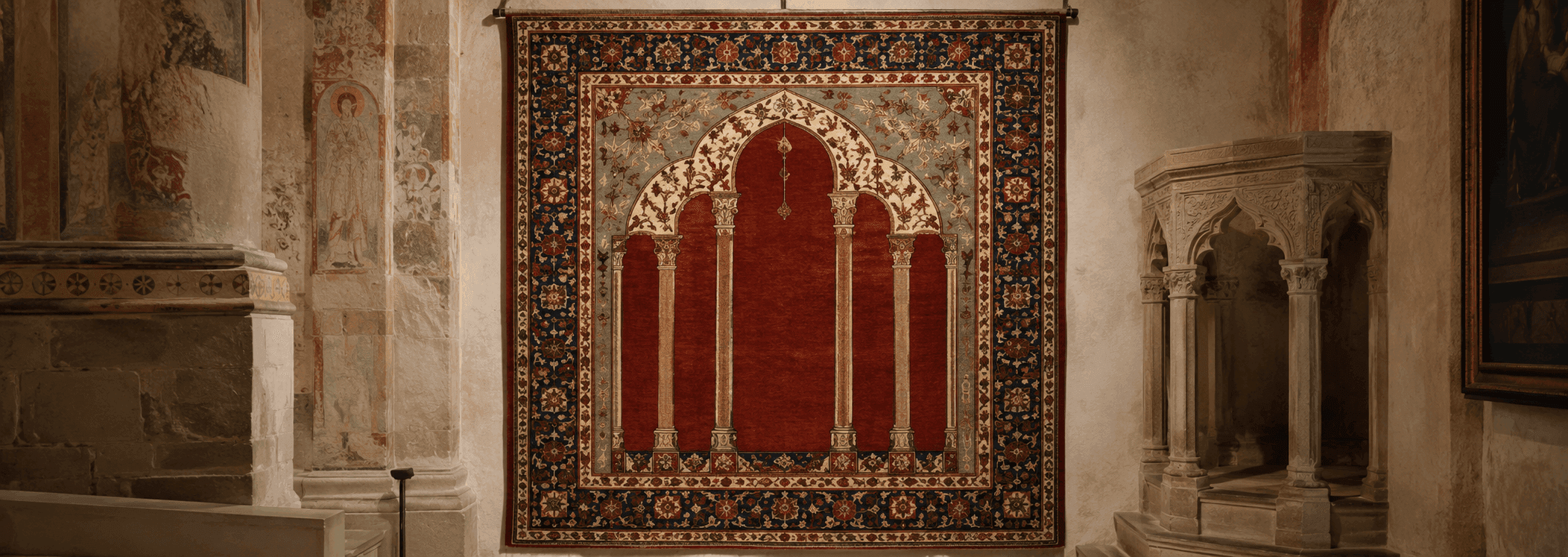
Transylvanian Carpets: History, Designs, and Cultural Significance
Despite their name, “Transylvanian carpets” were not generally woven in Transylvania. The term refers primarily to Ottoman Anatolian rugs exported to Europe and preserved in the Protestant churches of Transylvania. They date mainly from the 16th to the 18th century.
Geographical and Historical Context
Transylvania is a historical region in present-day central Romania, enclosed by the Carpathian mountain system. It belonged to the medieval Kingdom of Hungary, later became an autonomous principality under Ottoman suzerainty, and subsequently came under Habsburg rule. It became part of Romania after World War I.
Beginning in the 12th century, Hungarian kings invited German-speaking settlers—later known collectively as the Transylvanian Saxons—to develop towns, strengthen frontier defenses, and support trade. They established fortified settlements and churches throughout the region.
The German name for Transylvania, Siebenbürgen, means “Seven Fortresses,” although the precise origin of this name remains debated.
How Ottoman Carpets Reached Transylvania
Transylvania occupied an important commercial position between the Ottoman Empire and Central Europe. From the 15th century onward, merchants imported substantial numbers of Ottoman carpets, especially from western Anatolia.
These carpets were expensive prestige objects. Wealthy merchants, guilds, municipal authorities, and prominent families acquired them for domestic or ceremonial use. Many were later donated to Lutheran churches, where they decorated walls, galleries, pews, and other furnishings.
The Reformation contributed to changes in Saxon church interiors, but it would be misleading to attribute the carpets’ presence solely to the removal of Catholic images. Documentary evidence indicates that the rugs also served as valuable commemorative gifts and signs of civic, family, and guild status.
Their use as wall hangings and ceremonial furnishings, rather than everyday floor coverings, helped preserve them. Consequently, Transylvania retains one of the most important collections of early Ottoman carpets outside the Islamic world.
Why They Are Called “Transylvanian” Carpets
The name describes where these carpets were preserved, not where they were manufactured. Most surviving examples are attributed to Ottoman weaving centers in western Anatolia.
Large numbers of related carpets were exported throughout Europe, but many examples elsewhere were worn out, discarded, or dispersed. Those kept in Transylvanian churches often survived in comparatively good condition.
The term “Transylvanian carpet” entered scholarly use in the early 20th century. Today, it refers both broadly to Ottoman rugs preserved in Transylvania and more narrowly to several related groups distinguished by their niche designs and characteristic borders. The Metropolitan Museum of Art similarly identifies these works as western Anatolian carpets that became known as Transylvanian because so many were preserved in Romanian and Hungarian churches.
Materials and Construction
Most Transylvanian carpets are wool-pile rugs constructed with knotted pile. Typical structural characteristics include:
- Wool pile
- Woolen foundations in many examples
- Symmetrical knots, commonly associated with Anatolian weaving
- Relatively small dimensions
- Narrow guard borders surrounding a wider principal border
- Carefully finished sides and ends
Materials and construction vary among individual rugs, so not every example follows precisely the same technical formula.
Principal Designs
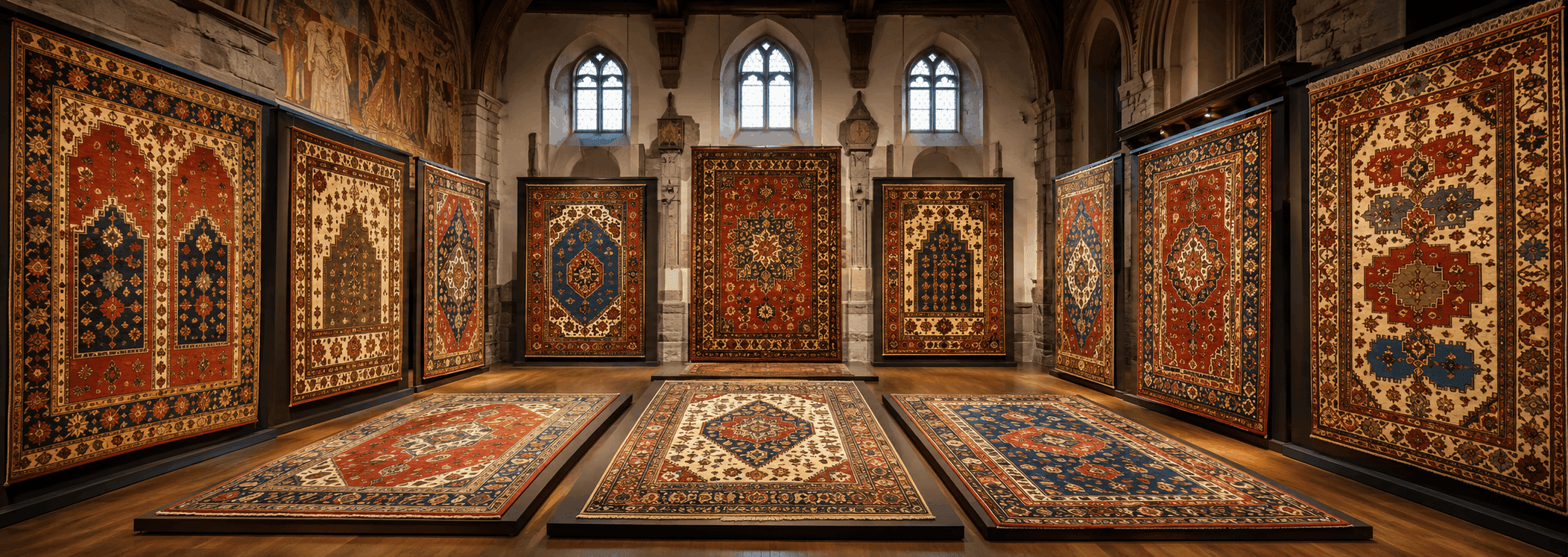
Transylvanian carpets are commonly divided into single-niche, columned, double-niche, and medallion or geometric groups.
Single-Niche Carpets
Single-niche carpets have an arched field related to the mihrab form used in Islamic prayer rugs. Their fields are frequently plain or sparsely decorated, allowing the arch and border to dominate the composition.
Decorative elements may include:
- Hanging lamps
- Vases
- Rosettes and blossoms
- Palmettes
- Leaves and scrolling vines
- Small floral sprigs
Some examples appear in 17th-century European paintings, demonstrating that rugs of this kind circulated beyond Transylvania.
Columned Prayer Rugs
Columned carpets feature an arch supported by two or more slender columns. These architectural compositions recall prayer niches, arcades, and windows found in Ottoman religious buildings.
The central field may contain a lamp, vase, flowering plant, or a relatively plain expanse of color. A Transylvanian prayer rug attributed to Turkey and possibly the Kula region, now in the Metropolitan Museum of Art, uses columns to support a prayer-niche design.
Double-Niche Carpets
Double-niche carpets have an arch at each end, creating a vertically symmetrical composition. They were especially prominent during the 17th century.
A historical theory links this format to Ottoman restrictions on exporting objects bearing sacred designs to non-Muslims. According to this interpretation, adding a second niche transformed the conventional prayer-rug composition into a more secular, reversible design. The evidence is not conclusive, however, and the double-niche format may also have developed through broader artistic and commercial influences.
Medallion and Geometric Carpets
Some examples feature central medallions, eight-pointed stars, concentric lozenges, or cross-like geometric arrangements. These designs are related to the wider tradition of western Anatolian carpets, including rugs associated with Uşak.
Borders and Decorative Motifs
One of the most recognizable features of many Transylvanian carpets is the broad principal border containing elongated cartouches, rosettes, stars, or stylized floral forms.
Some motifs resemble writing but are better described as inscription-like or pseudo-script ornament unless readable text can be identified. Their sources may include Ottoman and Persian textiles, bookbindings, ceramics, architectural decoration, and earlier carpet traditions.
The relationship between the central field, spandrels, borders, and guard stripes gives these rugs their distinctive visual balance.
Colors
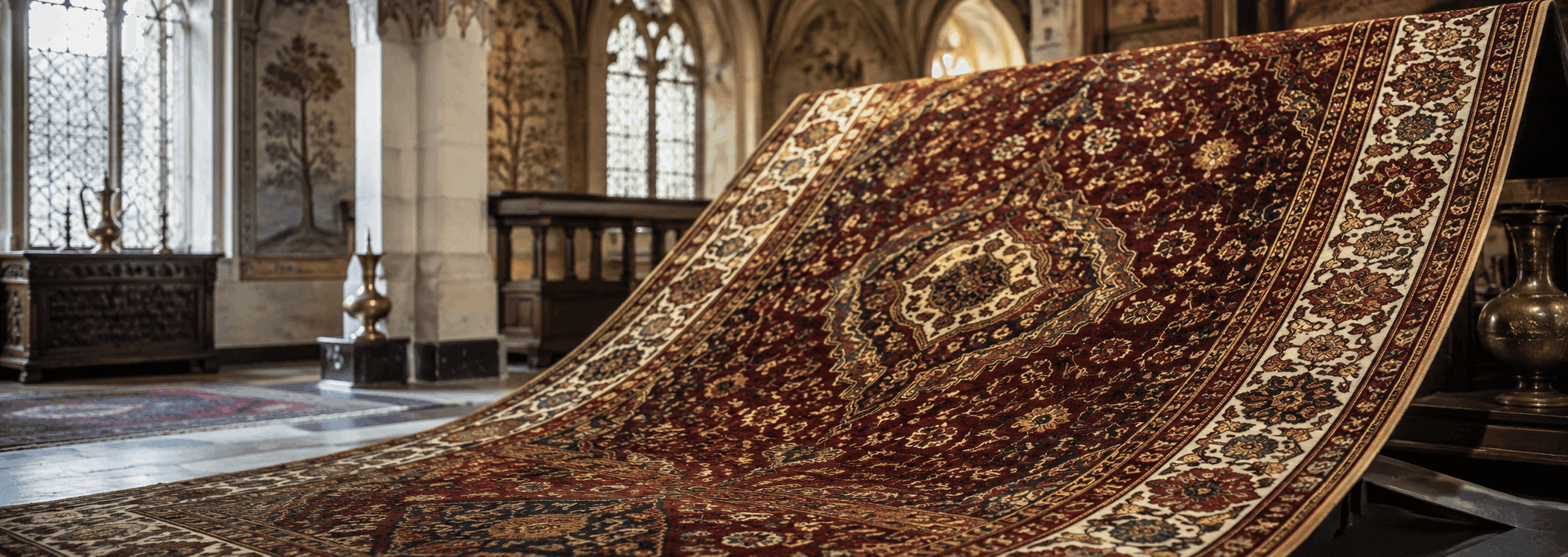
Their palettes are limited but vivid. Common colors include:
- Brick red
- Deep crimson
- Ochre yellow
- Brown
- Ivory
- Dark blue
- Green
Red and ochre frequently dominate the field. Strong contrasts between the field, pale spandrels, and patterned borders make the designs visually effective when displayed vertically inside churches.
Important Collections
Major groups of Ottoman carpets remain in or originate from Transylvanian churches and museums, particularly:
- The Black Church in Brașov
- St. Margaret’s Church in Mediaș
- Churches in Sighișoara and Rupea
- The Brukenthal National Museum in Sibiu
- The National Museum of Art of Romania in Bucharest
Related examples are also held by the Museum of Fine Arts in Budapest, the Metropolitan Museum of Art in New York, and other international collections.
Cultural Significance
Transylvanian carpets demonstrate how objects can acquire new meanings as they move between cultures. Rugs originally produced within the Ottoman artistic tradition became luxury goods, commemorative donations, church furnishings, and symbols of social identity in Christian Europe.
Their preservation in Lutheran churches represents an important encounter between Islamic material culture and Central European religious life. Today, these carpets are valued not only for their beauty and craftsmanship but also as evidence of the commercial and cultural connections that linked Anatolia, Transylvania, and the wider European world.
FAQs
1. Were Transylvanian carpets woven in Transylvania?
No. Most were woven in western Anatolia and exported to Transylvania, where many were preserved in Protestant churches.
2. What designs characterize Transylvanian carpets?
Common designs include single niches, column-supported arches, double niches, medallions, geometric forms and broad floral borders.
3. Why are Transylvanian carpets culturally significant?
They document the commercial and cultural exchange between the Ottoman world and Christian Europe, acquiring new ceremonial and religious roles.